Three types of linear stepper motors divided by structure
2024/07/22 16:07
瀏覽256
迴響0
推薦0
引用0
Linear stepper motor actuators are an effective solution for converting rotary motion into linear motion, especially when the application does not require the accuracy of closed-loop servo motors/encoders. It can generally be divided into three types based on its structure: external, through-shaft and fixed.
1.External drive type
The simplest method of this structure is to use the lead screw pair directly as the motor shaft. The nut on the screw must be restricted from rotation to achieve linear motion. This type of linear stepper motor is usually called external drive type.
Stroke is an important consideration. External drive motors are generally selected in linear slide systems with a stroke of 60~500mm. In this case, the linear slide and nut are connected to prevent the nut from rotating while supporting the load to ensure that the nut is not affected by potential lateral forces.
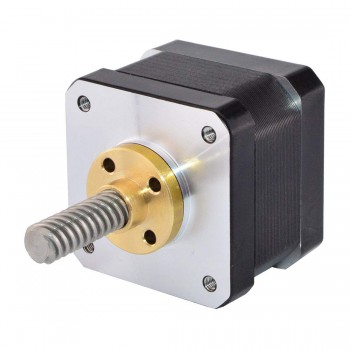
Long lead screws do bring some risks. The biggest risk is that the actuator and lead screw will resonate at certain points in the stroke, which will not affect performance but will cause noticeable noise. In some extreme cases, the noise or vibration is so large that the motor loses steps and causes position deviation. The use of drive technologies such as subdivision and setting acceleration and deceleration can reduce noise. At the same time, the design of the solution of adding bearing support to the end of the lead screw can also help reduce noise.
The installation of the motor and the load also needs to be focused on. If the motor is used to drive the linear module, installing the motor on one side of the module is not only conducive to convenient wiring and reciprocating movement of the nut and the slider on the guide rail, but also conducive to minimizing the platform height. If a through-type structure is used, it is necessary to consider whether the width of the motor is acceptable and whether the height of the slider of the guide rail is too high, because the design of modern industry has been seeking the concept of miniaturization.
2.Through-axis linear stepper motor
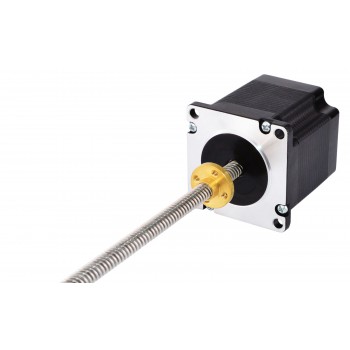
The nut is built into the motor, and the lead screw can pass through the motor for linear motion. In this design, the lead screw needs to be restricted from rotating to produce linear motion.
The through-axis (lead screw through) motor usually has an application stroke of 30-200mm. Compared with the external drive shaft motor, the advantage of the through-axis motor is that it allows a larger installation coaxiality error. If the lead screw and nut of the linear module are not parallel to the guide rail, it will cause system problems. Although the nut allows a certain radial clearance, it is not enough for the entire module; the radial clearance of the nut of the through-axis motor can allow the lead screw to be tilted within 1゜, which can tolerate a larger system error.
Another application that can only be achieved by through-axis motors is to use the motor as a sliding part, connected to the guide slider, and the two ends of the screw are fixed. One advantage of this application is that the screw does not rotate, so there is no critical speed limit; the second advantage is that multiple motors can be installed on the same screw, and the motors cannot "pass" each other, but their movements are independent of each other.
3.Fixed-axis motor
In some applications where it is impossible to provide a nut or screw anti-rotation mechanical device, the third type of motor can be selected. This type of motor is the same as the through-axis motor. The nut is built into the body, the screw shaft is connected to the spline shaft, and the spline and the spline sleeve at the front end of the motor cooperate to prevent rotation, thereby realizing the linear movement of the motor. This type of motor is called a fixed-axis motor.
In applications with short stroke requirements, such as less than 50mm, and where a rotation stop device cannot be provided, it is recommended to use a fixed-axis motor. The advantage of this type of motor is that it has a compact structure and does not require a rotation stop mechanical device. The spline sleeve at the front end of the motor is made of a mold and cannot withstand large lateral forces. The design function is mainly to limit the rotation of the screw relative to the motor. For occasions that need to withstand lateral loads, the ball spline design can be used, because the recirculating ball design of the spline sleeve can increase the lateral load-bearing capacity of the fixed-shaft motor.
Fixed-shaft motors usually install the motor body fixedly, and the motor output shaft directly pushes the load (the load is not fixed to the shaft); when the load and the motor shaft are fixedly connected, it is necessary to pay attention to whether the entire system is likely to be over-positioned.
Linear stepper motors can add different options, but some options are only available for one or several motors. Rotary encoders are generally used to feedback whether the motor has moved a given amount, and can be adapted to all types of hybrid linear stepper motors.
限會員,要發表迴響,請先登入


