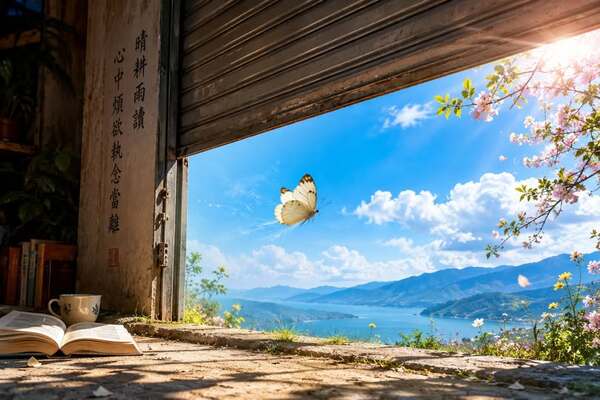
002. “A Butterfly Flying Over the Rolling Shutter Door” / Liao Wenji
The world outside the door is vast and free.
The world inside the door is narrow and confined.
To glimpse the brief blue sky,
the cabbage white butterfly exhausts all its strength
to fly from inside the door to the outside.
Its withered body clings to the scorching ground.
No one cares whether it lives or dies.
This body, borrowed from Heaven,
after accumulating the wear and depreciation of time,
will eventually return to dust.
The remainder of life is limited.
Not for the mortal world,
not for desire,
but only for the dream of this lifetime.
To farm on sunny days,
to study on rainy days.
The vexations, desires, and attachments in the heart should all be abandoned.
Lift the curtain,
and travel with spring,
wandering and learning among mountain peaks and watersides.
Outside the little window,
an expanse of azure blue.
Guided Reading by Chen Qufei
I. Interpreting the Poetic Meaning Through Hermeneutics — From “Flying Across” to the Metaphor of Enlightenment
“A Butterfly Flying Over the Rolling Shutter Door” is a modern poem that combines reflections on life with the spirit of Zen. Through the image of a cabbage white butterfly flying over a rolling shutter door, the poet symbolizes humanitys pursuit of freedom, ideals, and spiritual liberation.
In the opening stanza,
“The world outside the door is vast and free;
The world inside the door is narrow and confined,”
a striking binary contrast is established. The rolling shutter door is not merely a physical barrier; it also symbolizes the restraints, institutions, desires, and spiritual prisons found in real life. Although the cabbage white butterfly is tiny and fragile, it still “exhausts all its strength” to fly toward the blue sky, implying humanitys pursuit of the value of life and its longing for a realm of freedom.
The second stanza shifts the perspective back to life itself. The butterflys “withered body clings to the scorching ground,” conveying the inevitable destiny of exhaustion and decay. The line,
“This body, borrowed from Heaven,”
carries strong Buddhist and existential philosophical implications, suggesting that the physical body is merely a temporary vessel borrowed for a time, while life itself must ultimately return to dust. Here, the poet is not merely describing the butterfly but also reflecting humanitys finite and solitary condition through its image.
The third and fourth stanzas move from sorrow over mortality toward spiritual transcendence.
“Not for the mortal world, not for desire, but only for the dream of this lifetime,”
reveals the poets gradual detachment from worldly obsessions and movement toward a simple and lucid ideal of life. The phrase “To farm on sunny days, to study on rainy days” evokes the tradition of Eastern reclusive culture, while
“The vexations, desires, and attachments in the heart should all be abandoned”
possesses the flavor of Zen-style self-purification. Finally,
“Travel with spring; wander and learn among mountain peaks and watersides,”
marks lifes transition from the enclosed “inside the door” toward the expansive realm of nature. The concluding image,
“Outside the little window, an expanse of azure blue,”
symbolizes the ultimate liberation and clarity of the soul. Thus, the entire poem traces a spiritual journey from bondage, through awakening, to transcendence.
II. Analysis of Form and Rhetorical Techniques from the Perspective of Modern Poetry Aesthetics
In terms of formal design, the poem adopts a structure of short, segmented lines, giving the language a concise, contemplative quality while creating ample poetic silence. The four stanzas form a progressive spiritual sequence: the first depicts breaking free from constraints; the second contemplates lifes impermanence; the third relinquishes worldly desires; and the fourth returns the spirit to nature. This arrangement creates a clearly ascending structural progression, allowing the poems meaning to deepen step by step.
The opening stanza makes extensive use of contrast and symbolism:
“The world outside the door is vast and free;
The world inside the door is narrow and confined.”
The oppositions between outside and inside, and between vast freedom and narrow confinement, create both spatial and spiritual contrasts. The rolling shutter door symbolizes the oppression of reality and the hardships of life, while the cabbage white butterfly symbolizes the soul, dreams, and free will. In particular, the line,
“To glimpse the brief blue sky,”
uses the blue sky as a symbol of ideals and hope, expressing that even though life is brief, it is still worth striving wholeheartedly for beautiful possibilities.
The second stanza employs personification and metonymic metaphor:
“This body, borrowed from Heaven.”
Life is portrayed as something temporarily borrowed from Heaven and Earth, a classic philosophical metaphor. Rather than preaching directly, the poet conveys the concept of lifes finiteness through subtle imagery. Furthermore,
“After accumulating the wear and depreciation of time, it will eventually return to dust,”
objectifies the human body as an artifact that gradually depreciates through use, producing a stark existential atmosphere while also creating an austere aesthetic of time.
The third stanza shifts into Zen-inspired writing:
“To farm on sunny days,
To study on rainy days.
The vexations, desires, and attachments in the heart should all be abandoned.”
“To farm on sunny days, to study on rainy days” is a classic cultural image associated with the reclusive spirit of Tao Yuanming. Through concise phrasing, the poet establishes a rhythmic cadence while employing abstract expressions such as “vexations, desires, and attachments” to depict inner spiritual cultivation. Here, the technique of interweaving the concrete and the abstract is employed: outwardly, life appears simple and ordinary, while inwardly, profound spiritual reflection unfolds.
The final stanza skillfully employs spatial imagery and color symbolism:
“Travel with spring;
Wander and learn among mountain peaks and watersides.”
Spring symbolizes rebirth and hope, while mountain peaks and watersides create an expansive, flowing natural landscape. The concluding lines,
“Outside the little window,
An expanse of azure blue,”
bring the poem to a close through deliberate poetic openness. Azure blue is simultaneously the sky and the state of mind; it is both scenery and spiritual realm. By ending with landscape rather than direct emotion, the poem leaves readers with an enduring sense of tranquility and resonance.
III. The Poems Aesthetic Characteristics from the Perspective of Aesthetic Theory
The poems aesthetic qualities are first manifested in its aesthetics of philosophical reflection on life. Through the fleeting moment of a butterfly flying over a rolling shutter door, the poet contemplates freedom and the meaning of existence, presenting what Heidegger described as “being-toward-death.” Although life is finite, it acquires meaning through the pursuit of freedom. Consequently, the entire poem is permeated by an atmosphere that is both solemn and spiritually elevated.
Secondly, the poem possesses a distinctive Zen aesthetic. Expressions such as
“Not for the mortal world, not for desire,”
and
“The vexations, desires, and attachments in the heart should all be abandoned,”
embody the Buddhist and Zen ideal of letting go. Rather than fiercely criticizing reality, the poet employs restrained language and natural imagery to guide readers back toward inner clarity. This aesthetic closely resembles the classical Chinese ideals of subtle simplicity and ethereal emptiness.
Furthermore, the poem demonstrates the characteristics of both the aesthetics of negative space and the aesthetics of imagery. Rather than relying on elaborate narration, it employs concrete images—the butterfly, the rolling shutter door, the blue sky, and the little window—to encourage readers to extend their own associations. In particular, the concluding image,
“An expanse of azure blue,”
creates an open-ended poetic realm in which the poem transcends its own words, producing an enduring aesthetic resonance.
Moreover, the poem also embodies a natural aesthetic. From spring, to mountain peaks and watersides, to the azure blue sky, nature serves not merely as a backdrop but as a symbol of spiritual redemption. The poet unites the inner landscape of the human heart with the external landscape of nature, achieving the classical aesthetic ideal of the fusion of emotion and scenery. This approach echoes the tradition of Chinese landscape poetry while also reflecting the artistic pursuit of spiritual purification in modern poetry.
Overall, “A Butterfly Flying Over the Rolling Shutter Door” is a modern poem that integrates the philosophy of life, the spirit of Zen, and natural imagery. Through concise yet profound language, it transforms the pursuit of freedom and spiritual transcendence within the brevity of human life into a poetic aesthetic illuminated by serenity and quiet radiance.