The Twelve Days of Christmas (song)
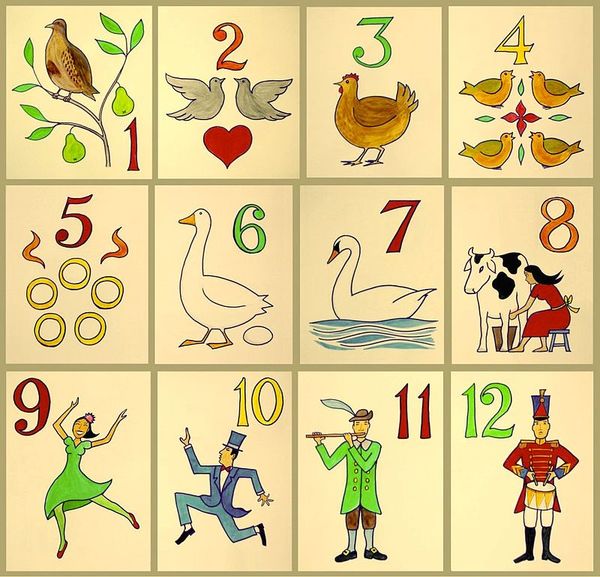
"The Twelve Days of Christmas" is an English Christmas carol that enumerates in the manner of a cumulative song a series of increasingly grand gifts given on each of the twelve days of Christmas (the twelve days that comprise the Christmas season starting with Christmas Day).[1][2] The song, published in England in 1780 without music as a chant or rhyme, is thought to be French in origin.[3] "The Twelve Days of Christmas" has a Roud Folk Song Index number of 68. The tunes of collected versions vary. The standard tune now associated with it is derived from a 1909 arrangement of a traditional folk melody by English composer Frederic Austin, who first introduced the now familiar prolongation of the verse "five gold rings".
https://www.youtube.com/watch?v=L_rMCwoCLv8
1. aspire (v.)
"strive for," c. 1400, from Old French aspirer "aspire to; inspire; breathe, breathe on" (12c.), from Latin aspirare "to breathe upon, blow upon, to breathe," also, in transferred senses, "to be favorable to, assist; to climb up to, to endeavor to obtain, to reach to, to seek to reach; infuse," from ad- "to" (see ad-) + spirare "to breathe" (see spirit (n.)). The notion is of "panting with desire," or perhaps of rising smoke. Related: Aspired; aspiring.
2. blaze (n.1)
"bright flame, fire," Old English blæse "a torch, flame, firebrand, lamp," from Proto-Germanic *blas- "shining, white" (source also of Old Saxon blas "white, whitish," Middle High German blas "bald," originally "white, shining," Old High German blas-ros "horse with a white spot," Middle Dutch and Dutch bles, German Blesse "white spot," blass "pale, whitish"), from PIE root *bhel- (1) "to shine, flash, burn" (see bleach (v.)).
3. havoc (n.) L
early 15c., from the expression cry havoc "give the signal to pillage" (Anglo-French crier havok, late 14c.). Havok, the signal to soldiers to seize plunder, is from Old French havot "pillaging, looting" (in crier havot), which is related to haver "to seize, grasp," hef "hook," probably from a Germanic source (see hawk (n.)), or from Latin habere "to have, possess." General sense of "devastation" first recorded late 15c.
4. incisive (adj.)
early 15c., inscisif, "slashing, cutting with a sharp edge," from Old French incisif (medical) "invasive, effective," and directly from Medieval Latin incisivus, from Latin incis-, past participle stem of incidere "to cut into" (see incision). Originally literal; figurative sense of "mentally acute, sharply and clearly expressive" first recorded 1850 as a borrowing from French. Related: Incisively; incisiveness.
5. inveigh (v.)
formerly also enveigh, late 15c., "to introduce," from Latin invehere "to bring in, carry in, introduce," also "assault, assail," from in- "against" (see in- (1)) + vehere "to carry" (see vehicle). Meaning "to give vent to violent denunciation" is from 1520s, from a secondary sense in Latin (see invective). Related: Inveighed; inveighing.
6. lethal (adj.)
"causing or resulting in death," 1580s, from Late Latin lethalis, alteration of Latin letalis "deadly, fatal," from lethum/letum "death," a word of uncertain origin. According to de Vaan, from Proto-Italic *leto-, which is perhaps a noun from a PIE past participle of a verb meaning "let, let go," on the notion of death as "a letting go." If so, related to Old Church Slavonic leto "summer, year" (from notion of "going"), Russian leto "summer," (pl.) "age, years;" Russian let' (archaic) "it is possible, allowed;" Old Norse lað, Old English læð "land," Gothic unleds "poor." The form altered in Late Latin by association with lethes hydor "water of oblivion" in Hades in Greek mythology, from Greek lethe "forgetfulness" (see Lethe).
7. mammoth (n.)
1706, from Russian mammot', probably from Ostyak, a Finno-Ugric language of northern Russia (compare Finnish maa "earth"). Because the remains were dug from the earth, the animal was believed to root like a mole. As an adjective, "gigantic," from 1802; in this sense "the word appears to be originally American" [Thornton, "American Glossary"], and its first uses are in derogatory accounts of the cheese wheel, more than 4 feet in diameter, sent to President Jefferson by the ladies of the Baptist congregation in Cheshire, Massachusetts, as a present, engraved with the motto "Rebellion to tyrants is obedience to God." Federalist editors mocked the affair, and called up the word mammoth (known from Peale's exhibition) to characterize it.
8. nettle (v.)
c. 1400, "to beat with nettles," from nettle (n.). Figurative sense of "irritate, provoke" is from 1560s. Related: Nettled; nettling.
Nettled. Teized, provoked, out of temper. He or she has pissed on a nettle; said of one who is pevish or out of temper. [Grose, "Dictionary of the Vulgar Tongue," 1785]
nettle (n.)
stinging plant, Old English netele, from Proto-Germanic *natilon (source also of Old Saxon netila, Middle Dutch netele, Dutch netel, German Nessel, M.Da. nædlæ "nettle"), diminutive of *naton, perhaps from PIE root *ned- "to twist, knot" (see net (n.)). "[N]ettles or plants of closely related genera such as hemp were used as a source of fiber" [Watkins].
9. overt (adj.)
early 14c., "open to view," from Old French overt (Modern French ouvert), past participle of ovrir "to open," from Latin aperire "to open, uncover," from PIE compound *ap-wer-yo- from *ap- "off, away" (see abo-) + base *wer- (5) "to cover" (see weir). Compare Latin operire "to cover," from the same root with PIE prefix *op- "over;" and Lithuanian atveriu "open," uzveriu "shut."
10. precipitate (adj.)
c. 1600, from Latin praecipitatus, past participle of praecipitare "to throw or dive headlong" (see precipitate (v.)). Meaning "hasty" is attested from 1650s. Related: Precipitately.
precipitate (v.)
"to hurl or fling down," 1520s, a back formation from
11. raze (v.)
1540s, alteration of racen "pull or knock down" (a building or town), from earlier rasen (14c.) "to scratch, slash, scrape, erase," from Old French raser "to scrape, shave" (see rase). Related: Razed; razing.
12. relegate (v.)
1590s "to banish, send into exile," from Latin relegatus, past participle of relegare "remove, dismiss, banish, send away, schedule, put aside," from re- "back" (see re-) + legare "send with a commission" (see legate). Meaning "place in a position of inferiority" is recorded from 1790. Related: Relegated; relegating; relegable.
13. repulse (v.)
early 15c., from Latin repulsus, past participle of repellere "drive back, reject" (see repel). Related: Repulsed; repulsing.
repulse (n.)
1530s, from Latin repulsa "refusal, denial," noun use of fem. past participle of repellere (see repel).
14. scurry (v.)
1810, perhaps from hurry-scurry (1732), a reduplication of hurry (v.). As a noun, 1823, from the verb.
15. sinecure (n.)
1660s, "church benefice with an emolument but without parish duties," from Medieval Latin beneficium sine cura "benefice without care" (of souls), from Latin sine "without" (see sans) + cura, ablative singular of cura "care" (see cure (n.1)).
16. singular (adj.)
mid-14c., "alone, apart; being a unit; special, unsurpassed," from Old French singuler "personal particular; distinctive; singular in number" (12c., Modern French singulier) or directly from Latin singularis "single, solitary, one by one, one at a time; peculiar, remarkable," from singulus (see single (adj.)). Meaning "remarkably good, unusual, rare, separated from others (by excellence), uncommon" is from c. 1400 in English; this also was a common meaning of Latin singularis.
17. stentorian (adj.)
"of powerful voice," c. 1600, from Stentor, legendary Greek herald in the Trojan War, whose voice (described in the "Iliad") was as loud as 50 men. His name is from Greek stenein "groan, moan," from PIE imitative root *(s)ten-, source of Old English þunor "thunder."
18. stereotype (v.)
1804, "to cast a stereotype plate," from stereotype (n.). From 1819 in the figurative sense "fix firmly or unchangeably." By 1953 as "assign preconceived and oversimplified notion of characteristics typical of a person or group." Related: Stereotyped; stereotyping.
stereotype (n.)
1798, "method of printing from a plate," from French stéréotype (adj.) "printed by means of a solid plate of type," from Greek stereos "solid" (see stereo-) + French type "type" (see type (n.)). Meaning "a stereotype plate" is from 1817. Meaning "image perpetuated without change" is first recorded 1850, from the verb in this sense. Meaning "preconceived and oversimplified notion of characteristics typical of a person or group" is recorded from 1922.
19. supine (adj.)
c. 1500, "lying on the back," from Latin supinus "bent backwards, thrown backwards, lying on the back," figuratively "inactive, indolent," from PIE *(s)up- (see sub-). The grammatical use for "Latin verbal noun formed from the past participle stem" (mid-15c.) is from Late Latin supinum verbum "supine verb," perhaps so called because, though furnished with a noun case ending, it "falls back" on the verb. Related: Supinely.
20. valor (n.)
c. 1300, "value, worth," from Old French valor, valour "valor, moral worth, merit, courage, virtue" (12c.), from Late Latin valorem (nominative valor) "value, worth" (in Medieval Latin "strength, valor"), from stem of Latin valere "be strong, be worth" (see valiant). The meaning "courage" is first recorded 1580s, from Italian valore, from the same Late Latin word. (The Middle English word also had a sense of "worth or worthiness in respect of manly qualities").
Week15
1. abrogate (v.)
"abolish by authoritative act, repeal," 1520s, from Latin abrogatus, past participle of abrogare "to annul, repeal (a law)," from ab "off, away from" (see ab-) + rogare "propose (a law), ask, request" (see rogation). Form abrogen, from Old French abroger, is recorded from early 15c. Related: Abrogated; abrogating; abrogative.
2. access (v.)
1962, originally in computing, from access (n.). Related: Accessed; accessing.
access (n.)
early 14c., "an attack of fever," from Old French acces "onslaught, attack; onset (of an illness)" (14c.), from Latin accessus "a coming to, an approach; way of approach, entrance," noun use of past participle of accedere "to approach" (see accede). English sense of "an entrance" (c. 1600) is directly from Latin. Meaning "habit or power of getting into the presence of (someone or something)" is from late 14c.
3. accomplice (n.)
"associate in crime," 1580s, an unetymological extension of earlier complice "an associate or confederate" (early 15c.), from Old French complice "a confederate, partner" (not in a criminal sense), from Late Latin complicem (nominative complex) "partner, confederate," from Latin complicare "to involve," literally "fold together" (see complicate). Altered perhaps on model of accomplish, etc., or by assimilation of the indefinite article in a complice.
4. alleged (adj.)
mid-15c., "quoted," past participle adjective from allege. Attested from 1610s in sense of "brought forth in court;" 1670s as "asserted but not proved."
5. asperity (n.)
c. 1200, asprete "hardship, harshness of feelings," a figurative use, from Old French asperité "difficulty, painful situation, harsh treatment" (12c., Modern French âpreté), from Latin asperitatem (nominative asperitas) "roughness," from asper "rough, harsh," which is of unknown origin; in Latin used also of sour wine, bad weather, and hard times. Figurative meaning "harshness of feeling" in English is attested from early 15c.
6. complicity (n.)
1650s, from French complicité, from Old French complice "accomplice, comrade, companion" (14c.), from Late Latin complicem, accusative of complex "partner, confederate," from Latin complicare "to fold together" (see complicate; also compare accomplice).
7. controversial (adj.)
1580s, from Late Latin controversialis "pertaining to controversy," from Latin controversia (see controversy).
8. culpable (adj.)
late 13c., coupable, from Old French coupable (12c., Modern French coupable), from Latin culpabilis "worthy of blame," from culpare "to blame," from culpa "crime, fault, blame, guilt, error." English (and for a time French) restored the first Latin -l- in later Middle Ages.
9. declaim (v.)
late 14c., from Middle French déclamer and directly from Latin declamare "to practice public speaking, to bluster," from de- intensive prefix + clamare "to cry, shout" (see claim (v.)). At first in English spelled declame, but altered under influence of claim. Related: Declaimed; declaiming.
10. epithet (n.)
"descriptive name for a person or thing," 1570s, from Middle French épithète or directly from Latin epitheton (source also of Spanish epíteto, Portuguese epitheto, Italian epiteto), from Greek epitheton "an epithet; something added," noun use of adjective (neuter of epithetos) "attributed, added, assumed," from epitithenai "to add on," from epi "in addition" (see epi-) + tithenai "to put" (see theme). Related: Epithetic; epithetical.
11. extrinsic (adj.)
"not of the essence or inner nature of a thing," 1540s, from French extrinsèque, from Late Latin extrinsecus (adj.) "outer," from Latin extrinsecus (adv.) "outwardly, on the outside; from without, from abroad," from exter "outside" + in, suffix of locality, + secus "beside, alongside," originally "following," from PIE *sekw-os "following," from root *sekw- (1) "to follow" (see sequel).
12. fetter (v.)
c. 1300, from Old English gefetrian, from the noun (see fetter (n.)). Related: Fettered; fettering.
13. invalidate (v.)
1640s, from invalid (adj.2) + -ate (2). Related: Invalidated; invalidating.
14. landmark (n.)
Old English landmearc "object set up to mark the boundaries of a kingdom, estate, etc.," from land (n.) + mearc (see mark (n.1)). General sense of "conspicuous object in a landscape," originally especially one that can be seen from sea, is from 1560s. Modern figurative sense of "event, etc., considered a high point in history" is from 1859.
15. liquidation (n.)
1570s, in law, of debts, noun of action from past participle stem of Late Latin liquidare "melt, make liquid" (see liquidate). Originally as a legal term in reference to assets; of companies going out of business, 1869; of inconvenient groups of persons, "a killing, a wiping out," 1925 in communist writings. In O. Henry, "the act of taking a drink of liquor."
16. nomadic (adj.)
1800, from nomad + -ic.
17. paragon (n.)
1540s, from Middle French paragon "a model, pattern of excellence" (15c., Modern French parangon), from Italian paragone, originally "touchstone to test gold" (early 14c.), from paragonare "to test on a touchstone, compare," from Greek parakonan "to sharpen, whet," from para- "on the side" (see para- (1)) + akone "whetstone," from PIE root *ak- "be sharp, be pointed" (see acro-).
18. persevere (v.)
mid-14c., from Old French perseverer "continue, persevere, endure" and directly from Latin perseverare "continue steadfastly, persist," from persevereus "very strict, earnest," from per "very" (see per) + severus "strict" (see severity). Related: Persevered; persevering.
19. preclude (v.)
1610s, from Latin praecludere "to close, shut off; hinder, impede," from prae "before, ahead" (see pre-) + claudere "to shut" (see close (v.)). Related: Precluded; precluding.
20. recant (v.)
1530s, from Latin recantare "recall, revoke," from re- "back" (see re-) + cantare "to chant" (see chant (v.)). A word from the Reformation. Loan-translation of Greek palinoidein "recant," from palin "back" + oeidein "to sing." Related: Recanted; recanting.
限會員,要發表迴響,請先登入


