John Denvor& The Muppets
https://www.youtube.com/watch?v=dPki7AqPAP4
The twelve Days of Christmas
*male-: bad
malicious
maliganant
villain
Where is Abel you brother?
The Septuagint, an early Greek translation of the Hebrew Bible, offers an alternative version of the seventh verse:
If you offer correctly but do not divide correctly, have you not sinned? Be still; his recourse is to you, and you will rule over him.
Later in the narrative, God asks Cain, "Where is Abel thy brother?" Cain replies, "I know not: am I my brother's keeper?"
Beowulf & Grendel

Beowulf & Grendel is a 2005 film Canadian-Icelandic fantasy adventure film directed by Sturla Gunnarsson, loosely based on the Anglo-Saxon epic poem Beowulf. It stars Gerard Butler as Beowulf, Stellan Skarsgård as Hrothgar, Ingvar Eggert Sigurðsson as Grendel and Sarah Polley as the witch Selma. The screenplay was written by Andrew Rai Berzins. The soundtrack was composed by Hilmar Örn Hilmarsson. While some of the film remains true to the original poem, other plot elements deviate from the original poem: three new characters, Grendel's father, the witch Selma, and Grendel's son are introduced, and several related plot points were developed specifically for the film.
Machiavelli-The Prince
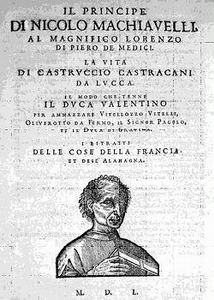
The Prince is a 16th-century political treatise, by the Italian diplomat and political theorist, Niccolò Machiavelli. From correspondence a version appears to have been distributed in 1513, using a Latin title, De Principatibus (About Principalities). However, the printed version was not published until 1532, five years after Machiavelli's death. This was done with the permission of the Medici pope Clement VII, but "long before then, in fact since the first appearance of The Prince in manuscript, controversy had swirled about his writings".
Plato-The Republic
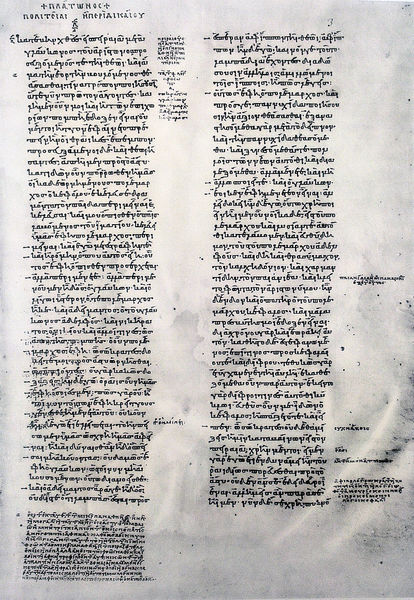
The Republic is a Socratic dialogue, written by Plato around 380 BCE, concerning justice, the order and character of the just city-state and the just man. It is Plato's best-known work, and has proven to be one of the world's most influential works of philosophy and political theory, both intellectually and historically.
Apocalypse
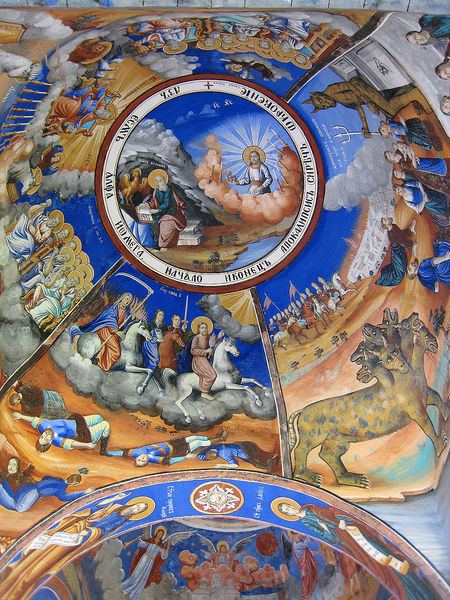
An apocalypse is a disclosure of knowledge or revelation. In religious contexts it is usually a disclosure of something hidden, “a vision of heavenly secrets that can make sense of earthly realities".
In the Book of Revelation, the last book of the New Testament, the revelation which John receives is that of the ultimate victory of good over evil and the end of the present age, and that is the primary meaning of the term, one that dates to 1175.
1100 Vocabularies WEEK 12
1. anathema (n.)
1520s, "an accursed thing," from Latin anathema "an excommunicated person; the curse of excommunication," from Ecclesiastical Greek anathema "a thing accursed," a slight variation of classical Greek anathāma, which meant merely "a thing devoted," literally "a thing set up (to the gods)," such as a votive offering in a temple, from ana "up" (see ana-) + tithenai "to put, place" (see theme).
By the time it reached Late Latin the meaning of the Greek word had progressed through "thing devoted to evil," to "thing accursed or damned." Later it was applied to persons and the Divine Curse. Meaning "act or formula of excommunicating and consigning to damnation by ecclesiastical authority" is from 1610s.
Anathema maranatha, taken as an intensified form, is held to be a misreading of I Corinthians xvi.22 where anathema is followed by Aramaic maran atha "Our Lord hath come" (see Maranatha), apparently a solemn formula of confirmation, like amen; but possibly it is a false transliteration of Hebrew mohoram atta "you are put under the ban," which would make more sense in the context. [Klein]
2. diatribe (n.)
1640s (in Latin form in English from 1580s), "discourse, critical dissertation," from French diatribe (15c.), from Latin diatriba "learned discussion," from Greek diatribe "employment, study," in Plato, "discourse," literally "a wearing away (of time)," from dia- "away" (see dia-) + tribein "to wear, rub," from PIE root *tere- (1) "to rub, turn, twist" (see throw (v.)). Sense of "invective" is 1804, apparently from French.
3. expunge (v.)
c. 1600, from Latin expungere "prick out, blot out, mark (a name on a list) for deletion" by pricking dots above or below it, literally "prick out," from ex- "out" (see ex-) + pungere "to prick, pierce," related to pugnus "a fist" (see pugnacious). According to OED, taken by early lexicographers in English to "denote actual obliteration by pricking;" it adds that the sense probably was influenced by sponge (v.). Related: Expunged; expunging; expungible.
4. flamboyant (adj.)
1832, originally in reference to a 15c.-16c. architectural style with wavy, flame-like curves, from French flamboyant "flaming, wavy," present participle of flamboyer "to flame," from Old French flamboiier "to flame, flare, blaze, glow, shine" (12c.), from flambe "a flame, flame of love," from flamble, variant of flamme, from Latin flammula "little flame" (see flame (n.)). Extended sense of "showy, ornate" is from 1879. Related: Flamboyantly.
5. fortuitous (adj.)
1650s, from Latin fortuitus "happening by chance, casual, accidental," from forte "by chance," ablative of fors "chance" (related to fortuna; see fortune). It means "accidental, undesigned" not "fortunate." Earlier in this sense was fortuit (late 14c.), from French. Related: Fortuitously; fortuitousness.
6. fractious (adj.)
"apt to quarrel," 1725, from fraction in an obsolete sense of "a brawling, discord" (c. 1500) + -ous; probably on model of captious. Related: Fractiously; fractiousness.
7. ilk (adj.)
Old English ilca "the same" (pron.), from Proto-Germanic *ij-lik (compare German eilen), in which the first element is from the PIE demonstrative particle *i- (see yon) and the second is that in Old English -lic "form" (see like (adj.)). Of similar formation are each, which and such, but this word disappeared except in Scottish and thus did not undergo the usual southern sound changes. Phrase of that ilk implies coincidence of name and estate, as in Lundie of Lundie; it was applied usually to families, so that by c. 1790 ilk began to be used with the meaning "family," then broadening to "type, sort."
8. incoherent (adj.)
1620s, "without coherence" (of immaterial or abstract things, especially thought or language), from in- (1) "not, opposite of" + coherent. As "without physical coherence" from 1690s. Related: Incoherently.
9. inhibition (n.)
late 14c., "formal prohibition; interdiction of legal proceedings by authority;" also, the document setting forth such a prohibition, from Old French inibicion and directly from Latin inhibitionem (nominative inhibitio) "a restraining," from past participle stem of inhibere "to hold in, hold back, keep back," from in- "in, on" (see in- (2)) + habere "to hold" (see habit (n.)). Psychological sense of "involuntary check on an expression of an impulse" is from 1876.
10. integral (adj.)
late 15c., "of or pertaining to a whole; intrinsic, belonging as a part to a whole," from Middle French intégral (14c.), from Medieval Latin integralis "forming a whole," from Latin integer "whole" (see integer). Related: Integrally. As a noun, 1610s, from the adjective.
11. jaunty (adj.)
also janty, jantee, etc., 1660s, "elegant, stylish," an imperfect or jocular attempt to render into English the contemporary pronunciation of French gentil "nice, pleasing," in Old French "noble" (see gentle). Meaning "easy and sprightly in manner" first attested 1670s. The same French word otherwise was Englished as genteel. Related: Jauntily; jauntiness.
12. nominal (adj.)
early 15c., "pertaining to nouns," from Latin nominalis "pertaining to a name or names," from nomen (genitive nominis) "name," cognate with Old English nama (see name (n.)). Meaning "of the nature of names" (in distinction to things) is from 1610s. Meaning "being so in name only" first recorded 1620s.
13. ostentatious (adj.)
1701, from ostentation + -ous. Earlier in a similar sense were ostentative (c. 1600); ostentive (1590s). Related: Ostentatiously; ostentatiousness (1650s).
14. placard (n.)
late 15c., "formal document authenticated by an affixed seal," from Middle French placquard "official document with a large, flat seal," also "plate of armor," from Old French plaquier "to lay on, cover up, plaster over," from Middle Dutch placken "to patch (a garment), to plaster," related to Middle High German placke "patch, stain," German Placken "spot, patch." Meaning "poster" first recorded 1550s in English; this sense is in Middle French from 15c.
15. prestigious (adj.)
1540s, "practicing illusion or magic, deceptive," from Latin praestigious "full of tricks," from praestigiae "juggler's tricks," probably altered by dissimilation from praestrigiae, from praestringere "to blind, blindfold, dazzle," from prae "before" (see pre-) + stringere "to tie or bind" (see strain (v.)). Derogatory until 19c.; meaning "having dazzling influence" is attested from 1913 (see prestige). Related: Prestigiously; prestigiousness.
16. remuneration (n.)
c. 1400, from Middle French remuneration and directly from Latin remunerationem (nominative remuneratio) "a repaying, recompense," noun of action from past participle stem of remunerari "to pay, reward," from re- "back" (see re-) + munerari "to give," from munus (genitive muneris) "gift, office, duty" (see municipal).
17. schism (n.)
late 14c., scisme, "dissention within the church," from Old French scisme, cisme "a cleft, split" (12c.), from Church Latin schisma, from Greek skhisma (genitive skhismatos) "division, cleft," in New Testament applied metaphorically to divisions in the Church (I Corinthians xii.25), from stem of skhizein "to split" (see shed (v.)). Spelling restored 16c., but pronunciation unchanged. Often in reference to the Great Schism (1378-1417) in the Western Church.
18. timorous (adj.)
early 15c., from Middle French timoureus (14c.), from Medieval Latin timorosus "fearful," from Latin timor "fear, dread, apprehension, anxiety; religious awe, reverence," from timere "to fear, be afraid, dread," of unknown origin. Some early senses in English seem to show confusion with Middle English temerous "rash" (see temerity). Related: Timorously; timorousness.
19. truncated (adj.)
late 15c., past participle adjective from truncate. Originally in heraldry; modern senses are post-1700.
20. utopia (n.)
1551, from Modern Latin Utopia, literally "nowhere," coined by Thomas More (and used as title of his book, 1516, about an imaginary island enjoying the utmost perfection in legal, social, and political systems), from Greek ou "not" + topos "place" (see topos). Extended to any perfect place by 1610s. Commonly, but incorrectly, taken as from Greek eu- "good" (see eu-) an error reinforced by the introduction of dystopia.
限會員,要發表迴響,請先登入


