1.Salem Massachusetts
Hawthorne's The House of Seven Gables
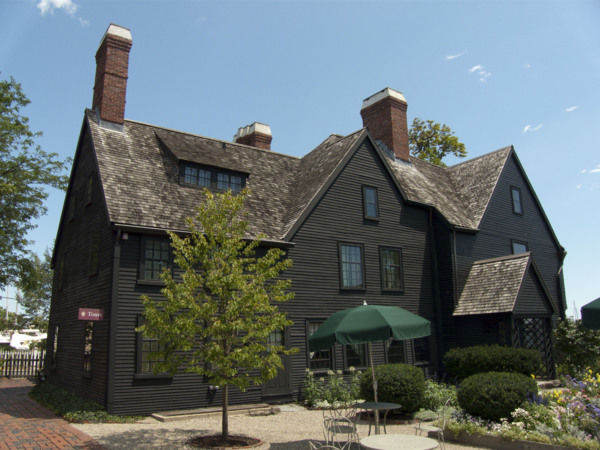
The House of the Seven Gables is a Gothic novel written beginning in mid-1850 by American author Nathaniel Hawthorne and published in April 1851 by Ticknor and Fields of Boston. The novel follows a New England family and their ancestral home. In the book, Hawthorne explores themes of guilt, retribution, and atonement and colors the tale with suggestions of the supernatural and witchcraft. The setting for the book was inspired by a gabled house in Salem belonging to Hawthorne's cousin Susanna Ingersoll and by ancestors of Hawthorne who had played a part in the Salem Witch Trials of 1692. The book was well received upon publication and later had a strong influence on the work of H. P. Lovecraft. The House of the Seven Gables has been adapted several times to film and television.
Witch house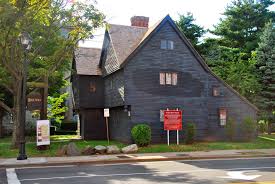
The Witch House (also called the Jonathan Corwin House), was the home of Judge Jonathan Corwin and is the only structure still standing in Salem, Massachusetts with direct ties to the Salem witch trials of 1692. The house was bought by Judge Corwin in 1675, when he was 24 years old, and he lived there for more than forty years. Corwin is buried in the nearby Broad Street Cemetery. The house remained in the Corwin family until the mid-19th century. The Witch House is located at 310 Essex Street, at the cross streets of North & Summer in the Chestnut Street District of Salem.
The Salem Witch Trials Memorial (Salem witch trials)
- the victims' protests of innocence
In 1692, 14 women and 6 men were accused of being witches, were tried, convicted, and executed. Executions took place on June 10, July 19, August 19, September 19 and September 22, 1692. To this day, the events of 1692 are used as a yardstick to measure the depth of civility and due process in our society.
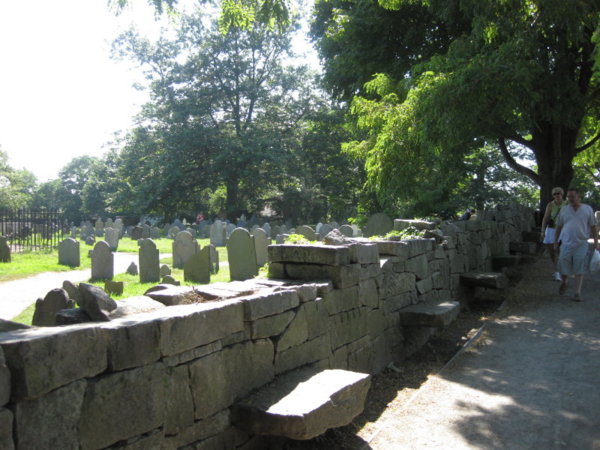
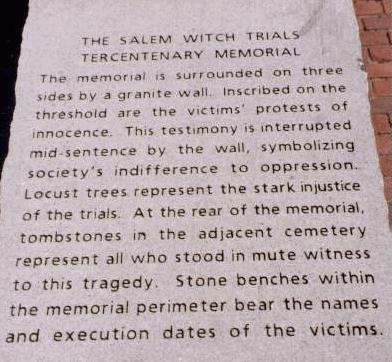
The Witch Trials Memorial was dedicated by Nobel Laureate Elie Wiesel in August 1992 as part of the Salem Witch Trials TerCentenary. The design was selected in a international competition that received 246 entries. The winning design by Maggie Smith and James Cutler was inspired by the Vietnam Memorial.
The Memorial consists of 20 granite benches cantilevered from a low stone wall surrounding an area adjoining the Old Burying Point. The benches are inscribed with the name of the accused and the means and date of execution.
2. New Orleans
seafood+ Jazz music
3. Virginia
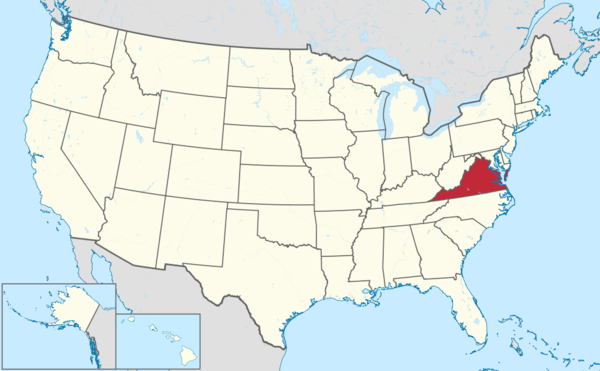
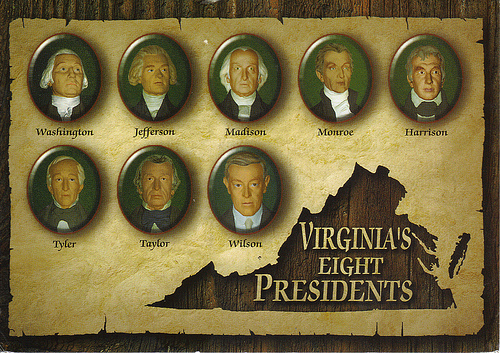
"Mother of Presidents" due to the most U.S. presidents having been born there.
- eight presidents
4. R.I.P.
R.I.P. is an abbreviation for the Latin words requiescat in pace. Its English equivalent is "May (s/he) rest in peace"
____________________________________________________________________
p.473
Rip Van Winkle
Whoever has made a voyage up the Hudson must remember the Catskill Mountains. They are a dismembered branch of the great Appalachian family, and are seen away to the west of the river, swelling up to a noble height, and lording it over the surrounding country. Every change of season, every change of weather, indeed, every hour of the day, produces some change in the magical hues and shapes of these mountains, and they are regarded by all the good wives, far and near, as perfect barometers. When the weather is fair and settled, they are clothed in blue and purple, and print their bold outlines on the clear evening sky; but sometimes, when the rest of the landscape is cloudless, they will gather a hood of gray vapors about their summits, which, in the last rays of the setting sun, will glow and light up like a crown of glory.
-英國勢力的消長
-整段在描述山嵐的景致
In that same village, and in one of these very houses (which, to tell the precise truth, was sadly time-worn and weather-beaten), there lived many years since, while the country was yet a province of Great Britain, a simple, good-natured fellow, of the name of Rip Van Winkle. He was a descendant of the Van Winkles who figured so gallantly in the chivalrous days of Peter Stuyvesant, and accompanied him to the siege of Fort Christina. He inherited, however, but little of the martial character of his ancestors. I have observed that he was a simple, good-natured man; he was, moreover, a kind neighbor and an obedient, henpecked husband. Indeed, to the latter circumstance might be owing that meekness of spirit which gained him such universal popularity; for those men are most apt to be obsequious and conciliating abroad who are under the discipline of shrews at home. Their tempers, doubtless, are rendered pliant and malleable in the fiery furnace of domestic tribulation, and a curtain lecture is worth all the sermons in the world for teaching the virtues of patience and long-suffering. A termagant wife may, therefore, in some respects, be considered a tolerable blessing; and if so, Rip Van Winkle was thrice blessed.
- Character feature
Certain it is that he was a great favorite among all the good wives of the village, who, as usual with the amiable sex, took his part in all family squabbles, and never failed, whenever they talked those matters over in their evening gossipings, to lay all the blame on Dame Van Winkle. The children of the village, too, would shout with joy whenever he approached. He assisted at their sports, made their playthings, taught them to fly kites and shoot marbles, and told them long stories of ghosts, witches, and Indians. Whenever he went dodging about the village, he was surrounded by a troop of them, hanging on his skirts, clambering on his back, and playing a thousand tricks on him with impunity; and not a dog would bark at him throughout the neighborhood.
- his wife: Dame Van Winkle
- other children don't like him, neither
The great error in Rip’s composition was an insuperable aversion to all kinds of profitable labor. It could not be from the want of assiduity or perseverance; for he would sit on a wet rock, with a rod as long and heavy as a Tartar’s lance, and fish all day without a murmur, even though he should not be encouraged by a single nibble. He would carry a fowling piece on his shoulder, for hours together, trudging through woods and swamps, and up hill and down dale, to shoot a few squirrels or wild pigeons. He would never even refuse to assist a neighbor in the roughest toil, and was a foremost man at all country frolics for husking Indian corn, or building stone fences. The women of the village, too, used to employ him to run their errands, and to do such little odd jobs as their less obliging husbands would not do for them; in a word, Rip was ready to attend to anybody’s business but his own; but as to doing family duty, and keeping his farm in order, it was impossible.
His children, too, were as ragged and wild as if they belonged to nobody. His son Rip, an urchin begotten in his own likeness, promised to inherit the habits, with the old clothes of his father. He was generally seen trooping like a colt at his mother’s heels, equipped in a pair of his father’s cast-off galligaskins, which he had much ado to hold up with one hand, as a fine lady does her train in bad weather.
Rip Van Winkle, however, was one of those happy mortals, of foolish, well-oiled dispositions, who take the world easy, eat white bread or brown, whichever can be got with least thought or trouble, and would rather starve on a penny than work for a pound. If left to himself, he would have whistled life away, in perfect contentment; but his wife kept continually dinning in his ears about his idleness, his carelessness, and the ruin he was bringing on his family. Morning, noon, and night, her tongue was incessantly going, and everything he said or did was sure to produce a torrent of household eloquence. Rip had but one way of replying to all lectures of the kind, and that, by frequent use, had grown into a habit. He shrugged his shoulders, shook his head, cast up his eyes, but said nothing. This, however, always provoked a fresh volley from his wife, so that he was fain to draw off his forces, and take to the outside of the house—the only side which, in truth, belongs to a henpecked husband.
Rip’s sole domestic adherent was his dog Wolf, who was as much henpecked as his master; for Dame Van Winkle regarded them as companions in idleness, and even looked upon Wolf with an evil eye, as the cause of his master’s so often going astray. True it is, in all points of spirit befitting an honorable dog, he was as courageous an animal as ever scoured the woods—but what courage can withstand the ever-during and all-besetting terrors of a woman’s tongue? The moment Wolf entered the house his crest fell, his tail drooped to the ground, or curled between his legs; he sneaked about with a gallows air, casting many a sidelong glance at Dame Van Winkle, and at the least flourish of a broomstick or ladle would fly to the door with yelping precipitation.
Times grew worse and worse with Rip Van Winkle as years of matrimony rolled on; a tart temper never mellows with age, and a sharp tongue is the only edged tool that grows keener by constant use. For a long while he used to console himself, when driven from home, by frequenting a kind of perpetual club of the sages, philosophers, and other idle personages of the village, which held its sessions on a bench before a small inn, designated by a rubicund portrait of his majesty George the Third. Here they used to sit in the shade, of a long lazy summer’s day, talking listlessly over village gossip, or telling endless sleepy stories about nothing. But it would have been worth any statesman’s money to have heard the profound discussions which sometimes took place, when by chance an old newspaper fell into their hands, from some passing traveler. How solemnly they would listen to the contents, as drawled out by Derrick Van Bummel, the schoolmaster, a dapper, learned little man, who was not to be daunted by the most gigantic word in the dictionary; and how sagely they would deliberate upon public events some months after they had taken place.
From even this stronghold the unlucky Rip was at length routed by his termagant wife, who would suddenly break in upon the tranquillity of the assemblage, and call the members all to nought; nor was that august personage, Nicholas Vedder himself, sacred from the daring tongue of this terrible virago, who charged him outright with encouraging her husband in habits of idleness.
Poor Rip was at last reduced almost to despair; and his only alternative, to escape from the labor of the farm and clamor of his wife, was to take gun in hand and stroll away into the woods. Here he would sometimes seat himself at the foot of a tree, and share the contents of his wallet with Wolf, with whom he sympathized as a fellow-sufferer in persecution. “Poor Wolf,” he would say, “thy mistress leads thee a dog’s life of it; but never mind, my lad, while I live thou shalt never want a friend to stand by thee!” Wolf would wag his tail, look wistfully in his master’s face, and if dogs can feel pity, I verily believe he reciprocated the sentiment with all his heart.
In a long ramble of the kind on a fine autumnal day, Rip had unconsciously scrambled to one of the highest parts of the Kaatskill Mountains. He was after his favorite sport of squirrel shooting, and the still solitudes had echoed and re-echoed with the reports of his gun. Panting and fatigued, he threw himself, late in the afternoon, on a green knoll, covered with mountain herbage, that crowned the brow of a precipice. From an opening between the trees he could overlook all the lower country for many a mile of rich woodland. He saw at a distance the lordly Hudson, far, far below him, moving on its silent but majestic course, the reflection of a purple cloud, or the sail of a lagging bark, here and there sleeping on its glassy bosom, and at last losing itself in the blue highlands.
On the other side he looked down into a deep mountain glen, wild, lonely, and shagged, the bottom filled with fragments from the impending cliffs, and scarcely lighted by the reflected rays of the setting sun. For some time Rip lay musing on this scene; evening was gradually advancing; the mountains began to throw their long blue shadows over the valleys; he saw that it would be dark long before he could reach the village, and he heaved a heavy sigh when he thought of encountering the terrors of Dame Van Winkle.
-描述山嵐景致
-要回家就嘆氣
As he was about to descend, he heard a voice from a distance, hallooing, “Rip Van Winkle! Rip Van Winkle!” He looked around, but could see nothing but a crow winging its solitary flight across the mountain. He thought his fancy must have deceived him, and turned again to descend, when he heard the same cry ring through the still evening air: “Rip Van Winkle! Rip Van Winkle!”—at the same time Wolf bristled up his back, and giving a low growl, skulked to his master’s side, looking fearfully down into the glen. Rip now felt a vague apprehension stealing over him; he looked anxiously in the same direction, and perceived a strange figure slowly toiling up the rocks, and bending under the weight of something he carried on his back. He was surprised to see any human being in this lonely and unfrequented place, but supposing it to be some one of the neighborhood in need of assistance, he hastened down to yield it.
- 好像了解到了什麼
On nearer approach, he was still more surprised at the singularity of the stranger’s appearance. He was a short, square-built old fellow, with thick bushy hair, and a grizzled beard. His dress was of the antique Dutch fashion—a cloth jerkin strapped around the waist—several pair of breeches, the outer one of ample volume, decorated with rows of buttons down the sides, and bunches at the knees. He bore on his shoulders a stout keg, that seemed full of liquor, and made signs for Rip to approach and assist him with the load. Though rather shy and distrustful of this new acquaintance, Rip complied with his usual alacrity, and mutually relieving one another, they clambered up a narrow gully, apparently the dry bed of a mountain torrent. As they ascended, Rip every now and then heard long rolling peals, like distant thunder, that seemed to issue out of a deep ravine, or rather cleft between lofty rocks, toward which their rugged path conducted. He paused for an instant, but supposing it to be the muttering of one of those transient thunder showers which often take place in mountain heights, he proceeded. Passing through the ravine, they came to a hollow, like a small amphitheater, surrounded by perpendicular precipices, over the brinks of which impending trees shot their branches, so that you only caught glimpses of the azure sky and the bright evening cloud. During the whole time, Rip and his companion had labored on in silence; for though the former marveled greatly what could be the object of carrying a keg of liquor up this wild mountain, yet there was something strange and incomprehensible about the unknown that inspired awe and checked familiarity.
On entering the amphitheater, new objects of wonder presented themselves. On a level spot in the center was a company of odd-looking personages playing at ninepins. They were dressed in a quaint, outlandish fashion: some wore short doublets, others jerkins, with long knives in their belts, and most had enormous breeches, of similar style with that of the guide’s. Their visages, too, were peculiar: one had a large head, broad face, and small, piggish eyes; the face of another seemed to consist entirely of nose, and was surmounted by a white sugar-loaf hat set off with a little red cock’s tail. They all had beards, of various shapes and colors. There was one who seemed to be the commander. He was a stout old gentleman, with a weather-beaten countenance; he wore a laced doublet, broad belt and hanger, high-crowned hat and feather, red stockings, and high-heeled shoes, with roses in them. The whole group reminded Rip of the figures in an old Flemish painting, in the parlor of Dominie Van Schaick, the village parson, and which had been brought over from Holland at the time of the settlement.
-形容那個陌生人
By degrees, Rip’s awe and apprehension subsided. He even ventured, when no eye was fixed upon him, to taste the beverage, which he found had much of the flavor of excellent Hollands. He was naturally a thirsty soul, and was soon tempted to repeat the draught. One taste provoked another, and he reiterated his visits to the flagon so often, that at length his senses were overpowered, his eyes swam in his head, his head gradually declined, and he fell into a deep sleep.
On awaking, he found himself on the green knoll from whence he had first seen the old man of the glen. He rubbed his eyes—it was a bright sunny morning. The birds were hopping and twittering among the bushes, and the eagle was wheeling aloft and breasting the pure mountain breeze. “Surely,” thought Rip, “I have not slept here all night.” He recalled the occurrences before he fell asleep. The strange man with a keg of liquor—the mountain ravine—the wild retreat among the rocks—the woe-begone party at ninepins—the flagon—“Oh! that flagon! that wicked flagon!” thought Rip—“what excuse shall I make to Dame Van Winkle?”
He looked round for his gun, but in place of the clean, well-oiled fowling piece, he found an old firelock lying by him, the barrel incrusted with rust, the lock falling off, and the stock worm-eaten. He now suspected that the grave roysters of the mountain had put a trick upon him, and having dosed him with liquor, had robbed him of his gun. Wolf, too, had disappeared, but he might have strayed away after a squirrel or partridge. He whistled after him, shouted his name, but all in vain; the echoes repeated his whistle and shout, but no dog was to be seen.
He had now entered the skirts of the village. A troop of strange children ran at his heels, hooting after him, and pointing at his gray beard. The dogs, too, none of which he recognized for his old acquaintances, barked at him as he passed. The very village was altered: it was larger and more populous. There were rows of houses which he had never seen before, and those which had been his familiar haunts had disappeared. Strange names were over the doors—strange faces at the windows—everything was strange. His mind now began to misgive him; he doubted whether both he and the world around him were not bewitched. Surely this was his native village, which he had left but the day before. There stood the Catskill Mountains—there ran the silver Hudson at a distance—there was every hill and dale precisely as it had always been—Rip was sorely perplexed—“That flagon last night,” thought he, “has addled my poor head sadly!”
He entered the house, which, to tell the truth, Dame Van Winkle had always kept in neat order. It was empty, forlorn, and apparently abandoned. This desolateness overcame all his connubial fears—he called loudly for his wife and children—the lonely chambers rung for a moment with his voice, and then all again was silence.
He now hurried forth, and hastened to his old resort, the little village inn—but it too was gone. A large rickety wooden building stood in its place, with great gaping windows, some of them broken, and mended with old hats and petticoats, and over the door was painted, “The Union Hotel, by Jonathan Doolittle.” Instead of the great tree which used to shelter the quiet little Dutch inn of yore, there now was reared a tall naked pole, with something on the top that looked like a red nightcap, and from it was fluttering a flag, on which was a singular assemblage of stars and stripes—all this was strange and incomprehensible. He recognized on the sign, however, the ruby face of King George, under which he had smoked so many a peaceful pipe, but even this was singularly metamorphosed. The red coat was changed for one of blue and buff, a sword was stuck in the hand instead of a scepter, the head was decorated with a cocked hat, and underneath was painted in large characters, GENERAL WASHINGTON.
-人事異遷
“God knows,” exclaimed he, at his wit’s end; “I’m not myself—I’m somebody else—that’s me yonder—no—that’s somebody else, got into my shoes—I was myself last night, but I fell asleep on the mountain, and they’ve changed my gun, and everything’s changed, and I’m changed, and I can’t tell what’s my name, or who I am!”
- climax 新興國家的恐慌
To make a long story short, the company broke up, and returned to the more important concerns of the election. Rip’s daughter took him home to live with her; she had a snug, well-furnished house, and a stout cheery farmer for a husband, whom Rip recollected for one of the urchins that used to climb upon his back. As to Rip’s son and heir, who was the ditto of himself, seen leaning against the tree, he was employed to work on the farm; but evinced an hereditary disposition to attend to anything else but his business.
Having nothing to do at home, and being arrived at that happy age when a man can do nothing with impunity, he took his place once more on the bench, at the inn door, and was reverenced as one of the patriarchs of the village, and a chronicle of the old times “before the war.” It was some time before he could get into the regular track of gossip, or could be made to comprehend the strange events that had taken place during his torpor. How that there had been a revolutionary war—that the country had thrown off the yoke of old England—and that, instead of being a subject of his Majesty, George III., he was now a free citizen of the United States. Rip, in fact, was no politician; the changes of states and empires made but little impression on him; but there was one species of despotism under which he had long groaned, and that was—petticoat government; happily, that was at an end; he had got his neck out of the yoke of matrimony, and could go in and out whenever he pleased, without dreading the tyranny of Dame Van Winkle. Whenever her name was mentioned, however, he shook his head, shrugged his shoulders, and cast up his eyes; which might pass either for an expression of resignation to his fate, or joy at his deliverance.
下一則: week6 Nathaniel Hawthorne’s Young Goodman Brown, My Kinsman, Major Molineux


