Trees are important assets of every community. Trees increase our quality of life by bringing natural elements and wildlife habitats into urban settings. Using trees in cities to deflect the sunlight reduces the heat island effect caused by pavement and commercial buildings. Trees contribute to their environment by providing oxygen, improving air quality, climate amelioration, conserving water, preserving soil, and supporting wildlife. During the process of photosynthesis, trees take in carbon dioxide and produce the oxygen we breathe.
Therefore, trees are well not only planted but maintained in many cities including Taipei. There even are regulations of Protected Trees in Taipei were placed in effect from April 18, 2003. Bureau of Culture is the responsible agent of Protected Trees. Trees with any of the following facts are protected:
Tree stem diameter of 0.8 meter or above
Tree stem circumference of 2.5 meter or above
Tree height of 15 meter or above
Tree age of 50 years old or above
Tree of rare species or representation of ecology, biology, geography, regional history or culture and identified by the authority
*Stem diameter and circumference is measured at 1.3 meter above ground
I believe there are similar regulations in other cities or counties to protect trees since ecological environment has been well recognized nationwide these days.
Once a tree is identified as a Protected Tree, whether a public or private property, it is not allowed to fell, move, or destroy without a formal approval. Any violation will be fined between NTD 50,000 and 100,000. If a Protected Tree is supposed to be under hazard caused by any construction, a plant move and restoration plan should be proposed by the construction unit for approval prior to the construction is initiated. Any violation will be fined up to NTD 50,000. The agent is authorized to execute investigation on site with document when necessary. The owner of the property may not refuse or escape from the investigation. Any violation will be fined between NTD 10,000 and 30,000.
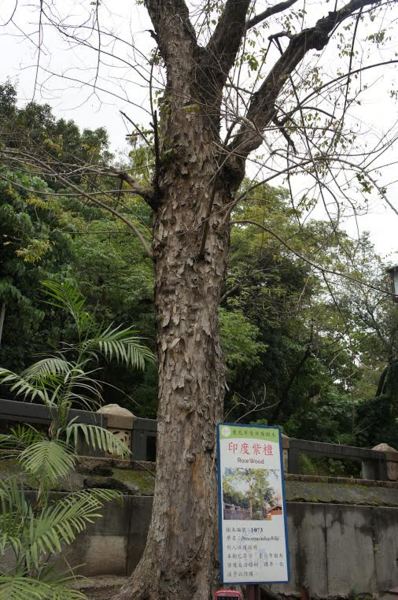
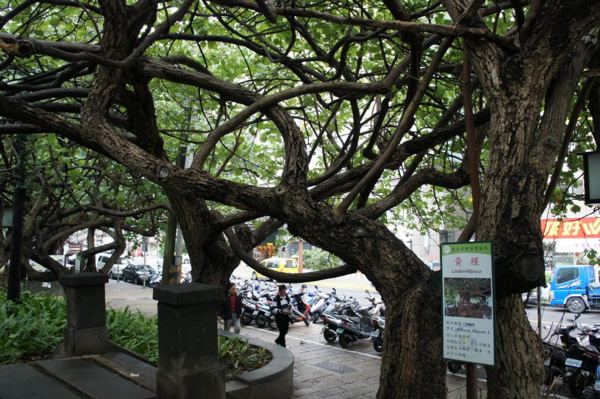
There are currently 1,861 Protected Trees registered in Taipei, and among them, 267 are located in Beitou District. Many of them are located in the beautiful Beitou Park. Banyan(榕), camphor (樟樹), and Formosan gum(楓香) trees are commonly seen Protected Trees since they are widely planted in Taiwan. However, it is unusual to see a giant soapnuts(無患子) tree like the one in front of Beitou Hot Spring Museum. It is the king of soapnuts tree in Taipei, 18 meter high and 0.81 meter diameter. There are only two Protected soapnuts trees registered in Taipei. The other one locates in Tienmoo. There are five old Cuban Bast (黃槿) trees registered in Taipei. Three of them are standing at the entrance of Beitou Park probably near 100 years. There is a Rose Wood(印度紫檀) tree, which is an excellent furniture material, identified as a Protected Tree not far from Beitou Hot Spring Museum.
A registered Protected Tree in Taipei will carry a plate stating identification of the tree and can be found on the registration list published and maintained by Taipei City Government. Take a look at the tall trees or uncommon trees next time, and you may learn more about the Protected Trees in Taipei.
下一則: Stone Arch Bridge (translated by Henry from 北投采風)
 2樓. 珍妮的異想世界2015/06/05 05:36
樹木見證了歷史,從樹木可以支到這個地區的滄海桑田.
北投對自然資源保護不移餘力,讓士林人很汗顏,我要多努力向北投文化人看齊.
Ben這篇文章可以看出他對北投公園植物的愛惜之心.
 1樓. Henry2015/05/28 13:18
Ben really concentrates on the details of Beitou district, which owns many protected trees as registered in Taipei. Ben is also very organized to describe what Bureau of Culture doing. We appreciate Ben to teach us so many different kinds of trees, especailly those scarce and huge ones.
(likochia7@gmail.com)


