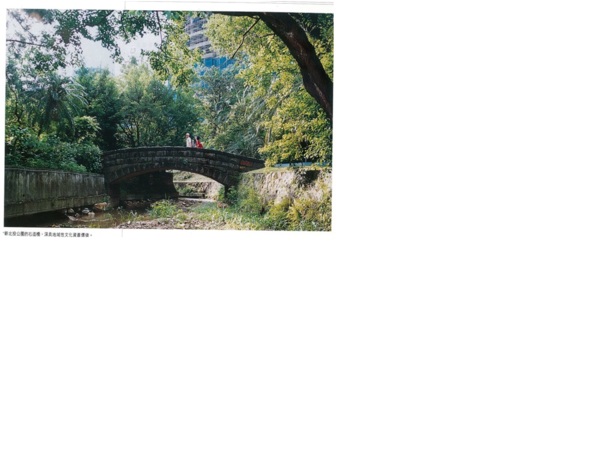
Stone arch bridge北投石拱橋
There’s one quaint “stone arch bridge” located close to the skating rink of Beitou Park, which is always bearing the crossing passengers silently there. Until one day a Japanese friend, who deeply loves Taiwan, told us the story relevant to this stone manufactured bridge.
In 1996, ex-mayor of Taipei city, Mr. Chen visited Beitou Branch of Taipei library (situated at Beitou Park), after holding the middle- stage presentation about the planning project of Beitou line Gondola纜車, during the actual site survey on the Beitou Creek and Beitou park together with the following gentlemen, Japanese professor surprised to find there’s one set of stone bridge inside the park, which was regarded as the precious civilization asset in Japan. Hence Japanese professor described the story of stone arch bridge.
The technology of stone manufactured arch bridge was originated from
Ancient Egypt, Greece and Rome ages, then later conveyed to eastern India from Europe. Then spread to China routing from India. At the end, said technology has been conveyed to Japan. Therefore the Kyushu area of Japan, which is located closest to Mainland China, has been facilitated with several stone manufactured arch bridges.
There were several sets of stone arch bridge in Beitou Park originally. But after several times of reconstruction, only one unique stone arch bridge survived. Although scale is small, it owns high Beitou regional cultural assets’ value. Specific to the environmental upgrading field of the future Community building社區總體營造, national grade cultural assets were not necessarily required to create the good environment. Instead the unique regional cultural asset to be excavated and its application to be maximized in community building will be more fundamental and will be mandatory methods and direction.
Beitou Park was built in year 1911, which is almost equivalent to end of Japanese Meiji明治 dynasty or the beginning of Da-Zen大正 dynasty.
During this period, the general bridge in Japan was made of wood. But most of the major bridges were stone manufactured arch bridge. Minor ones made of cast iron.
The trend of stone arch bridge was extended till to the end of Da-Zen 大正dynasty. However, at the beginning of Showa dynasty, stone arch bridge was replaced with RC( reinforce concrete) arch bridge. There were two reasons to do so- one is the application of RC on the construction of bridge is the brand new technology at that time. The other one is most of the bridges were damaged by the huge earthquake as happened in 關東. And the re-built bridges mainly focused on RC arch.
Thereafter, this RC arch technology was conveyed from Tokyo to all areas of Japan. And simultaneously it was passed to Taiwan here.
Zon-San old bridge中山舊橋 standing on the Keelung river( built from year 1930-1933)is the remains of this trend. 中山舊橋 was built via the brand new technology at that time. RC as its material, its structure and outside shape copied from stone manufactured arch bridge. From the bridge civilization history, we could see this bridge really owns the specific characteristic as that stage indicated.
At the early investigation stage, it’s uncertain this stone arch bridge at Beitou Park was built together with park, or reconstructed later. It necessitated having a thorough investigation including the structure of this bridge and stone raw materials, etc. if we want to know. Anyway we could see it’s the remains of Japanese governing period from the style and construction method.
This stone bridge has been integrated in Park’s silent environment, and its quiet and simple shape seems advised us – if the past carefree feeling has been forgotten as a result from long term staying in the noisy and modern world.


