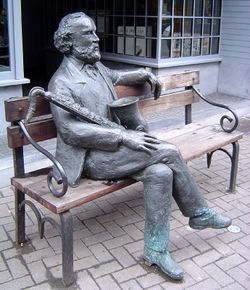
Antoine-Joseph (known as Adolphe) Sax (November 6, 1814 – February 4, 1894) was a Belgian (of Saxon origin) musical instrument designer, best known for inventing the saxophone.
Adolphe Sax was born in Dinant in Wallonia, Belgium. His father, Charles-Joseph Sax, was an instrument designer himself, who made several changes to the design of the horn. Adolphe began to make his own instruments at an early age, entering two of his flutes and a clarinet into a competition at the age of fifteen. He subsequently studied those two instruments at the Royal School of Singing in Brussels.
Having left the school, Sax began to experiment with new instrument designs, while his father continued to produce conventional instruments to bring money into the household. Adolphe's first important invention was an improvement of the bass clarinet design which he patented at the age of 20.
In 1841, Sax relocated permanently to Paris and began work on a new set of instruments which were exhibited there in 1844. They were valved bugles, and although he had not invented the instrument itself, his examples were so superior to those of his rivals that they became known as saxhorns. They range in approximately 7 different sizes, looking somewhat similar to the euphonium and also paved the path to the creation of the flugelhorn. Today, they are widely used in concert bands and sometimes in orchestras. The saxhorn also laid the groundwork for the modern euphonium. He also developed the saxtromba in 1845, though this survived only briefly.
The spread of saxhorn instruments throughout the world was ferocious. The superior saxhorn valves were accepted as state of the art and still largely unchanged today. The advances made by Adolphe Sax no doubt leading to the formation of the famous British Brass Band movement who exclusively adopted the saxhorn range. An example of which are the Jedforest Instrumental Band who formed in 1854 within the Scottish Borders only a decade after Saxhorn models became available.
The late 1830's and/or early 1840s saw Sax inventing the clarinette-bourdon, an early (and unsuccessful) design of contrabass clarinet. Most significantly, at this time he developed the instrument for which he is now best known, the saxophone, though his new invention was actually patented in 1846. The saxophone was invented for use in both orchestras and concert bands. The composer Hector Berlioz wrote approvingly of the new instrument in 1842. By 1846 Sax had designed, on paper at least, a full range of saxophones (from soprano to bass). Although they never became standard orchestral instruments, the saxophones made his reputation, and secured him a job teaching at the Paris Conservatoire from 1867.
Sax continued to make instruments later in life, as well as presiding over a new saxophone class at the Paris Conservatoire. However, rival instrument-makers attacked the legitimacy of his patents and mounted a lengthy campaign of litigation against Sax and his company, driving him into bankruptcy twice (in 1856 and 1873). The prolonged legal struggle may also have undermined his own health; he suffered from lip cancer between 1853 and 1858 but made a full recovery.
- fever in love tk saxophone Dreamer soprano tk saxophone雲中夢想家高音薩克斯風一體管
- TK SAXOPHONE 4 tk saxophone雲中夢想家高音薩克斯風一體管 tk saxophone Dreamer soprano
- JZ saxophone串燒 wilson chen 陳嘉俊 TK薩克斯風 ~爵士就是要這樣玩~
- Lover man/Charlie Parker致敬BY wilson chen TK SAXOPHONE Tk薩克斯風
- 蒙面歌王 千面嬌娃《I Will Always Love You》陳嘉俊wilson chen薩克斯風演出精彩片段 TK saxophone
- TK薩克斯風台中旗艦店(台灣薩克斯風之父第二代&第三代台中市一中街旗艦薩克斯風交流區)


