宏本身也可以使用自已,遞回在MetaPost中是可以的。要注意不要形成無窮遞回,所以需要用條件式來控制。這是 Learning MetaPost by Doing 內的例子:
beginfig(1);
u:=2cm; branchrotation=60;
offset:=180-branchrotation;
thinning:=0.7;
shortening:=0.8;
def drawit(expr p, linethickness) = draw p withpen pencircle scaled linethickness; enddef;
vardef tree(expr A, B, n, size) =
save C, D, thickness; pair C, D;
thickness:=size;
C:=shortening[B, A rotatedaround(B, offset + uniformdeviate(branchrotation))];
D:=shortening[B,A rotatedaround(B, -offset-uniformdeviate(branchrotation))];
if n>0:
drawit (A--B, thickness);
thickness:=thinning*thickness;
tree(B, C, n-1, thickness);
tree(B, D, n-1, thickness);
else:
drawit(A--B, thickness);
thickness:=thinning*thickness;
drawit(B--C, thickness);
drawit(B--D, thickness);
fi;
enddef;
tree((0,0), (0, u), 10, 8mm);
endfig;
end;
結果如下:

tree()主要目的就是畫出一條直線(A--B)加上二條分枝(B--C), (B--D)。其中 A rotatedaround( B, degree) 就是把A以B為圓心繞行degree度的pair值。這個pair值再乘上shortenning,所以它距B的距離就會縮短。分枝的寛度則乘上thinning。uniformdeviate是一個運算元,它可產生0到1中間的任意數值。
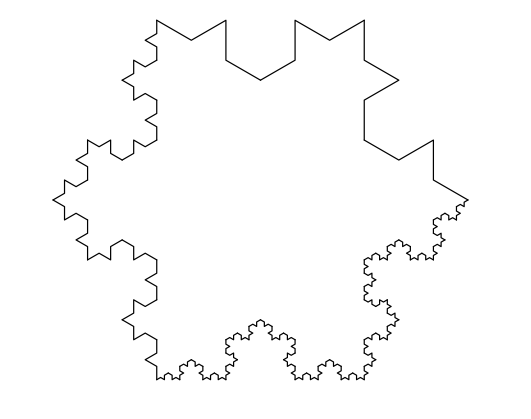
另外一個是畫出冰花。
u=3cm;
vardef koch(expr A, B, n)=
save C; pair C;
C:=A rotatedaround(1/3[A, B],120);
if n>1:
koch(A, 1/3[A,B], n-1);
koch(1/3[A,B], C, n-1);
koch(C, 2/3[A,B], n-1);
koch(2/3[A,B], B, n-1);
else:
draw A--1/3[A,B]--C--2/3[A,B]--B;
fi
enddef;
beginfig(1);
z0=(u, 0);
z1=z0 rotated 120;
z2=z1 rotated 120;
koch(z0, z1, 2);
koch(z1, z2, 3);
koch(z3, z0, 4);
endfig;
end;
結果如下:


限會員,要發表迴響,請先登入


