Word Information
✦ mor-; mori- : death
moral : relating to right and wrong and the way that people should behave ⇔ amoral
morale : the amount of enthusiasm that a person or group of people feel about their situation at a particular time
morgue : a building or room where dead bodies are kept temporarily
mortician : a undertaker
mortified : very embarrassed
moribund : no longer effective and not likely to continue for much longer
Chapel
Chronologically speaking, the words “church” and “chapel” emerged into widespread use at about the same time, dating back to approximately the thirteenth century.
Of the two, “church” is the broader term, referring both to the worship space in an architectural sense as well as the congregation as a collective group of people meeting within the church building. Though the word’s original connotations were of a building designated for holy worship, church services now often take place in secular locations, and former church buildings are frequently converted into private homes, bookstores, and bars.
Chapels are commonly smaller spaces, usually a room within the church or a larger, non-faith-based institution like an airport, hospital, or university, and they are not necessarily consecrated ground.
Unlike both churches and chapels, which originated in the general Christian tradition but are not specific to any particular incarnation of it, cathedrals fulfill a specific role within the Catholic faith. Named for the bishop’s throne, the cathedra—and despite its implications of stained glass and grandeur—a “cathedral” is simply the designated principal church within a diocese. Naturally, where the bishop goes, lofty arches and flying buttresses often follow, but those are just a side effect. If the bishop’s seat moves elsewhere, so too does the designation of “cathedral.” Such was the case with Crotia’s Church of the Holy Cross, once billed as “the smallest cathedral in the world”—in the absence of a bishop, the Croatian Tourist Board is pushing the definition just a bit.
 Church of the Holy Cross
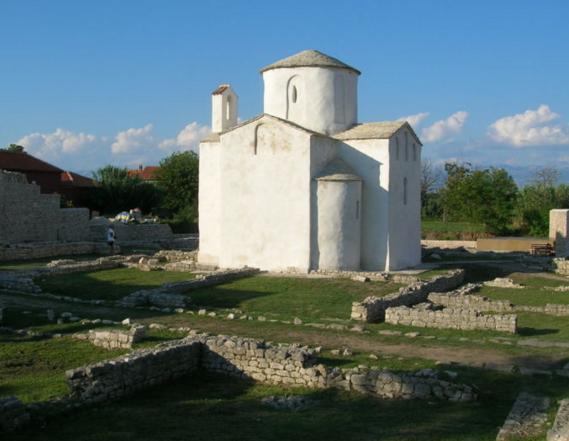
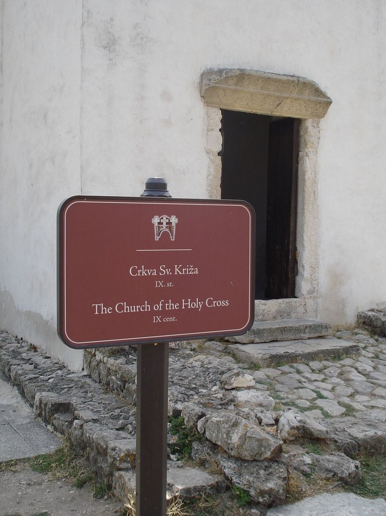
The Church of the Holy Cross called "the smallest cathedral in the world" is the most valuable preserved monument of early Croatian religious architecture and one of Nin's symbols. By its position and beauty it dominates the area where it stands. It was built in the 9th century, in the Early Christian period. It is the only religious object in Nin which has remained untouched since its construction to date.
It was built on the remains of ancient houses which are visible even today. During the reign of Croatian Kings it served as a Court chapel for the nearby Duke's Court. A number of medieval graves were discovered around the church.
This small church, thanks to the position of its windows and the angle of the fall of light is a kind of calendar, and according to the sun 's rays, the exact date of the equinox and solstice can be determined, which on the first day of summer is the start of an interesting event called"The Festival of Sun and Light."
Spellbound by its beauty, the famous English architect Thomas Jackson, called it "the smallest cathedral in the world."
Charles John Huffam Dickens
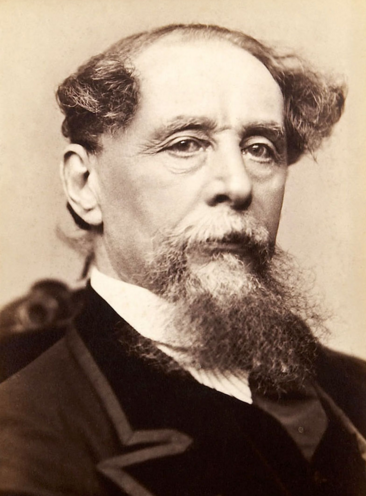
Charles John Huffam Dickens ( 7 February 1812 – 9 June 1870) was an English writer and social critic. He created some of the world's best-known fictional characters and is regarded as the greatest novelist of the Victorian era. His works enjoyed unprecedented popularity during his lifetime, and by the twentieth century critics and scholars had recognised him as a literary genius. His novels and short stories enjoy lasting popularity.
 famous works
A Christmas Carol
A Christmas Carol tells the story of a bitter old miser named Ebenezer Scrooge and his transformation into a gentler, kindlier man after visitations by the ghost of his former business partner Jacob Marley and the Ghosts of Christmas Past, Present and Yet to Come.
The book was written at a time when the British were examining and exploring Christmas traditions from the past as well as new customs such as Christmas cards and Christmas trees. Carol singing took a new lease on life during this time. Dickens's sources for the tale appear to be many and varied, but are, principally, the humiliating experiences of his childhood, his sympathy for the poor, and various Christmas stories and fairy tales.
background
childhood experiences 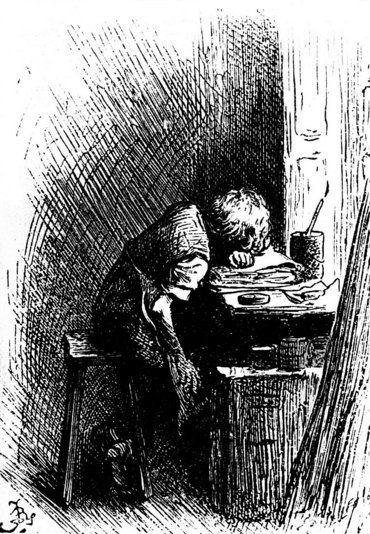
In 1824, Dickens's father, John, was imprisoned in the Marshalsea while 12-year-old Charles was forced to take lodgings nearby, pawn his collection of books, leave school and accept employment in a blacking factory.
The devastating impact of the period wounded him psychologically, coloured his work, and haunted his entire life with disturbing memories. Dickens both loved and demonised his father, and it was this psychological conflict that was responsible for the two radically different Scrooges in the tale.

Children living in poverty
Dickens was keenly touched by the lot of poor children in the middle decades of the 19th century. In early 1843, he toured the Cornish tin mines, where he saw children working in appalling conditions. The suffering he witnessed there was reinforced by a visit to the Field Lane Ragged school, one of several London schools set up for the education of the capital's half-starved, illiterate street children.
Inspired by the February 1843 parliamentary report exposing the effects of the Industrial Revolution upon poor children called Second Report of the Children's Employment Commission, Dickens planned in May 1843 to publish an inexpensive political pamphlet tentatively titled, "An Appeal to the People of England, on behalf of the Poor Man's Child", but changed his mind, deferring the pamphlet's production until the end of the year. He wrote to Dr. Southwood Smith, one of 84 commissioners responsible for the Second Report, about his change in plans.
In a fundraising speech on 5 October 1843, at the Manchester Athenæum, Dickens urged workers and employers to join together to combat ignorance with educational reform, and realized in the days following that the most effective way to reach the broadest segment of the population with his social concerns about poverty and injustice was to write a deeply felt Christmas narrative rather than polemical pamphlets and essays. It was during his three days in Manchester that he conceived the plot of A Christmas Caro
Washington Irving's Christmas stories
The tales and essays attracted Dickens, and the two authors shared the belief that the staging of a nostalgic English Christmas might restore a social harmony and well-being lost in the modern world.

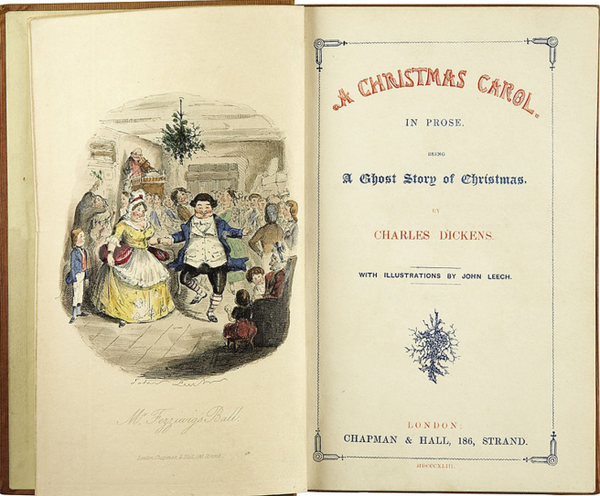
Dickens was regarded as the literary colossus of his age. His 1843 novella, A Christmas Carol, remains popular and continues to inspire adaptations in every artistic genre.
famous works
A Tale of Two Cities
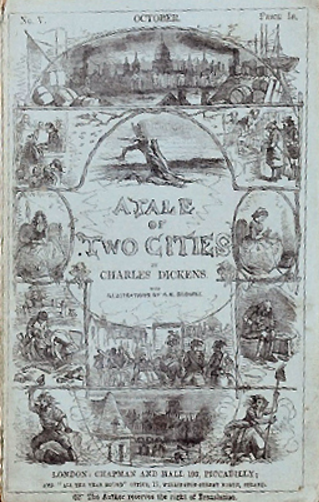
A Tale of Two Cities is a novel by Charles Dickens, set in London and Paris before and during the French Revolution. The novel depicts the plight of the French peasantry demoralized by the French aristocracy in the years leading up to the revolution, the corresponding brutality demonstrated by the revolutionaries toward the former aristocrats in the early years of the revolution, and many unflattering social parallels with life in London during the same period. It follows the lives of several characters through these events.
 Dickens's famous opening sentence introduces the universal approach of the book, the French Revolution, and the drama depicted within:
"It was the best of times, it was the worst of times, it was the age of wisdom, it was the age of foolishness, it was the epoch of belief, it was the epoch of incredulity, it was the season of Light, it was the season of Darkness, it was the spring of hope, it was the winter of despair, we had everything before us, we had nothing before us, we were all going direct to Heaven, we were all going direct the other way - in short, the period was so far like the present period, that some of its noisiest authorities insisted on its being received, for good or for evil, in the superlative degree of comparison only."
*epoch : a long period of time, especially one in which there are new developments and great change
*incredulity : not wanting or not able to believe something, and usually showing this
*superlative : of the highest quality; the best
western canon
The Western canon is the body of books, music and art that scholars generally accept as the most important and influential in shaping Western culture. It includes work perceived as the major works of artistic merit. Such a canon is important to the theory of educational perennialism and the development of high culture.
* Educational perennialism(永恆主義):
Educational perennialism is a normative educational philosophy. Perennialists believe that one should teach the things that are of everlasting pertinence to all people everywhere, and that the emphasis should be on principles, not facts. Since people are human, one should teach first about humans, rather than machines or techniques and liberal rather than vocational topics.
Like a classical philologist, Harold Bloom ,who published the western canon, divides his Canon into four “ages” or periods: The Theocratic Age (2000 BCE-1321 CE); The Aristocratic Age (1321-1832); The Democratic Age: 1832-1900); and The Chaotic Age (20th Century).
* theocracy(n.) : a government led by religious leaders
theocratic (adj.)
* aristocratic (adj.): belonging to or typical of the aristocracy
aristocracy(n.) : the people in the highest class of society, who usually have money, land, and power and who often have special titles, such as ‘duke’ or ‘countess’: can be followed by a singular or plural verb
* chaotic(adj.) : happening in a confused way and without any order or organization
chaos (n.)
* Harold Bloom : an American literary critic
Edith Wharton
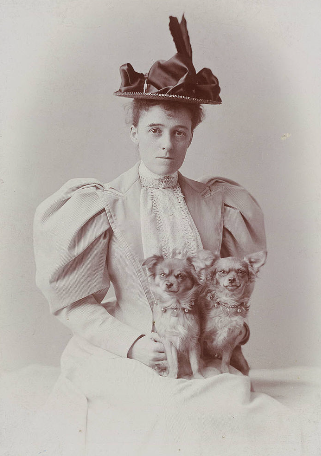
Edith Wharton (January 24, 1862 – August 11, 1937) was a Pulitzer Prize-winning American novelist, short story writer, and designer. She was nominated for the Nobel Prize in Literature in 1927, 1928 and 1930. Wharton combined her insider's view of America's privileged classes with a brilliant, natural wit to write humorous, incisive novels and short stories of social and psychological insight. She was well acquainted with many of her era's other literary and public figures, including Theodore Roosevelt.
 The Pulitzer Prize gold medal award
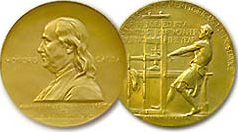
The Pulitzer Prize is an award for achievements in newspaper and online journalism, literature, and musical composition in the United States. It was established in 1917 by provisions in the will of American (Hungarian-born) Joseph Pulitzer who had made his fortune as a newspaper publisher, and is administered by Columbia University in New York City. Prizes are awarded yearly in twenty-one categories. In twenty of the categories, each winner receives a certificate and a US$10,000 cash award. The winner in the public service category of the journalism competition is awarded a gold medal.
senses
Humans have a multitude of senses. Sight, hearing, taste, smell, and touch are the five traditionally recognized senses.
In this painting by Pietro Paolini, each individual represents one of the five senses.
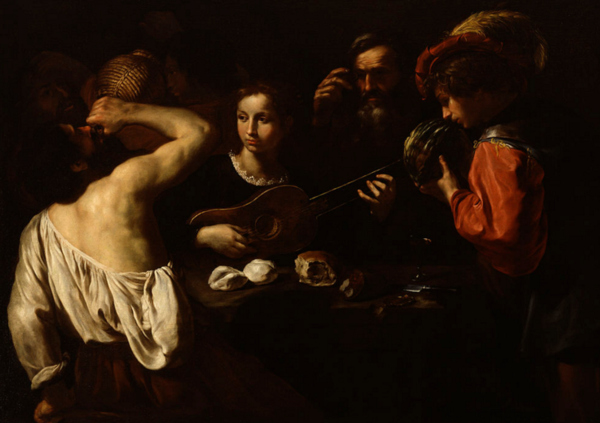
A broadly acceptable definition of a sense would be "A system that consists of a group of sensory cell types that responds to a specific physical phenomenon, and that corresponds to a particular group of regions within the brain where the signals are received and interpreted." There is no firm agreement as to the number of senses because of differing definitions of what constitutes a sense.
The senses are frequently divided into exteroceptive and interoceptive:
Exteroceptive senses are senses that perceive the body's own position, motion, and state, known as proprioceptive senses.
Interoceptive senses are senses that perceive sensations in internal organs.
Non-human animals may possess senses that are absent in humans, such as electroreception and detection of polarized light.
* Electroreception is the biological ability to perceive natural electrical stimuli.
* polarize : to form two very different groups, opinions, or situations that are completely opposite to each other, or to cause this to happen
⇒ e.g. The issue has polarized the entire community.
The following is an example of sensual qualities.
《天淨沙》 作者:馬致遠
枯藤老樹昏鴉,小橋流水人家,古道西風瘦馬。
夕陽西下,斷腸人在天涯。
限會員,要發表迴響,請先登入


