Trinity
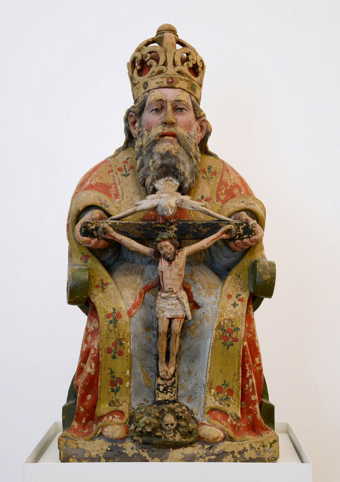
The Christian doctrine of the Trinity defines God as three consubstantial persons, expressions, or hypostases: the Father, the Son (Jesus Christ), and the Holy Spirit; "one God in three persons". The three persons are distinct, yet are one "substance, essence or nature". In this context, a "nature" is what one is, while a "person" is who one is.
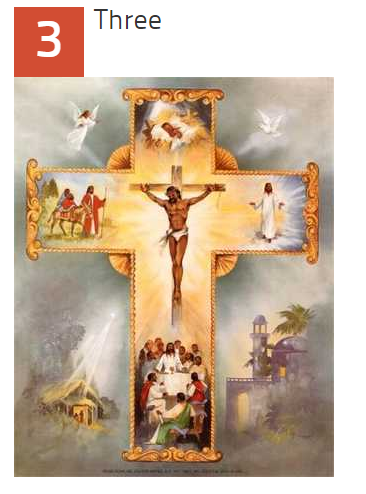
3 is the number of the Trinity, of course, and thus, indicates a wholeness, but it also seems to indicate an inner sanctity. Of Jesus’ 12 Apostles, he loves 3 of them more than the rest. They are Peter, and brothers John and James. It is understood that because they had strong faith in Jesus, he liked them more than the other 9. They were allowed to witness his Transfiguration, another example of 3: he suddenly stood talking in bright white clothing with Moses and Elijah.
Samuel is called by the Lord 3 times before he realizes it and answers. Satan tempts Jesus 3 times before giving up. It is on the third day of creation that Earth is made. The placard on the Cross is written in 3 languages. Jesus raised 3 people from the dead, Lazarus, a widow’s son, and the daughter of a man named Jairus.
There are 3 angels named in the Bible: Michael, Gabriel, and Lucifer. Jesus was about 33 when he died. He was set up on the cross at the third hour of the day, and lasted until the ninth. He rose from the dead on the third day, just as Jonah was in the belly of a great fish 3 days. Jesus fell under the cross 3 times on the Via Dolorosa.

The Bible uses 40 to denote completion or fulfillment. It is used 146 times throughout both Testaments. It is the traditional Hebrew number for the duration of a trial of any kind, when times are hard and a person’s faith is tested. The Israelites slaved in hard bondage under the Egyptian pharaohs for 400 years, 10 times 40. God forced them to wander in the Wilderness of Sin, throughout the Sinai Peninsula, for 40 years as punishment for their “stiff-necked unbelief.” “Sin,” here, does not denote sinfulness, but the Hebrew word for the Sumerian moon god, from which “Sinai” is derived. Moses was 40 years times 3 when he died, at 120.
Moses was 40 days on Mount Sinai receiving God’s Law, another 40 days on the mountain after the golden calf sin. Elijah, some 300 years later, spent 40 days on the same mountain worshiping God.
There are tons of references to “40 days and 40 nights” throughout the Bible. The most notable are the 40 days and nights of rainfall that caused the Flood of Noah. During this time, the whole world flooded to a depth of some 15 feet above the tallest mountains. It took 375 days for the water to recede.
Jesus fasted for 40 days in the wilderness before being tempted by Satan. Jesus remained on Earth for 40 days after his Resurrection, appearing to the Apostles and teaching them, before ascending to Heaven. At the time of his Ascension, there were about 120 Christians on Earth, or 40 times 3.
It was about 40 years from Jesus’ Ascension to the destruction of Jerusalem, in 70 AD, by the Romans.
In the original Koine Greek, as recorded in the Codices Sinaiticus and Vaticanus, the oldest complete manuscripts of the New Testament (c. 200-250 AD), Jesus utters the word “fulfill” in some variation or other, precisely 40 times throughout the Gospels.
★Psalm 23
In the 23rd Psalm (Greek numbering: Psalm 22) in the Hebrew Bible/Old Testament, the writer describes God as his Shepherd. The text, beloved by Jews and Christians alike, is often alluded to in popular media and has been set to music many times.
George W. Bush: 9/11 Address to the Nation (2001)
America and our friends and allies join with all those who want peace and security in the world, and we stand together to win the war against terrorism. Tonight, I ask for your prayers for all those who grieve, for the children whose worlds have been shattered, for all whose sense of safety and security has been threatened. And I pray they will be comforted by a power greater than any of us, spoken through the ages in Psalm 23: "Even though I walk through the valley of the shadow of death, I fear no evil, for You are with me."
★ Charon
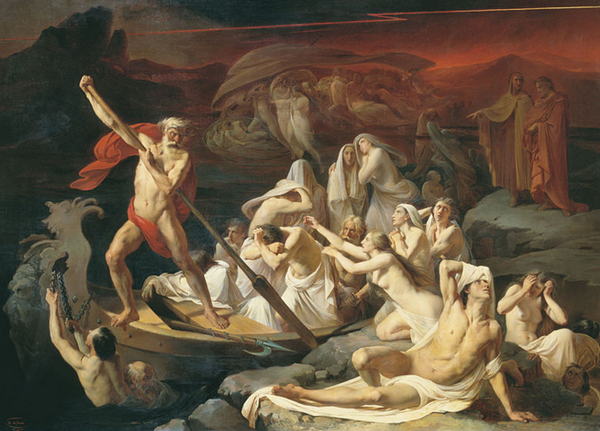
In Greek mythology, Charon or Kharon is the ferryman of Hades who carries souls of the newly deceased across the rivers Styx and Acheron that divided the world of the living from the world of the dead.
✦ Greek underworld:
The Greek underworld, in mythology, was an otherworld where souls went after death and was the Greek idea of afterlife. At the moment of death the soul was separated from the corpse, taking on the shape of the former person, and was transported to the entrance of Underworld. The Underworld itself was described as being either at the outer bounds of the ocean or beneath the depths or ends of the earth. It was considered the dark counterpart to the brightness of Mount Olympus, and was the kingdom of the dead that corresponded to the kingdom of the gods. Hades was a realm invisible to the living and it was made solely for the dead.
Orpheus
Psyche ⇨ They all have visited the underworld, and come back finally.
Odysseus
Aeneas
Free Will
God dignifies us with free will, the power to make decisions of our own rather than having God or fate predetermine what we do.
The Fall
The Fall is the traditional term referring to the first sin of Adam and Eve which brought judgment upon both nature and mankind. Genesis 3:1-24 gives the account of the Fall of humanity. Sin and death entered the world, and humanity has been affected by it ever since. This came about because Adam and Eve disobeyed God's commandment not to eat of the "tree of knowledge of good and evil."
raven
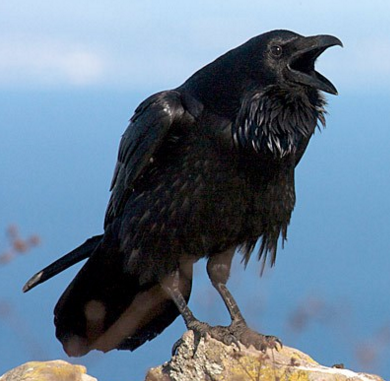
There are many references to ravens in legends and literature. Most of these refer to the widespread common raven. Because of its black plumage, croaking call, and diet of carrion, the raven has long been considered a bird of ill omen and of interest to creators of myths and legends.
Ravens of the Tower of London
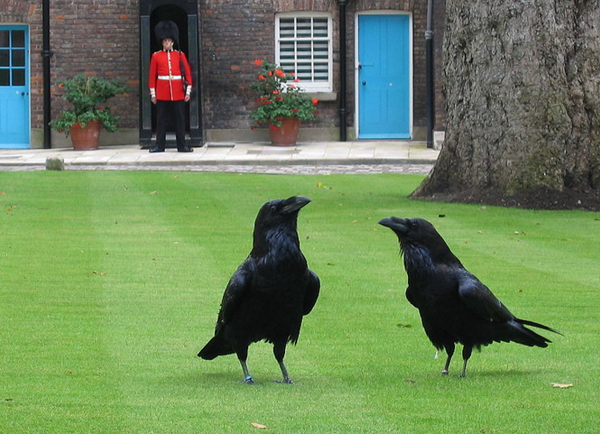
The ravens of the Tower of London are a group of captive common ravens which live in the Tower of London. The group of ravens at the Tower comprises at least eight individuals (six required, with two in reserve). The presence of the ravens is traditionally believed to protect the Crown and the Tower; a superstition holds that "If the Tower of London ravens are lost or fly away, the Crown will fall and Britain with it."
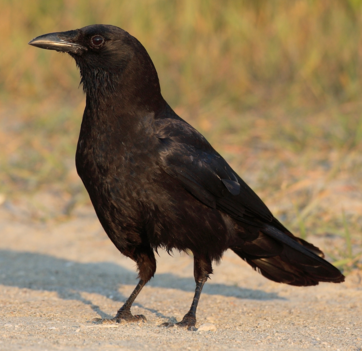
crow
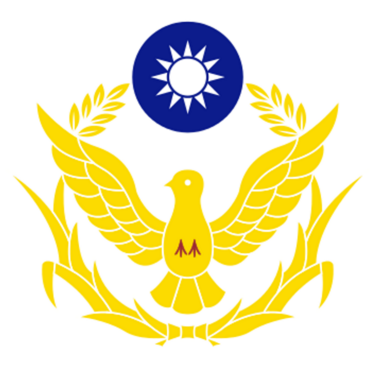
Dove symbolizes "peace."
Sam the Eagle
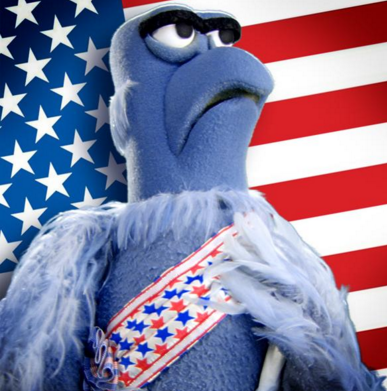
Sam the Eagle is an American eagle who feels his species and role as national symbol have placed certain responsibilities upon his shoulders. He has taken it upon himself to promote and protect wholesome American morals and values, and he works behind the scenes of The Muppet Show as self-appointed censor and advocate of cultural, educational acts such as Wayne and Wanda.
限會員,要發表迴響,請先登入


