★ Three Unities in Greek Theater
Theater has its roots in ancient Greece. The Greek philosopher Aristotle studied earlier plays as well as those of his time and developed his rules for the composition of tragedy. Aristotle established these guidelines in his work “Poetics” in the fourth century B.C.E.
Unity of Time
Aristotle proposed that the action of a play should take place within a short period of time, covering no more than twenty-four hours. Real-time performances captured the audience’s attention and created a sense of immediacy. The characters may refer to events outside the time period of the play in order to set the tone and context of the performance. However, ideally, the actual action of the play should be contained within the time limits of the play itself.
Unity of Place
Aristotle contended that plays should take place in only one setting. He felt that moving from one location to another was confusing to the audience and distracted from the plot. The plot, to his way of thinking, was the most important aspect of the performance. Characters, setting and other elements were considered secondary to the strong flow of action leading inevitably to a conclusion.
Unity of Action
Unity of action refers to Aristotle’s contention that a play should contain one central plot or theme and a clear beginning, middle and end. He considered the worst plot to be made up of a string of episodes; it lacked the "cause and effect" that a true plot should have. All scenes within the play should further the plot; digressions should be discouraged. Nothing random or illogical should break up the flow of the action. Aristotle was particularly critical of using divine intervention to extricate characters from their circumstances. This was the practice of having a god appear at the end of the play to sort out the problems created by the actions of the characters or to resolve a situation.
★Tragic Hero
The term hero is derived from a Greek word that means a person who faces adversity, or demonstrates courage in the face of danger. However, sometimes he faces downfall as well. When a hero confronts downfall, he is recognized as a tragic hero or protagonist. Aristotle, the Greek philosopher, characterizes these plays or stories as tragedies in which the main character is a tragic hero, who confronts his downfall due to fate, his mistake or any other social reason.
Aristotle defines a tragic hero as “a person who must evoke a sense of pity and fear in the audience. He is considered a man of misfortune that comes to him through error of judgment” and brings his downfall to evoke the feelings of pity and fear among the audience.
Example :
Oedipus from “Oedipus Rex”
Aristotle has used Oedipus as a perfect example of a tragic hero, as he has hubris that is his pride makes him blind to the truth. He refuses to listen to wise men like Tiresias, who predicts that Oedipus has killed his father, Laius. He is tragic because he struggles against the forces of his fate and pitiable due to his weakness, which arouses fear in the audience. Thus, he is an ideal example of the tragic hero for causing his own downfall, falling from his own estate and facing undeserved punishment.
★ Farce
A farce is a literary genre and the type of a comedy that makes the use of highly exaggerated and funny situations aimed at entertaining the audience. Farce is also a subcategory of dramatic comedy that is different from other forms of comedy, as it only aims at making the audience laugh. It uses elements like physical humor, deliberate absurdity, bawdy jokes and drunkenness just to make people laugh and we often see one-dimensional characters in ludicrous situations in farces.
Example :
Oscar Wilde’s novel, The Importance of Being Earnest, is one of the best verbal farces. Just like a typical farce that contains basic elements like mockery of upper class, disgraceful physical humor, absurdity and mistaken identities, this novel also contains demonstrates these features of a farce. The most absurd thing in this is the fact that Miss Prism commits a blunder by leaving her manuscript in perambulator and instead putting her child into her handbag.
How to Take Great Notes
★ Catharsis
Catharsis refers to an emotional release for the characters in a literary work, or an emotional release for the audience of the work. In Greek, the word catharsis literally means "cleansing". The emotional release that characters or the audience experience during the catharsis can lead to a sense of forgiveness and renewal. Most tragic works of literature end with catharsis.
Example :
In Oedipus Rex, a Greek tragedy, Oedipus unknowingly marries his mother. At the end of the play, when the tragic mistake has been revealed, Jacosta commits suicide and Oedipus gouges his eyes out. Both characters experience release. Jocasta, by seeking release in death; Oedipus by doing penance by gouging out his own eyes.
★ Mimesis
Mimesis is a critical and philosophical term that carries a wide range of meanings, which include imitation, representation, mimicry.
★ strike :
We are on strike. ( n.)
the union voted to strike. (v.)
★ masturbate :
to rub your sexual organs in order to get sexual pleasure
★ declare :
declare war/ peace (on)
★ abstinence :
the practice of avoiding something such as alcohol or sex
⇒ abs- ( 歐巴桑 ) : to forbid
Aristotle
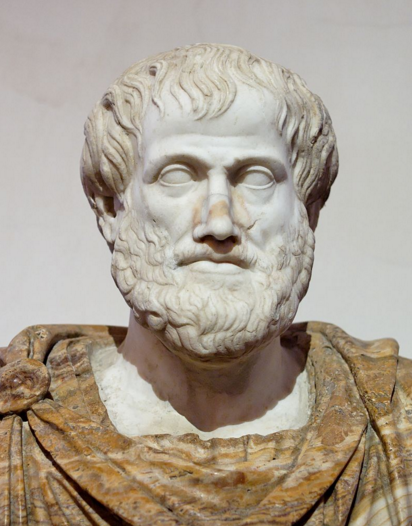
Aristotle was born at Stagirius, a Greek colony on the coast of Thrace. His father was the court physician for the king of Macedonia. When he was 17, Aristotle was sent to Athens to study at Plato's Academy. He stayed at the Academy for 20 years both as a student and then as a teacher.
After Plato died in 347, Aristotle left Athens, eventually ending up in Macedonia, where he became the tutor of Alexander (the Great), son of the Macedonian king. When Alexander became king in 335, Aristotle returned to Athens to establish his own school called the Lyceum. At the Lyceum, discussions were held while the teachers and students walked around the grounds of the school, earning it the name of the "peripatetic", or walking, school.
Aristotle's philosophy stresses biology, instead of mathematics like Plato. He believed the world was made up of individuals (substances) occurring in fixed natural kinds (species). Each individual has built-in patterns of development, which help it grow toward becoming a fully developed individual of its kind. Nature has built into each individual patterns for growth, purpose, and direction.
To organize these patterns, Aristotle introduced the philosophic idea of causality. He believed that each thing or event has more than one "reason" that helps to explain what, why, and where it is. To Aristotle the four causes are: the material cause, what something is made out of; the efficient cause, the source of motion; the formal cause, the species, kind, or type; and the final cause, the full development of an individual or the intended function of an invention. For example, a young lion is made up of tissue and organs (material cause) by its parents who generated it (efficient cause). The formal cause is its species, lion; and its final cause is its instinct and drive to become a mature lion. Aristotle believed that all things could be better understood when its causes were stated in specific terms. He used his causal pattern to organize all knowledge.
Plato
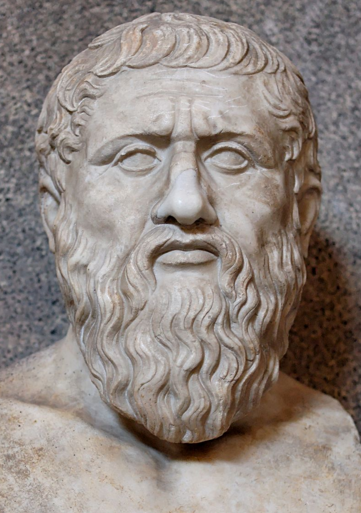
Plato's middle to later works, including his most famous work, the Republic, are generally regarded as providing Plato's own philosophy, where the main character in effect speaks for Plato himself. These works blend ethics, political philosophy, moral psychology, epistemology, and metaphysics into an interconnected and systematic philosophy. It is most of all from Plato that we get the theory of Forms, according to which the world we know through the senses is only an imitation of the pure, eternal, and unchanging world of the Forms. Plato's works also contain the origins of the familiar complaint that the arts work by inflaming the passions, and are mere illusions. We also are introduced to the ideal of "Platonic love:" Plato saw love as motivated by a longing for the highest Form of beauty—The Beautiful Itself, and love as the motivational power through which the highest of achievements are possible. Because they tended to distract us into accepting less than our highest potentials, however, Plato mistrusted and generally advised against physical expressions of love.
Socrates
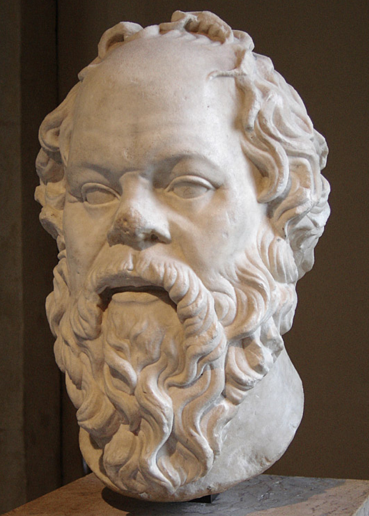
Socrates is one of the few individuals whom one could say has so-shaped the cultural and intellectual development of the world that, without him, history would be profoundly different. He is best known for his association with the Socratic method of question and answer, his claim that he was ignorant (or aware of his own absence of knowledge), and his claim that the unexamined life is not worth living, for human beings. He was the inspiration for Plato, the thinker widely held to be the founder of the Western philosophical tradition. Plato in turn served as the teacher of Aristotle, thus establishing the famous triad of ancient philosophers: Socrates, Plato, and Aristotle. Unlike other philosophers of his time and ours, Socrates never wrote anything down but was committed to living simply and to interrogating the everyday views and popular opinions of those in his home city of Athens. At the age of 70, he was put to death at the hands of his fellow citizens on charges of impiety and corruption of the youth. His trial, along with the social and political context in which occurred, has warranted as much treatment from historians and classicists as his arguments and methods have from philosophers.
★ point of view for The Great Gatsby
First person point of view in which the story is told from the perspective of one of the characters in the narrative; with this point of view the reader is told only what this character knows and observes. Nick Carraway gives the reader his perspective; so, the reader only learns Gatsby's background and history as it is revealed to him by Gatsby, and he learns of the other characters through his interactions with them, or by what he is told. With this point of view, there is a sense of immediacy to the narrative
✦ omniscient :. knowing everything (全知觀點)
限會員,要發表迴響,請先登入


