★Xerox Corporation
Xerox Corporation is a U.S. based global corporation that sells business services and document technology products to businesses and governments of all sizes. Because of its success, the name of the company is used to express the meaning of "photocopy."

xerox copy : a copy made by a xerographic printer
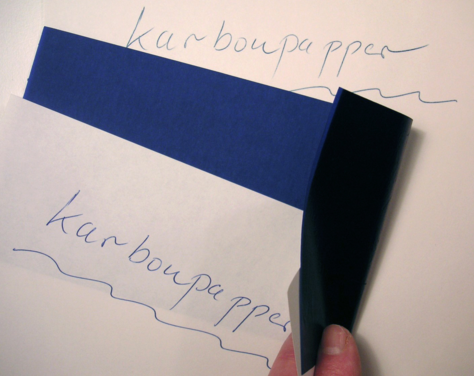
carbon copy : A carbon copy is the under-copy of a document created when carbon paper is placed between the original and the under-copy during the production of a document.
✦With the advent of email, the abbreviation cc or bcc (blind carbon copy) has also come to refer to simultaneously sending copies of an electronic message to secondary recipients.
★ Q-tip
Cotton swabs (American) or cotton buds (British) consist of a small wad of cotton wrapped around one or both ends of a short rod, usually made of either wood, rolled paper, or plastic. They are commonly used in a variety of applications including first aid, cosmetics application, cleaning, and arts and crafts. The cotton swab is a tool invented in the 1920s by Leo Gerstenzang after he attached wads of cotton to toothpicks. His product, which he named "Baby Gays", went on to become the most widely sold brand name, "Q-tips", with the Q standing for "quality". The term "Q-tips" is often used as a genericized trademark for cotton swabs in the USA and Canada.


tulip
Q-tip has similar sound to " tulip."
Although different tulip colors carry distinct meanings - yellow tulips symbolizing cheerful thoughts, white conveying forgiveness and purple representing royalty - a Turkish legend may be responsible for the red tulip's symbolism. The story goes that a prince named Farhad was love struck by a maiden named Shirin. When Farhad learned that Shirin had been killed, he was so overcome with grief that he killed himself - riding his horse over the edge of a cliff. It's said that a scarlet tulip sprang up from each droplet of his blood, giving the red tulip the meaning "perfect love."
(click) 棉花棒、魔鬼沾、立可白的英文?美國人都直接講「品牌名」
Silver Shoes
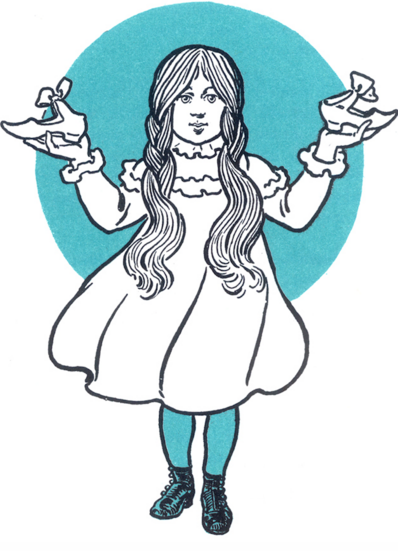
The Silver Shoes are the magical shoes that appear in L. Frank Baum's 1900 novel The Wonderful Wizard of Oz as heroine Dorothy Gale's transport home. They are originally owned by the Wicked Witch of the East but passed to Dorothy when her house lands on the Witch. As gathered from the clues throughout the various books and films, the Silver Shoes will only pass to a new owner if they have physically defeated the previous owner, or the previous owner willingly hands them over.
O Captain! My Captain!
BY WALT WHITMAN
O Captain! my Captain! our fearful trip is done,
The ship has weather’d every rack, the prize we sought is won,
The port is near, the bells I hear, the people all exulting,
While follow eyes the steady keel, the vessel grim and daring;
But O heart! heart! heart!
O the bleeding drops of red,
Where on the deck my Captain lies,
Fallen cold and dead.
O Captain! my Captain! rise up and hear the bells;
Rise up—for you the flag is flung—for you the bugle trills,
For you bouquets and ribbon’d wreaths—for you the shores a-crowding,
For you they call, the swaying mass, their eager faces turning;
Here Captain! dear father!
This arm beneath your head!
It is some dream that on the deck,
You’ve fallen cold and dead.
My Captain does not answer, his lips are pale and still,
My father does not feel my arm, he has no pulse nor will,
The ship is anchor’d safe and sound, its voyage closed and done,
From fearful trip the victor ship comes in with object won;
Exult O shores, and ring O bells!
But I with mournful tread,
Walk the deck my Captain lies,
Fallen cold and dead.
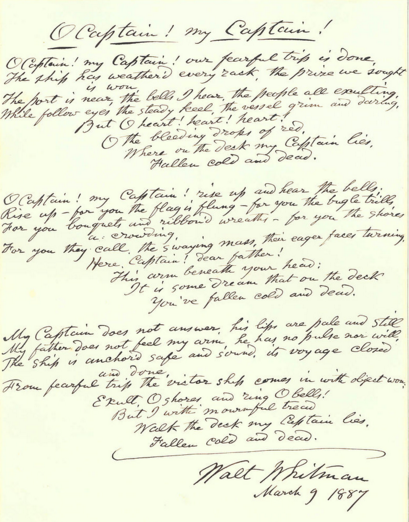
⇗ An 1887 handwritten draft of Whitman's 1865 poem "O Captain! My Captain!
"O Captain! My Captain!" is an extended metaphor poem written in 1865 by Walt Whitman, about the death of American president Abraham Lincoln.
One Art
by Elizabeth Bishop
The art of losing isn't hard to master;
so many things seem filled with the intent
to be lost that their loss is no disaster.
Lose something every day. Accept the fluster
of lost door keys, the hour badly spent.
The art of losing isn't hard to master.
Then practice losing farther, losing faster:
places, and names, and where it was you meant to travel.
None of these will bring disaster.
I lost my mother's watch. And look! my last, or
next-to-last, of three loved houses went.
The art of losing isn't hard to master.
I lost two cities, lovely ones. And, vaster,
some realms I owned, two rivers, a continent.
I miss them, but it wasn't a disaster.
--Even losing you (the joking voice, a gesture
I love) I shan't have lied. It's evident
the art of losing's not too hard to master
though it may look like (Write it!) like disaster.
⇑ Poem from "In her shoes"

★ nemesis v.s. enemy
Nemesis refers to someone or something you can not conquer or overcome; enemy is people or nations that are hostile to each other.
限會員,要發表迴響,請先登入


