Snow White
"Snow White" is a German fairy tale known across much of Europe and is today one of the most famous fairy tales worldwide.
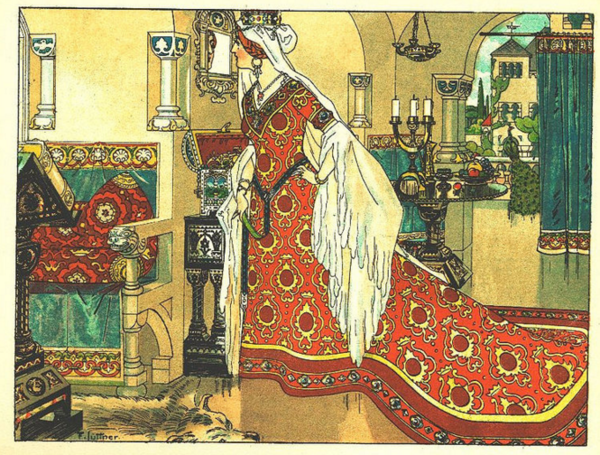
The new queen, Snow White's evil stepmother, possesses a magic mirror, which she asks every morning, "Mirror mirror on the wall, who is the fairest one of all?" The mirror always replies: "My Queen, you are the fairest one of all." The Queen is always pleased with that, because the magic mirror never lies.
⇧ fair :(adj.) (of a woman) beautiful
other meanings as an adjective :
ⓐ(of an idea, guess, or chance) good, but not excellent
ⓑif a situation is fair, everyone is treated equally and in a reasonable way
ⓒa fair guess or idea is reasonable and likely to be correct
e.g. I had a fair idea of what he was going to say next.
the state fair
State fairs began in the nineteenth century for the purpose of promoting state agriculture, through competitive exhibitions of livestock and display of farm products. As the U.S. evolved from a predominantly agrarian to an industrial society in the twentieth century, modern state fairs have expanded to include carnival amusement rides and games, display of industrial products, automobile racing, and entertainment such as musical concerts. Large fairs can admit more than a million visitors over the course of a week or two. The first U.S. state fair was that of New York, held in 1841 in Syracuse, and has been held annually to the present year.
Vanity Fair
Vanity Fair is a magazine of popular culture, fashion, and current affairs.

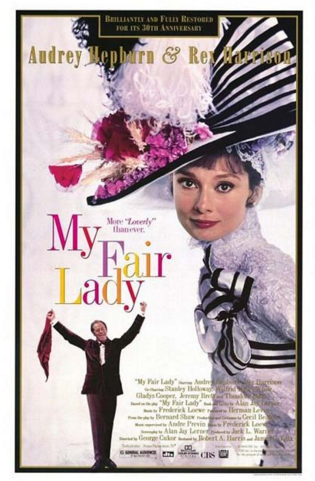
My Fair Lady is a 1964 American musical film.
Pygmalion effect
The Pygmalion effect, or Rosenthal effect, is the phenomenon whereby higher expectations lead to an increase in performance. The effect is named after the Greek myth of Pygmalion, a sculptor who fell in love with a statue he had carved.
A corollary of the Pygmalion effect is the golem effect, in which low expectations lead to a decrease in performance; both effects are forms of self-fulfilling prophecy. By the Pygmalion effect, people internalize their positive labels, and those with positive labels succeed accordingly. The idea behind the Pygmalion effect is that increasing the leader's expectation of the follower's performance will result in better follower performance. Within sociology, the effect is often cited with regard to education and social class.
Studies of the Pygmalion effect have been difficult to conduct. Results show a positive correlation between leader expectation and follower performance, but it is argued that the studies are done in an unnatural, manipulated setting. Scientists argue that the perceptions a leader has of a follower cause the Pygmalion effect. The leader's expectations are influenced by their perception of the situation or the followers themselves. Perception and expectation may possibly be found in a similar part in the brain.
You're So Vain
"Vanity of vanities," says the Preacher, "Vanity of vanities! All is vanity."
“Vanity” here means “futile” (like “in vain”) – not in the sense of obsession with beauty.
BASICALLY: Solomon is telling us the meaning of life is that life has no meaning.
(Solomon was, according to the Bible, a king of Israel and a son of David.)
Bicentennial Man movie trailer
This film follows the 'life' and times of the lead character, an android who is purchased as a household robot programmed to perform menial tasks. Within a few days the Martin family realizes that they don't have an ordinary droid as Andrew begins to experience emotions and creative thought. In a story that spans two centuries, Andrew learns the intricacies of humanity while trying to stop those who created him from destroying him.
★
troop: soldiers on duty in a large group
truce : a short interruption in a war or argument, or an agreement to stop fighting or arguing for a period of time
★ duty: something that you have to do because it is part of your job, or something that you feel is the
right thing to do
✦duty-free :
Duty-free goods are goods bought in special shops in airports, on ships, etc. on which you do not pay government tax
obligation : the fact that you are obliged to do something; something that you
must do
✦ The phrase "debt obligation" is redundant. A debt is money owed to another person or business, and obligation refers to your practical and legal responsibilities to repay the debt. A debt obligation therefore includes any money an individual or business owes to another entity.
responsibility : something that it is your job or duty to deal with
★ propaganda : information, especially false information, that a government or organization spreads in
order to influence people’s opinions and beliefs
protagonist : the main character in a play, film, book, or story
★ paraphrase : to repeat something written or spoken using different words, often in a humorous form or in a simpler and shorter form that makes the original meaning clearer
★ manual : think about "黑手(台)"
(adj.) done with the hands
(n.) a book that gives you practical instructions on how to do something or how to use something,
such as a machine
★ patronage : help or money that is given to a person or organization
Saint Christopher
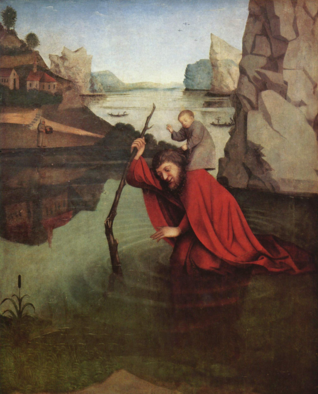
Saint Christopher is venerated by several Christian denominations as a martyr killed in the reign of the 3rd-century Roman Emperor Decius (reigned 249–251) or alternatively under the Roman Emperor Maximinus II Dacian (reigned 308–313). There appears to be confusion due to the similarity in names "Decius" and "Dacian". However his veneration only appears late in Christian tradition, and did not become widespread in the Western Church until the Late Middle Ages, although churches and monasteries were named after him by the 7th century.
His most famous legend, which is mainly known from the West and may draw from Ancient Greek mythology, tells that he carried a child, who was unknown to him, across a river before the child revealed himself as Christ. Therefore, he is the patron saint of travelers, and small images of him are often worn around the neck, on a bracelet, carried in a pocket, or placed in vehicles by Christians.
限會員,要發表迴響,請先登入


