. .
.
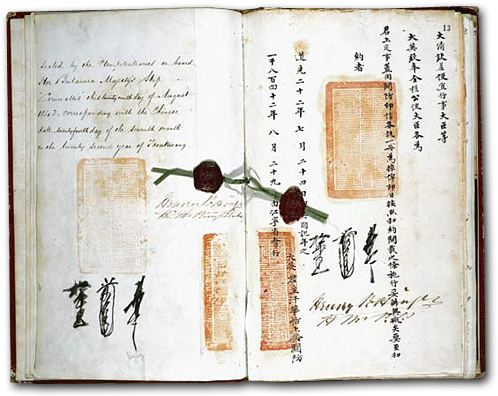
.The Treaty of Nanking signed in 1842, along with a copper case containing the wax seal of Queen Victoria, is displayed at an exhibition of diplomatic archives at the National Palace Museum. (Courtesy of NPM)
.
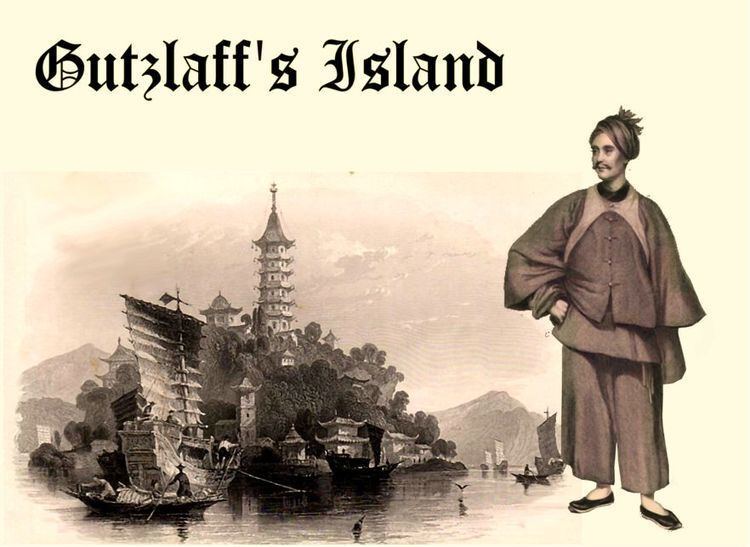

.郭實獵 (Karl Gützlaff)..1840年鴉片戰爭中,他擔任英軍司令官的翻譯和嚮導,以及英軍占領下的定海知縣、寧波知府。他參與及起草《南京條約》。
.....
The Treaty of Nanking, signed between Great Britain and China to end the First Opium War (1839-1842), created a new framework for Chinese foreign relations and overseas trade that would last for nearly a century. The story behind this treaty features a culture clash between two great powers, with incidents of cultural misunderstanding, unappreciated gifts, drug smuggling, bribery, and piracy, as well as fortunes won and lost, millions of pounds of opium destroyed, prayers to the spirit of the Southern Sea, and serious debates over kowtowing. One of the most interesting and yet not widely known documents of the 19th century, the Treaty of Nanking forever changed the course of Chinese history and completely reshaped Chinas future relations with the West. Read in this captivating book about this fascinating time when the West sought to establish a lasting relationship with China, a formidable power in the East.
8. Juli 1803 - Der Missionar, Übersetzer und Spion Karl Gützlaff wird geboren
China zum Christentum bekehren - das will der evangelische Missionar Karl Gützlaff unbedingt. Dafür unterstützt er auch die Briten im Opiumkrieg - als Übersetzer und Spion.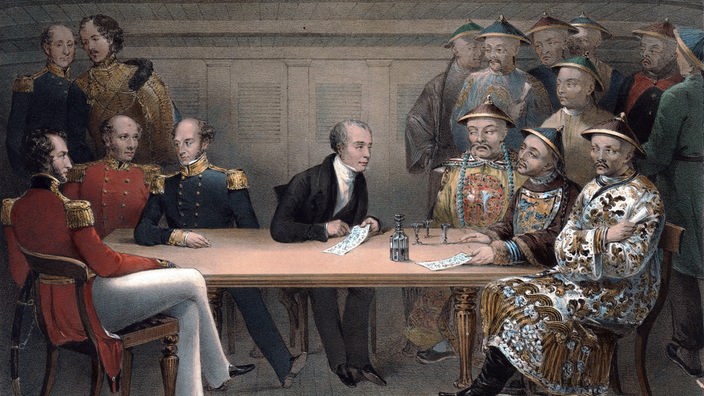
 鴉片戰爭之後.KF.擔任英國人的翻譯官.向大清王朝官員翻譯述說並且起草
南京條文各式各樣文件....
“The Signing and Sealing of the Treaty of Nanking in the State Cabin of H. M. S. Cornwallis, 29th August, 1842” (detail) Painted by Capt. John Platt This famous 1846 engraving commemorates the signing of the first of the unequal treaties in August 1842. In the West, this was widely heralded as a triumph of commerce, international law, and “civilization.” Anne S. K. Brown Military Collection, Brown University Library [1846_TreatyNanking_Brown] |
KF...He was interpreter to the British Plenipotentiary in negotiations during the First Opium War of 1839–42, then magistrate at Ningbo and Zhoushan. He was appointed the first assistant Chinese Secretary of the new colony of Hong Kong in 1842 and was promoted to Chinese Secretary in August of the following year.[ In response to the Chinese governments unwillingness to allow foreigners into the interior, he founded a school for "native missionaries" in 1844 and trained nearly fifty Chinese during its first four years.
.Chinese and English Pages, Treaty of Nanking.
南京條約...
 .
.


..KF. 披者羊皮狄惡魔,假藉傳教士及醫生之名,
實際上是為了幫助英國人查頓在中國境內販售鴉片,
他寫作《1831-1833年在中國沿海三次航行記》一書,詳細記載調查資料,提供給予英國作為鴉片戰爭有關情報.
One of the purposes of these trips was to open China to trade with Britain. While it failed at that, Gützlaffs book, published in 1834, titled Journal of Three Voyages along the Coast of China in 1831, 1832 and 1833 excited interest in expanding trade with China
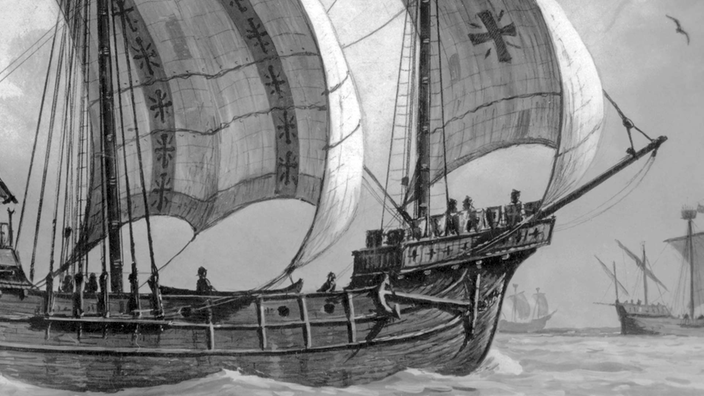
China missionary (and opium). Thus, an "opium trading, gun and gospel-carrying vessel" owned by a British company with a missionary as an interpreter began trading up and down the Chinese coast in violation of Chinese law. In the minds of many Chinese the opium trade and Christianity were linked.
.
郭實獵[,德文名卡爾·弗里德里希·奧古斯特·居茨拉夫(德語:Karl Friedrich August Gützlaff,1803年7月8日—1851年8月9日),另有譯郭士立、普魯士新教傳教士、醫生、探險家和翻譯家。1826年被派到南洋爪哇傳教。精通漢語和閩語、粵語,潮州語和客家語[。其以音譯「郭」為姓氏,在南洋加入福建同安郭氏宗親會,還為自己取筆名叫「愛漢者」。
1827年開始在中國沿海城市布道,入鄉隨俗而蓄假辮、穿華服,用醫術與華人交往,為羅存德的同工。在廣州創辦過近代第一份漢字期刊。因其廣州話日益精進,而取代英國首位來華傳教士馬禮遜,成為英國駐華商務監督的翻譯,參與推動了上海與香港開埠等的變遷。在笫一次鴉片戰爭期間,成為英遠東軍的翻譯、參謀兼嚮導.
《南京條約》談判中擔任英方翻譯,並起草了條約的漢字稿,以有關的角色而受後世非議[。有謠傳稱其曾任香港英治時期的高級官員撫華道,但其實撫華道成立於十九世紀中葉(大概1856年左右),職位設立之日郭實獵早已過世多時,所以郭實獵其實從未擔任此職? 。
.

.鴉片戰爭(1840年~1842年).
《三大恨討清檄文》,展現了當時英國顛倒黑白的洗白技巧。檄文中,英方洋洋灑灑列出三大罪狀:一恨清朝驅逐英商船隻,二恨清朝強佔定海與舟山,而最令人瞠目結舌的「三恨」,則是宣稱鴉片在西洋本是治病的「良好藥材」,是清朝百姓自己吸食成癮,清廷不約束自家子民,反而抄查英商財物,行為「形同倭盜」。.
英軍隨軍顧問、精通中文的傳教士郭實獵(Karl Gützlaff)巧妙利用了當時民間熾烈的滿漢情緒。他在檄文中怒嗆滿清只是遼東女真,趁著明朝動盪篡奪天下,如今英軍是「受天命所歸」,前來替大明朝「克復舊業、犁庭掃穴」。.
. .
.
Gützlaff worked on a Chinese translation of the Bible, published a Chinese-language magazine, Eastern Western Monthly Magazine, and wrote Chinese-language books on practical subjects. In 1840, Gützlaff (under the anglicized name Charles Gutzlaff) became part of a group of four people (with Walter Henry Medhurst, Elijah Coleman Bridgman, and John Robert Morrison) who cooperated to translate the Bible into Chinese
.
Karl Friedrich August Gützlaff[ (8 July 1803 – 9 August 1851), anglicised as Charles Gutzlaff, was a German Lutheran missionary to the Far East, notable as one of the first Protestant missionaries in Bangkok, Thailand (1828) and the first Lutheran missionary to China (1831-1848). He was a colorful "swashbuckling Pomeranian" who combined his prodigious talent as a prolific Christian author and linguist with participation in the illegal opium trade in 1830s China. He was one of the first Protestant missionaries in China to dress in Chinese clothing and was said to be so proficient in Chinese language and culture that he could pass as Chinese. His books were widely read and his adaptation to Chinese culture served as a model for the later work of missionary Hudson Taylor, founder of the China Inland Mission. In recognition of his travels, often illegal by Chinese law, up and down the Chinese coast, he was elected as a member to the American Philosophical Society in 1839.[] Controversial during his life, Gützlaff has continued to be so for historians.
During the First Opium War (1839-1842), Gützlaff served as an interpreter for the British government. Afterwards he became a magistrate in Ningbo and Zhoushan and the Chinese Secretary of the British administration in Hong Kong.0....
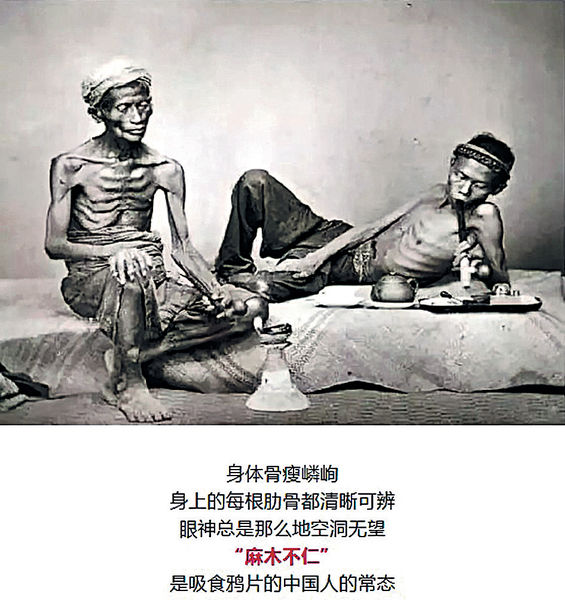
.
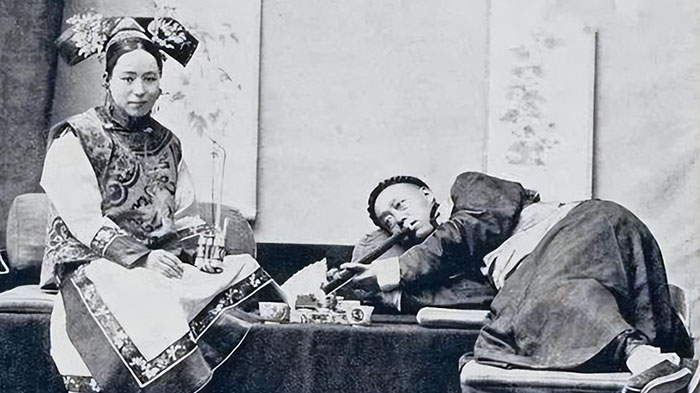
.
.Gützlaffs writing influenced both David Livingstone and Karl Marx. David Livingstone read Gützlaffs "Appeal to the Churches of Britain and America on Behalf of China" and decided to become a medical missionary.[20] Unfortunately, it was 1840, and the outbreak of the First Opium War made China too dangerous for foreigners. So the London Missionary Society sent him to Africa, where (in 1871) Henry Morton Stanley would find him working in Ujiji, Tanzania.[21]
While Gützlaff was fundraising in Europe in 1850, Karl Marx went to hear him speak in London. He also read Gützlaffs many writings, which became sources for Karl Marx articles on China for the London Times and the New York Daily Tribune in the 1840s and 1850s, all of which are anti-imperialist and anti-religion.[


下一則: 哈佛中國史.History of Imperial China
- 捷克布拉格的秋季時節..Prague in Autumn fall colors
- China J-35AE. better than US F-35.
- 中國派遣解放軍出兵俄羅斯協助“掃雷”,清理烏克蘭 戰場 ? China has dispatched PLA troops to Russia to assist in mine clearance and clearing the battlefield in Ukraine.
- 2026.烏茲別克購買中國24 架 J-10CE. 成軍.Uzbekistan purchases 24 J-10CE fighter jets from China
- 土耳其,沙烏地阿拉伯,巴基斯坦組織「麥加防衛聯盟」為什麼? The Mecca Defense Alliance .
- 2026.Black and white.001
限會員,要發表迴響,請先登入


