賀中國海軍航空母艦CV-18,福建號正式服役.
..
CHINA CV-18 ON DUTY..
.揚我國威 壯我軍威
.
https://youtu.be/5B6Be2gIdis?si=9qxHnV-AXdr1HXQC
.CHINA NAVY SO GREAT RISE UP.
.

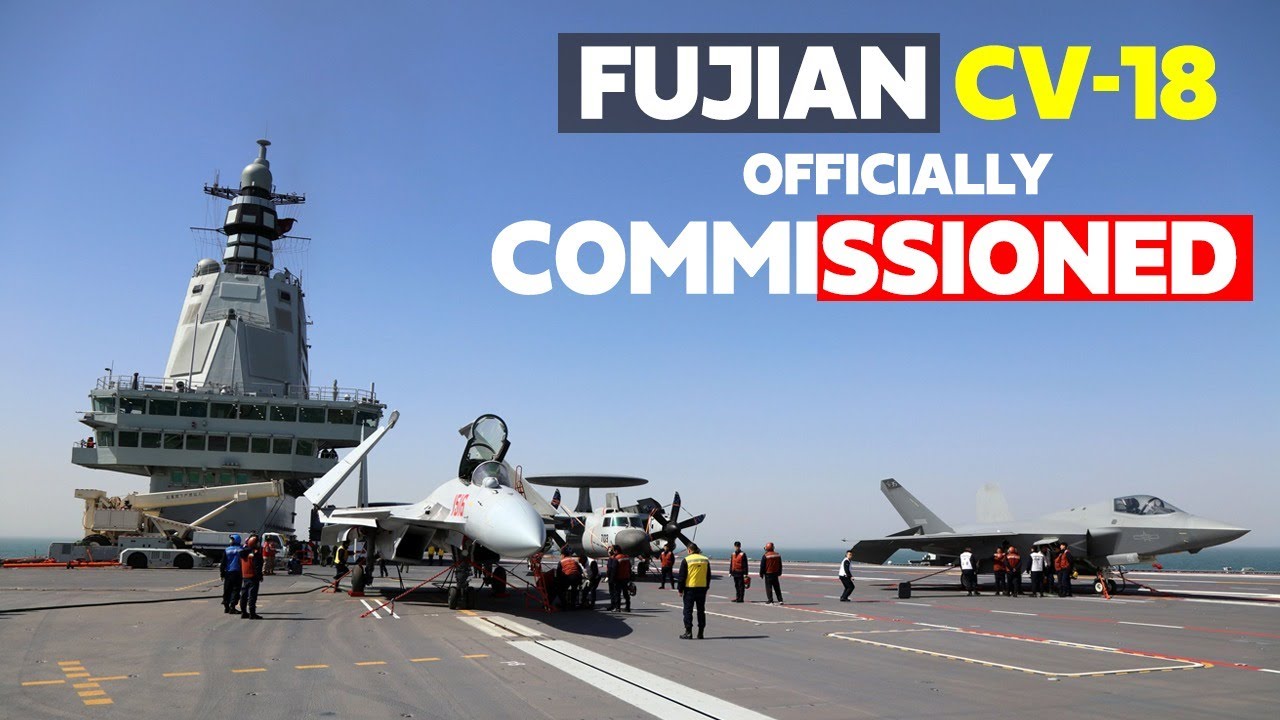
China commissions Fujian aircraft carrier..
China has commissioned its third and largest aircraft carrier, Fujian (CV-18), in a ceremony on Hainan Island.
Fujian is the largest operational aircraft carrier in the Peoples Liberation Army Navy (PLAN) and is also the first to be equipped with an electromagnetic aircraft launch system (EMALS). The vessel was commissioned at a naval dockyard in Sanya on 5 November, with Chinas Ministry of National Defense (MND) formally announcing the event on 7 November.
The carrier, which was laid down in 2016 and launched in 2022, has conducted at least nine sea trials since May 2024. Fujian s EMALS catapult makes it capable of operating a variety of new naval aircraft, including the Xian KJ-600 ‘Sea Plate airborne early warning and control (AEW&C) aircraft..
The Chinese Navy has commissioned the aircraft carrier Fujian, the most advanced in its fleet.
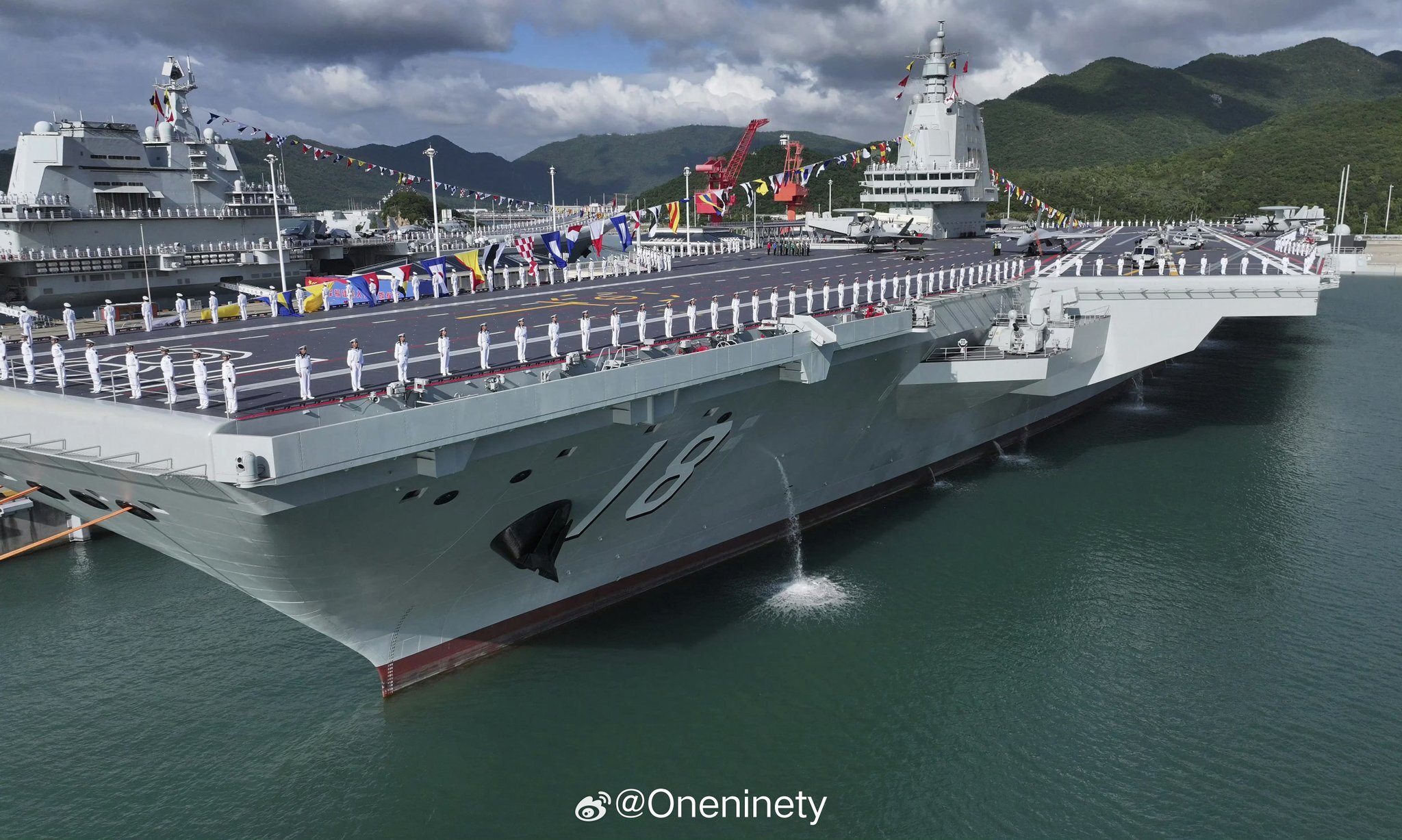
.The People’s Liberation Army Navy (PLAN) of China has officially commissioned its third aircraft carrier, the Fujian (CV-18), during a ceremony held on Wednesday at the Sanya Naval Base on Hainan Island. The event was presided over by President Xi Jinping, who also serves as General Secretary of the Communist Party of China’s Central Committee and Chairman of the Central Military Commission.
.
A new milestone in Chinese naval modernization
Launched in June 2022 by the Jiangnan Shipyard in Shanghai, the Fujian is named after the province facing Taiwan. The vessel displaces over 80,000 tons and is China’s first aircraft carrier to abandon the ski-jump launch system of its predecessors in favor of electromagnetic catapults (EMALS) and advanced arresting gear.
Military expert Zhang Junshe described the Fujian’s commissioning as “a symbol of the transformation of the Chinese Navy from coastal defense to far-sea operations.” Speaking to the Global Times, Zhang said the carrier marks “the beginning of the era of electromagnetic catapult carriers,” introducing three key advancements: the ability to launch heavier aircraft with more fuel and weapons, an increased sortie rate, and an integrated oceanic combat system combining offense and defense.
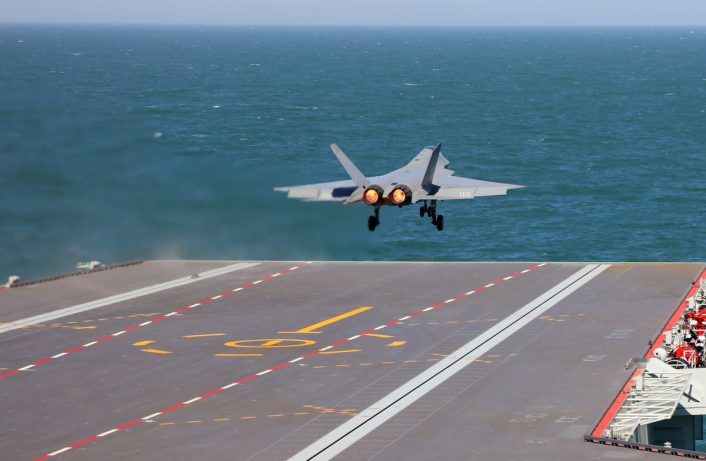
.Since May 2024, the Fujian has undergone multiple sea trials. In September, the PLAN confirmed successful catapult-assisted takeoffs and arrested landings by J-15T and J-35 fighters, as well as the KJ-600 airborne early warning aircraft. These, along with the J-15DT electronic warfare variant, will make up the ship’s carrier air wing.
. .A high-profile ceremony
The commissioning event brought together senior civilian and military officials. According to state media, the Shandong (CV-17) and a Type 075 amphibious assault ship were also present at Sanya Naval Base, underscoring China’s expanding naval power.
The Fujian now joins the PLAN’s Southern Theater Command Fleet (STC), a key region for South China Sea operations. Zhang Junshe noted that, like the Shandong, the Fujian is likely to be permanently based in Sanya, enabling a dual-carrier group in the area. “This will enhance oceanic defense operations, air and sea control, as well as land-attack and island-support missions,” he explained.
Zhang added that the simultaneous presence of both carriers in the southern theater “will exert a strategic deterrent effect on ‘Taiwan independence’ forces and on certain countries with hostile intentions toward China.”
.
.Technological innovation and expanded capabilities
Military analyst Song Zhongping described the Fujian as “China’s new-generation aircraft carrier,” highlighting its leap from ski-jump to electromagnetic catapult technology without adopting steam catapults. According to Song, this innovation “greatly improves the ship’s performance and capabilities, showcasing some of China’s most advanced technological achievements.”
.Song added that, despite its official commissioning, the Fujian must still undergo “real combat and confrontation testing” before reaching full operational capability.
Compared with previous STOBAR (Short Take-Off But Arrested Recovery) carriers, the Fujian represents a qualitative leap. It is expected to spend the next few years achieving full readiness as its launch and recovery systems, supply chains, weapons, and operational procedures are fully validated.
In addition to its new carrier-based fighters, the Fujian’s air wing will include Z-20 helicopters in utility and anti-submarine variants, enhancing anti-submarine warfare and transport capabilities.
Power projection and the future of the fleet
With three operational carriers, China consolidates its position as the world’s second most powerful navy by number and capability, behind only the United States. Chinese experts note that this number merely meets the PLAN’s minimum operational requirements, as one carrier is typically in maintenance, one in training, and one on active deployment.
“In the future, China will need to build more aircraft carriers to safeguard its sovereignty, security, and development interests,” Zhang Junshe stated.
International reports indicate that a fourth carrier is already under construction at Dalian Shipyard. Foreign media suggest it could be China’s first nuclear-powered carrier, although Defense Ministry spokesperson Zhang Xiaogang said in September that he was “not aware of the specific situation.”

.Despite already being the world’s second most powerful navy, China’s PLAN acknowledges that it is only now meeting its basic operational needs. Its strategy extends beyond deterrence—it is one of geopolitical power projection beyond its coastal waters.
During the military parade marking the 80th anniversary of Victory Day (the liberation from Japanese occupation in World War II), China showcased a wide range of weaponry and vehicles, particularly ballistic missiles. These systems, along with its air and ground forces, are suited for coastal defense, while its aircraft carriers project Chinese influence beyond the “first” and “second island chains” under strong U.S. influence, and into the deeper Pacific Ocean.
.A historic leap in PLAN modernization
The Fujian’s commissioning comes two decades after the Liaoning—originally the unfinished Soviet carrier Varyag—was towed to Dalian Shipyard for refitting. Since then, the Chinese Navy has evolved from operating a single training platform to fielding a modern carrier fleet capable of global power projection.
Expert Wang Yunfei emphasized that Chinese naval task forces now possess “strong anti-ship, air defense, and anti-submarine capabilities,” supported by hypersonic missiles launched from ships and submarines. According to him, this “gives China’s carrier strike groups a lethal edge over potential adversaries while strengthening national maritime defense.”
With the Fujian now in service, the PLAN reaches a new technological and operational threshold. Although years of training and testing still lie ahead, the ceremony in Sanya cements China’s status as a global naval power and marks another step in its long-term military modernization strategy toward the mid-21st century.
.
.
.
https://youtu.be/OSRl_SjnwEU?si=Non3hIsAId2hVXTf
.
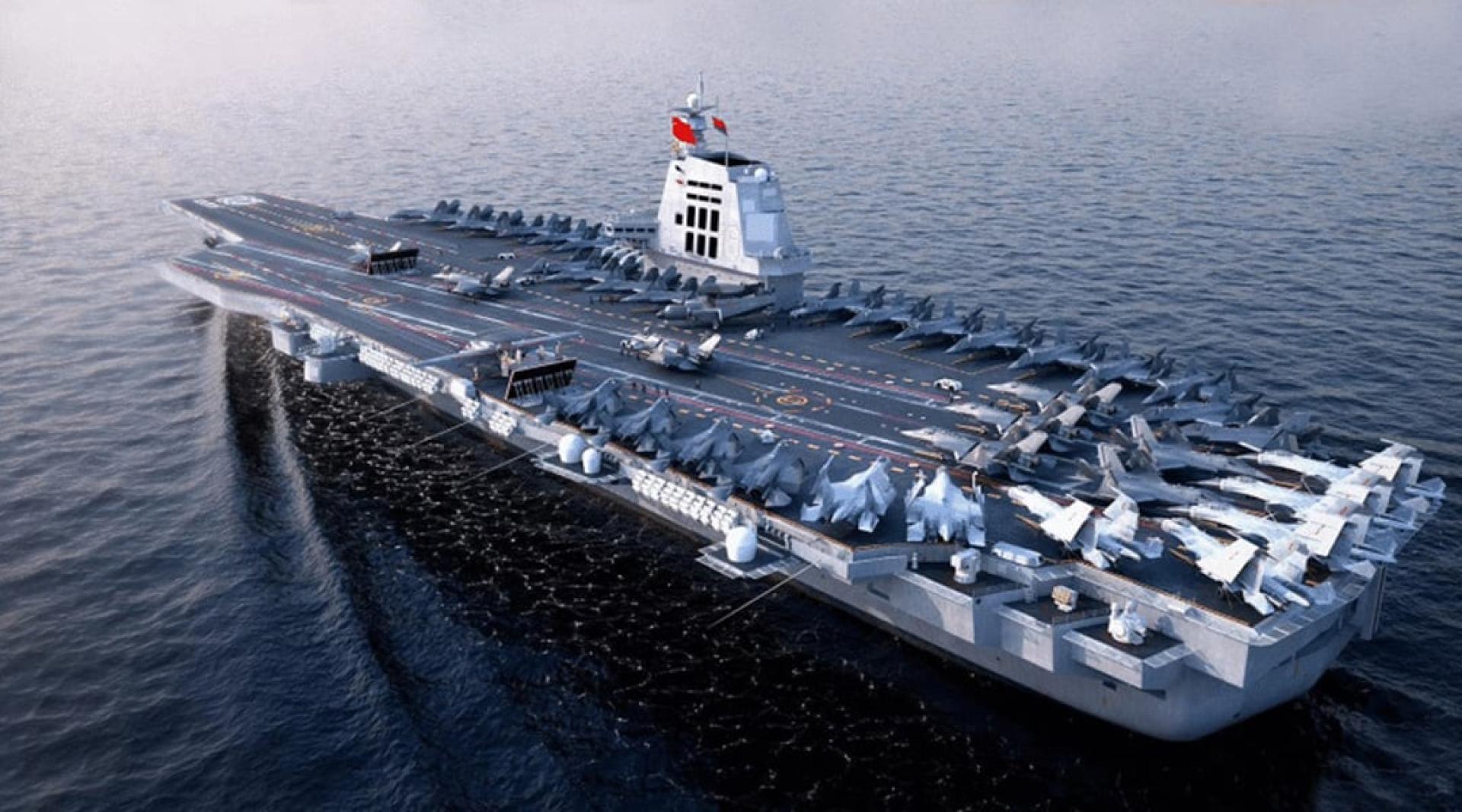
China Commissions the Fujian, Bringing CATOBAR Capability to PLAN Fleet.
.
.
China commissioned its third aircraft carrier, the Type 003 Fujian (CV-18), during a ceremony on Nov. 5, 2025, marking a major milestone in the PLAN’s carrier aviation development.
China officially announced the commissioning of the Type 003 Fujian aircraft carrier on Nov. 7, 2025. The event, which took place on Nov. 5, was attended by senior political and military leadership including Chairman Xi Jinping, and formally placed the ship into active service following nearly three years of pier-side work, systems testing, and sea trials.

https://youtu.be/uZgmVONG22c?si=3xpknXJs9DlET5Zl
.


限會員,要發表迴響,請先登入


