
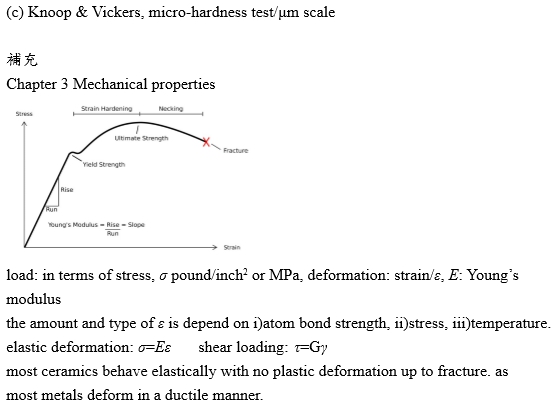
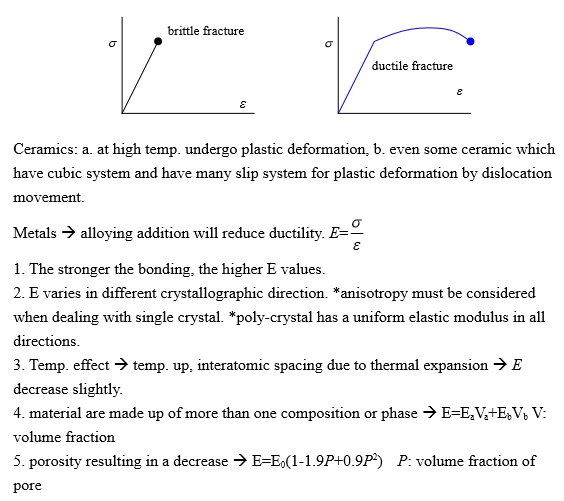
機械性質: 拉伸試驗tensile test
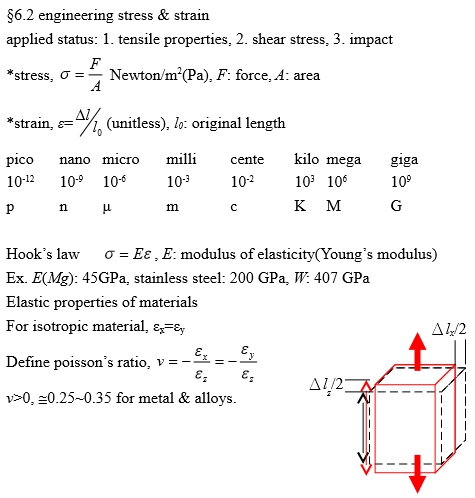
工程應力σ =P/A₀, 工程應變δ=(l-l₀)/l₀=Δl/l₀
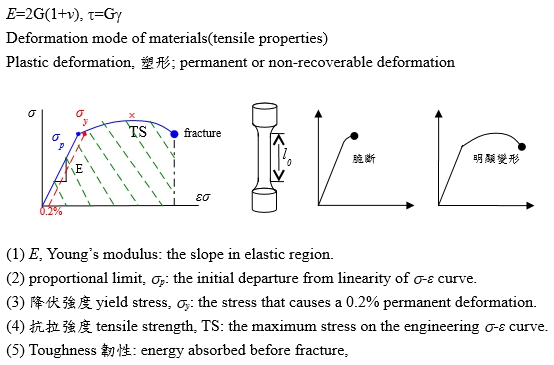
P-Δl curve與σ-δ curve視為相同, engineer stress-strain curve
0e: elastic reversible deformation, proportional limit at e point.
ebf: irreversible plastic deformation, partial recovery+residual strain by unload and reload test → work hardening, UTS(Ultimate Tensile Strength) at b point and start necking after b point.
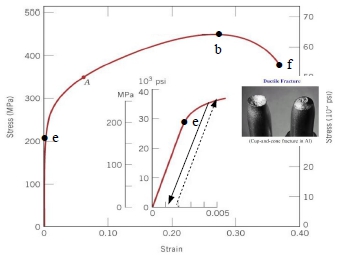
Stress strain diagram of low-C steel:
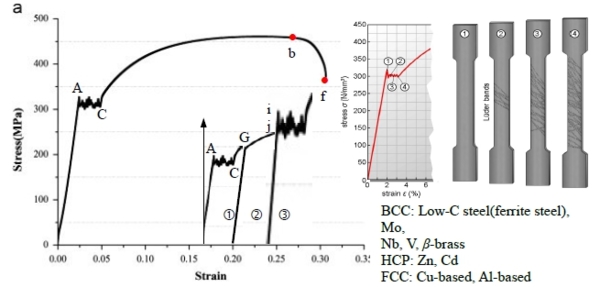
point A: upper yield point, Lüders band開始出現
point C: lower yield point, Lüders band延伸整個試片
Lüders band: 金屬加工時表面應變的巨觀現象,可用temper roll等前加工造成over-strain消除Lüders band
(2)over-straining: unload→retest immediately, yielding 消失
(3)strain-aged hardening: yielding 重現
blue brittle: Serrated stress strain curves in plain carbon steel in which discontinuous yielding
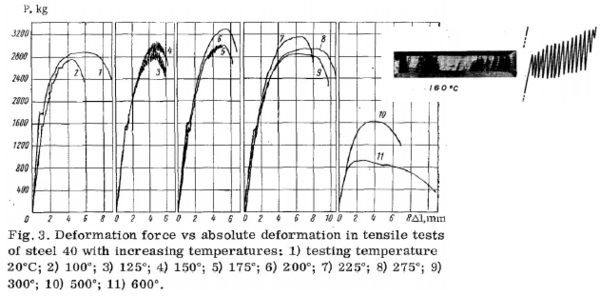
appears in the temperature range 500 to 650 K.
• Strain ageing increases yield point but lower ductility.
• Strain ageing is also associated with serrated stress-strain curves or repeated yielding, due to high speed of diffusion of solute atoms to catch and lock dislocations.
• This dynamic strain ageing is also called Portevin-LeChatelier effect.
During this blue brittleness region, steels shown
• Decreased tensile ductility. • Decreased notched-impact resistance. • Minimum strain rate sensitivity.
Note: This is just an accelerated strain aging by temperature.
雜質原子的影響: e.g. 肥粒鐵中的碳/氮原子會阻止strain anneal處理的晶粒成長,經過脫碳後,晶粒成長變快!表示碳/氮原子累積在晶界上,使晶界移動困難的效果
相同的機制也可解釋yield point的現象,例如: 將肥粒鐵作700℃, wet-H₂退火, strain-aging hardening 的效果就消失了!
Yielding mechanism: 應變由差排移動引起,差排有應變能造成的應力場,會吸引solute atoms聚集在差排附近,形成一種”solute atmosphere”,藉以降低差排的應變能. Upper yield point此應力為差排克服 solute atmosphere包圍下的能障,成為自由移動的差排,所施的應力; lower yield point是推動自由移動的差排所施的外力
包圍在差排附近的 solute atmosphere,外力使差排脫離其束縛,要再讓差排受到包圍,需靠擴散使solute atoms重新聚集到差排附近形成atmosphere,所以時間與溫度是影響solute atoms擴散的主要變數, e.g. blue brittle.
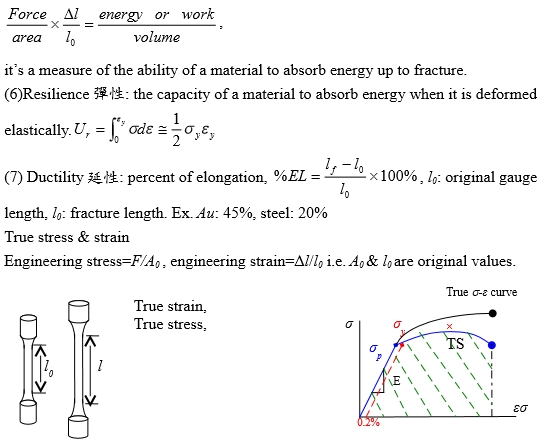
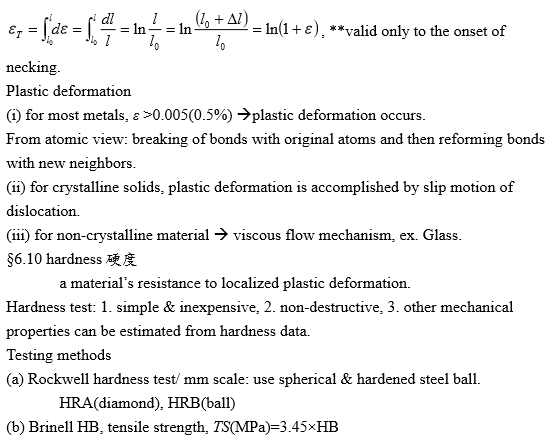
True stress, σₜ=F/A; true strain, ϵₜ=∫ₗ₀ₗdl/l=ln(l/l₀)=ln(1+δ) i.e. engineering strain, δ=(l-l₀)/l
true stress-strain curve vs. engineering stress-strain curve
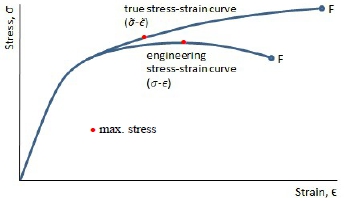
after necking, true strain > eng. strain, and stress does, too.
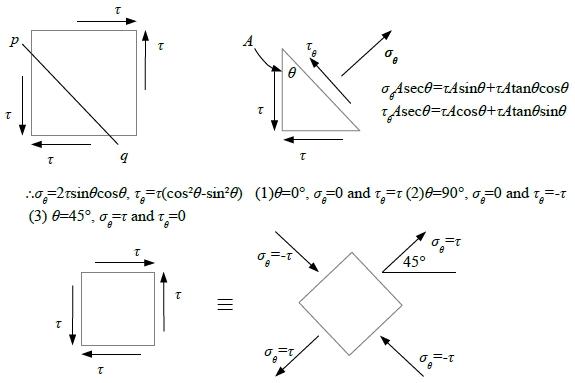
Shear stress
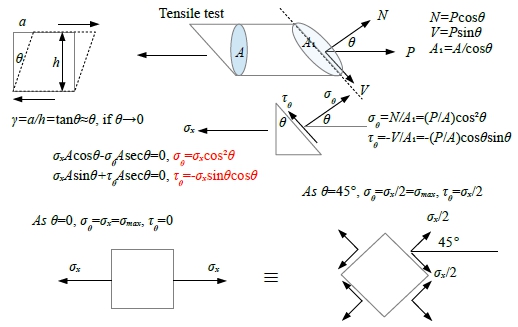
Pure shear in surface element of torsion test
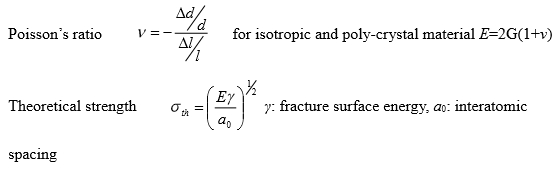
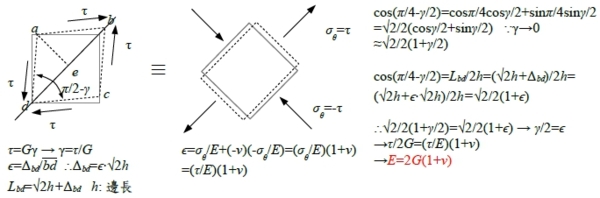
poisson ratio, ν=ϵₗₐₜₑᵣₐₗ/ϵₐₓᵢₐₗ
dislocation theory
cross slip: 只有screw dislocation可以參與移動
差排不會終止於晶體內部,會形成封閉曲線,否則終止於晶體表面或晶界
差排分解: b₁→b₂+b₃ 差排應變能降低才有利於分解
e.g. a/2[011]=a/6[121]+a/6[1 12], b₁²=(a/2)²[0² +1² +1²]=a²/2, b₂²=(a/6)²[1²+2²+1²]=a²/6, b₃²=(a/6)²[1²+1²+2²]=a²/6 ⸫ b₁²> b₂²+ b₃² 可分解
b與原子最密堆積方向平行 是最小能量 差排能~ b²
完整差排 → 部分差排+疊差 ∆G<0
FCC: slip system {111}<110> Shockley partial dislocation
相同位移 b₁=b₂+b₃,但是差排能 b₁²> b₂²+ b₃²利於分解
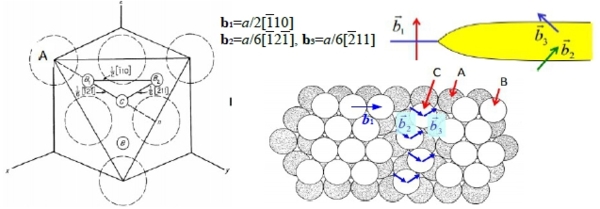
b₂, b₃稱為Shockley partial dislocation,有特定滑移面限制,不能做cross slip, 除非合併完整差排; 間距是stacking fault的寬度,寬度與疊差能成反比
e.g. IA metals易做cross slip, stacking fault width窄,容易緊縮產生cross slip. Cu的疊差寬度大,難以緊縮產生cross slip.
Frank partial dislocation: 被疊差釘住無法移動,是固定差排(sessile dislocation). 只能藉vacancy diffusion做climb.
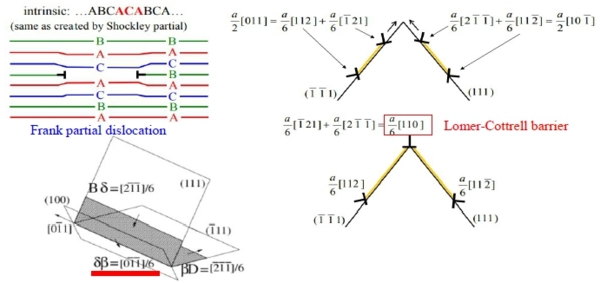
Lomer-Cottrell barrier: 新差排a/6[110]由shockley partial dislocation合併,平行於{111}平面的交叉線,位於(100)平面的edge dislocation, 但b不在緊密堆積平面,是一個固定差排(sessile dislocation)


