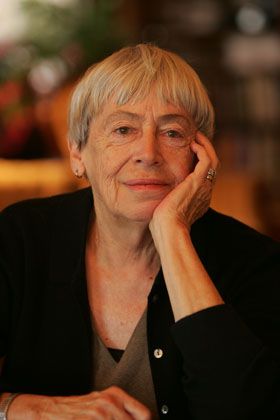
Ursula Kroeber Le Guin is an American author of novels, children's books, and short stories, mainly in the genres of fantasy and science fiction. She has also written poetry and essays. First published in the 1960s, her work has often depicted futuristic or imaginary alternative worlds in politics, the natural environment, gender, religion, sexuality and ethnography. She influenced such Booker Prize winners and other writers as Salman Rushdie and David Mitchell – and notable science fiction and fantasy writers including Neil Gaiman and Iain Banks. She has won the Hugo Award, Nebula Award, Locus Award, and World Fantasy Award, each more than once. In 2014, she was awarded the National Book Foundation Medal for Distinguished Contribution to American Letters. Le Guin has resided in Portland, Oregon, since 1959.
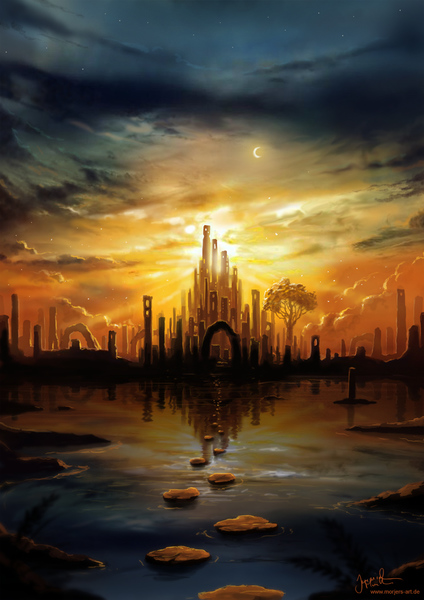
Utopia
A utopia is an imagined community or society that possesses highly desirable or nearly perfect qualities. Utopian ideals often place emphasis on egalitarian principles of equality in economics, government and justice, though by no means exclusively, with the method and structure of proposed implementation varying based on ideology. According to Lyman Tower Sargent "there are socialist, capitalist, monarchical, democratic, anarchist, ecological, feminist, patriarchal, egalitarian, hierarchical, racist, left-wing, right-wing, reformist, free love, nuclear family, extended family, gay, lesbian, and many more utopias". The word was coined by Sir Thomas More from the Greek language for his 1516 book Utopia (in Latin), describing a fictional island society in the Atlantic Ocean. The term has been used to describe both intentional communities that attempt to create ideal societies, and the imagined societies portrayed in fiction. Alternative views on structural and qualitative attributes of society have spawned other concepts, most prominently dystopia.
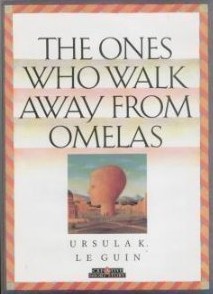
"The Ones Who Walk Away from Omelas"
It is a 1973 plotless, short, descriptive work of philosophical fiction, popularly classified as a short story, by Ursula K. Le Guin. With deliberately both vague and vivid descriptions, the narrator depicts a summer festival in theutopian city of Omelas, whose prosperity depends on the perpetual misery of a single child.

Elysium (極樂世界)
In the year 2154, two classes of people exist: the very wealthy, who live on a pristine man-made space station called Elysium, and the rest, who live on an overpopulated, ruined Earth. Secretary Delacourt, a government official, will stop at nothing to enforce anti-immigration laws and preserve the luxurious lifestyle of the citizens of Elysium. That doesn't stop the people of Earth from trying to get in by any means they can. When unlucky Max is backed into a corner, he agrees to take on a daunting mission that, if successful, will not only save his life but could bring equality to these polarized worlds.
限會員,要發表迴響,請先登入


