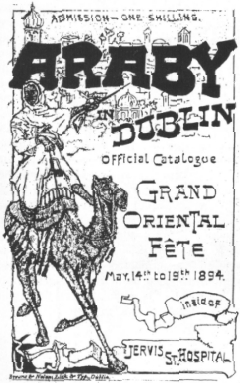
"Araby" is a short story by James Joyce published in his 1914 collection Dubliners.
PLOT
The little boy lives with his aunt and uncle on a dead-end street in Dublin, in a house formerly occupied by a now deceased priest. The boy is impressed and somewhat mystified by the moldy books—a historical romance, a pious tract, and a detective autobiography—and other reminders of the previous tenant.
The action of the story begins with the children’s games, played in the lanes and backyards of the neighborhood during the winter twilight. These games end when the sister of one of the boys—named Mangan—calls her little brother in to his tea. The image of this girl standing in the lighted doorway so fixes itself in the boy’s imagination that he begins to pursue her shyly in the street. Even in the bustle of the weekly grocery shopping, he carries with him a feeling about her that amounts to something like mystical rapture.
Then, one day, while the other little boys are playing, she asks him if he is going to a bazaar, named Araby. She is unable to go because of religious activities at her school, but he undertakes to go and bring her a gift instead. This brief conversation and the prospect of the trip to the bazaar causes the boy to lose concentration on his lessons and regard his playmates with disdain.
The Saturday of the bazaar is acutely agonizing for the boy. He has to wait all day long for his uncle to come home and give him the required pocket money. He withdraws from play and wanders through the upper empty rooms of the house, dreaming of the girl. His apprehension during suppertime is compounded by the chatter of a visiting woman. Finally, at nine o’clock, his uncle arrives home, somewhat drunk, for his dinner. He greets the boy’s anxious reminder of his trip with some patronizing cliches.
When he sets out at last, the boy finds that he is alone on the special train arranged for the bazaar, and finally arrives there at 9:50 p.m. In his haste, he pays the adult fee at the turnstile, only to find that the bazaar is just about to close and the day’s take is being counted. Hesitantly, he approaches one of the few stalls still open, one selling pottery. The young lady in charge of this stall pauses momentarily in her flirtatious banter with two young men to attend to the boy’s diffident interest in her wares. He is so put off by all his disappointments and her tone of voice, however, that he at once decides not to buy anything. Instead, he simply stands there in the middle of the darkening bazaar, incensed at the betrayal of his hopes and the shattering of his illusions.
Romantic elements
"Araby" contains many themes and traits common to Joyce in general and Dubliners in particular. As with many of the stories in the collection, "Araby" involves a character going on a journey, the end result of which is fruitless, and ends with the character going back to where he came from. "Eveline" is just one other story in Dubliners to feature a circular journey in this manner. Also, the narrator lives with his aunt and uncle, although his uncle appears to be a portrait of Joyce's father, and may be seen as a prototype for Simon Dedalus of A Portrait of the Artist as a Young Man and Ulysses. The scorn the narrator has for his uncle is certainly consistent with the scorn Joyce showed for his father, and the lack of "good" parents is pertinent.
In "The Structure of Araby," Jerome Mandel notes the shared plot archetypes between “Araby” and traditional medieval romantic literature, positing that Joyce deliberately “structured with rigorous precision upon a paradigm of medieval romance.”
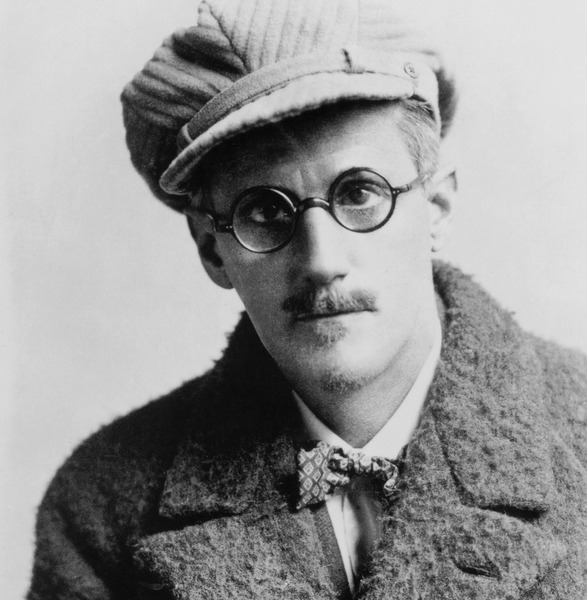
James Augustine Aloysius Joyce was born on 2 February 1882 to John Stanislaus Joyce and Mary Jane "May" Murray, in the Dublin suburb of Rathgar. He was baptized according to the Rites of the Catholic Church in the nearby St Joseph's Church in Terenure on 5 February by Rev. John O'Mulloy. His godparents were Philip and Ellen McCann. He was the eldest of ten surviving children; two of his siblings died of typhoid.
His father's family, originally from Fermoy in Cork, had once owned a small salt and lime works. Joyce's father and paternal grandfather both married into wealthy families, though the family's purported ancestor, Seán Mór Seoighe (fl. 1680) was a stonemason fromConnemara.In 1887, his father was appointed rate collector (i.e., a collector of local property taxes) by Dublin Corporation; the family subsequently moved to the fashionable adjacent small town of Bray 12 miles (19 km) from Dublin. Around this time Joyce was attacked by a dog, which engendered in him a lifelong cynophobia. He also suffered from astraphobia, as a superstitious aunt had described thunderstorms to him as a sign of God's wrath.
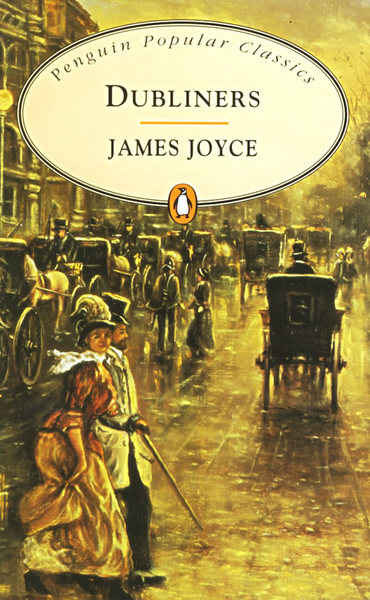
Dubliners
Joyce's Irish experiences constitute an essential element of his writings, and provide all of the settings for his fiction and much of its subject matter. His early volume of short stories, Dubliners, is a penetrating analysis of the stagnation and paralysis of Dublin society. The stories incorporate epiphanies, a word used particularly by Joyce, by which he meant a sudden consciousness of the "soul" of a thing.
限會員,要發表迴響,請先登入


