Explanation of technical points of integrated stepper motors
2024/12/24 17:06
瀏覽229
迴響0
推薦0
引用0
1.Definition of integrated stepper motors
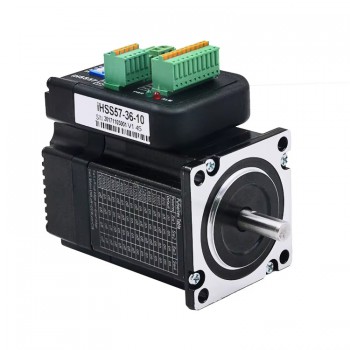
Integrated stepper motors are motors that integrate the control circuit and the motor body, with the advantages of precise control, accurate positioning, high efficiency and energy saving. It controls the movement of the motor through digital signals, usually using a fully digital control method, and controls the speed and direction of rotation of the motor by sending pulse signals.
2.Structural features of integrated stepper motors
1.Integrated design: The control circuit and the motor body are integrated together, occupying a small space, and convenient for installation and maintenance.
2.High-precision sensor: A high-precision sensor is used to detect the position and speed of the motor in real time to ensure the accuracy and stability of the motor.
3.High efficiency and energy saving: The use of digital control can effectively save energy and improve the efficiency and life of the motor.
4.Self-protection function: Built-in overcurrent protection, overheating protection and other safety protection functions can effectively prevent the motor from being damaged by external factors.
3.Operation mode of integrated stepper motors
1.Full-step operation: This is the simplest operation mode of stepper motors. In full-step operation mode, each step corresponds to a complete electrical pulse signal, and the step angle is the largest. Due to the large step angle, the accuracy of full-step operation is relatively low, and it may generate large vibration and noise when running at high speed.
2.Half-step operation: In order to improve accuracy and reduce noise, half-step operation can be used. In half-step operation mode, after receiving an electrical pulse signal, the motor will first rotate half a step, and then rotate half a step again when the next pulse signal arrives, thereby completing a complete step angle. This method makes the motor rotate smoother and effectively reduces noise and vibration, but requires additional control signals and calculations, which may increase the complexity and cost of the system.
3.Micro-step operation: This is a more sophisticated stepper motor control method. In micro-step operation mode, after receiving an electrical pulse signal, the motor will rotate an angle smaller than half a step. By continuously controlling multiple micro-step angles, high-precision rotation of the motor can be achieved.
4.Technical points of integrated stepper motors
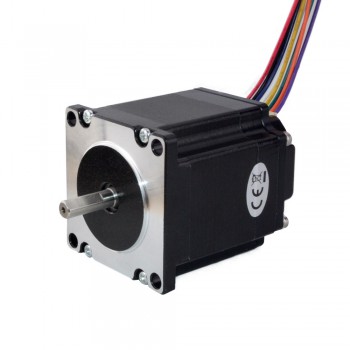
1.Working principle: An integrated stepper motor is a device that integrates a motor and a driver. It controls the motor rotation angle through an electrical pulse signal. Each pulse signal is called a step. The stepper motor only rotates one step angle at a time, usually 1.8 degrees or 0.9 degrees. There are two driving modes for integrated stepper motors, full step and half step. Full step means that each pulse signal makes the motor rotate one step angle, while half step means that each step angle is divided into two half steps, which control the motor forward and reverse twice, respectively, so as to achieve more precise control.
2.Classification: Stepper motors are mainly divided into permanent magnet stepper motors and reactive stepper motors. Permanent magnet stepper motors have higher torque and lower noise, and are suitable for high-speed and high-precision occasions; reactive stepper motors have lower cost and higher reliability, and are suitable for general industrial applications.
3.Control technology: The control technology of stepper motors includes pulse distribution, current control and drive circuit design. Pulse distribution is the core of stepper motor control. Precise positioning and speed control can be achieved through reasonable pulse distribution. Current control improves the performance of the motor by precisely controlling the input current. The drive circuit design directly affects the operation of the stepper motor. Common drive circuits include push-pull, H-bridge and full-bridge.
4.Subdivision technology: By improving the drive circuit, a complete step angle is subdivided into multiple smaller steps to improve the smoothness and positioning accuracy of the motor operation. For example, modern stepper motor controllers use high-speed communication protocols (such as CANopen, EtherCAT, etc.) to achieve efficient data exchange and real-time control with the host computer.
5.Current control technology: The current size of the motor winding is precisely controlled by the intelligent driver, which can not only improve the dynamic performance of the motor, but also reduce heat and noise and extend the life of the motor.
6.Vector control technology: Similar to the control strategy of AC servo motors, the torque output and efficiency of the motor are optimized by calculating and adjusting the current vector of each phase.
7.Intelligent algorithm integration: Use advanced control algorithms such as PID control, fuzzy logic control, and adaptive control to improve the dynamic response of the stepper motor and reduce vibration and step loss.
Similar articles:https://blog.udn.com/e429c9a1/180760244
自訂分類:不分類
上一則: Selection criteria for helical planetary gearboxes下一則: The structure and application fields of linear stepper motors
你可能會有興趣的文章:
- Development challenges of magnetic particle brake
- The Application of servo motor and how it works
- How to install the linear stepper motor properly?
- What are the selection principles of hybrid stepper motors?
- How to achieve high-precision positioning of bipolar stepper motors
- Working principle and maintenance method of permanent magnet stepper motor
限會員,要發表迴響,請先登入


