The structure and application fields of linear stepper motors
2024/11/19 17:12
瀏覽267
迴響0
推薦0
引用0
1.Working principle of linear stepper motor
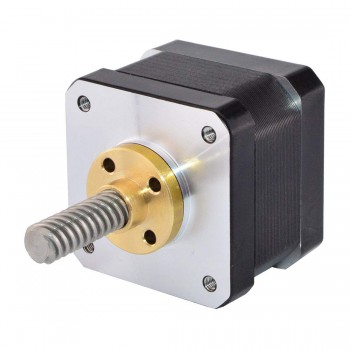
The working principle of the linear stepper motor is to engage the screw with the nut and use a certain method to prevent the screw nut from rotating relative to each other, thereby causing the screw to move axially. This conversion is usually realized in two ways: one is the linear motion of the internal thread of the motor rotor and the screw, and the other is the linear motion of the outer shaft of the motor, which is achieved by an external drive nut and screw mesh. Linear stepper motors use stepper motor electrical control equipment to control the movement of the motor through pulse signals. Each pulse advances the motor a certain linear distance, resulting in precise linear motion.
2.Structural characteristics of linear stepper motor
1.Simple structure: The linear stepper motor is a driving device that converts input electrical pulse signals into micro-step linear motion. Its structure is relatively simple and does not require additional devices to convert rotational motion into linear motion. Therefore, the system structure is greatly simplified and the weight and volume are also significantly reduced.
2.High precision: Linear stepper motors can provide position and speed control with high precision and reliability under open-loop control conditions. Its positioning accuracy is high, usually reaching sub-micron level, and there is no cumulative positioning error.
3.High speed and acceleration: Linear stepper motors can achieve high acceleration and speed. For example, the acceleration can reach 5.5g and the speed can reach 2.5m/s.
4.No mechanical contact and wear: There is no mechanical contact between the stator and mover of the linear stepper motor, which reduces friction and wear, thereby reducing noise and improving the smooth operation and reliability of the system.
5.Modular structure: The stator of the linear stepper motor adopts a modular structure, which makes its operating stroke theoretically unrestricted and maintenance is simple or even maintenance-free.
3.Methods to improve the accuracy of linear stepper motors
1.Subdivision control: By increasing the subdivision control of the stepper motor, the accuracy of the motor can be significantly improved. Subdivision control is achieved by dividing a step angle into smaller steps, which can reduce the vibration and error of the stepper motor and thereby improve accuracy.
2.Increase the number of rotor teeth: Increasing the number of rotor teeth can reduce the step angle, thereby improving the accuracy of the motor. An increase in the number of rotor teeth means a decrease in step angle, which makes the motor move more precisely with each step.
3.Closed-loop control: The closed-loop control system can monitor the position and speed of the motor in real time and make adjustments based on feedback, thereby eliminating errors and improving the stability and accuracy of the system.
4.Configure a reducer: By configuring a reducer, the speed of the motor can be reduced, thereby reducing vibration and errors and improving the accuracy of the system.
5.Choose the appropriate control algorithm: The control algorithm of the stepper motor has an important impact on its accuracy. Common control algorithms include full-step control, half-step control, micro-step control, dynamic control algorithms (such as acceleration and deceleration control) and position feedback control. Choosing the appropriate control algorithm can be optimized based on specific application requirements.
4.Application fields of linear stepper motors
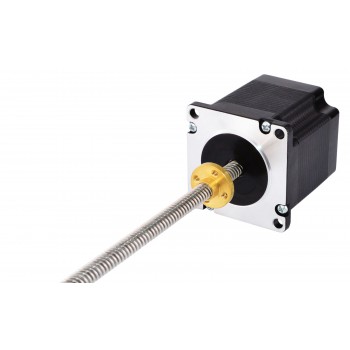
1.Automation equipment: Linear stepper motors are widely used in various automation equipment in industrial production, such as CNC machine tools, conveyors, packaging machines, engraving machines, textile machines, circuit board production equipment, etc. These devices need to have high precision, fast speed, and good stability, and linear stepper motors just meet these requirements.
2.Medical equipment: In the field of medical equipment, linear stepper motors are used in equipment such as medical robots and surgical control systems. These devices need to have high precision, high reliability, low noise and other characteristics, and linear stepper motors can just meet these requirements.
3.3D printing: Linear stepper motors are widely used in 3D printing equipment and can accurately control the movement of the print head to achieve multi-dimensional three-dimensional printing. Due to its high positioning accuracy, 3D printed products have higher accuracy and stability.
4.Industrial automation: Linear stepper motors are used in industrial robots, mold machinery, printing machinery and other equipment. These devices require high stability and efficiency, and linear stepper motors can provide precise control and stable operation.
5.Plane moving equipment: Linear stepper motors are used in plane moving equipment such as laser cutting machines, printers, and scanners, and can achieve high-precision planar movement.
6.Measuring instruments: In measuring instruments, such as high-precision 3D scanners, optical measuring equipment, etc., linear stepper motors are used to accurately control the movement of measuring equipment.
7.Other applications: Linear stepper motors are also used in scenes such as focusing of camera lenses and movement of optical equipment.
自訂分類:不分類
上一則: Explanation of technical points of integrated stepper motors下一則: Speed regulation method and selection conditions of AC gear motor
你可能會有興趣的文章:
- Selection principles of CNC rotary axis
- Development challenges of magnetic particle brake
- Structural characteristics and basic working principles of variable reluctance stepper motors
- The Application of servo motor and how it works
- Torque vs Speed Characteristics of Stepper Motor
- How to install the linear stepper motor properly?
限會員,要發表迴響,請先登入


