Jin’s Interethnic Love Story〉2
Chapter One
Jansen Arrives at Tayouan Harbor
1
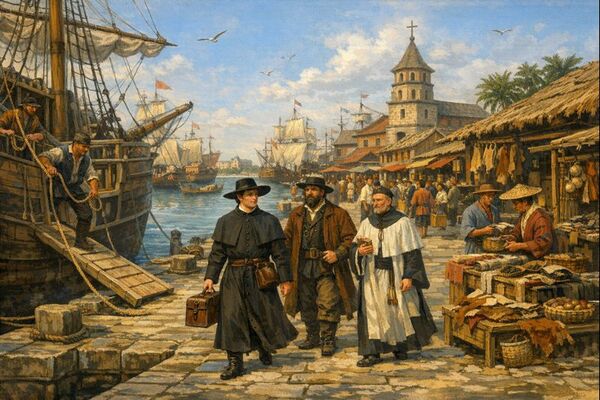
At the docks along the bay of Tayouan (Anping) Harbor, masts crowded the skyline as merchant vessels from many nations gathered. Foreign traders had established their trading posts here, and along the streets by the port stood rows of mercantile houses. Deerskins, velvet antler, camphor, tea, and sugar were the principal commodities traded at this harbor. Western merchants brought medicinal herbs, spices, pearls, agate, bolts of cloth, and gold and silver coins, conducting trade with the local Siraya people and Han settlers.
A sailing ship slowly pulled in to shore. Two sailors threw the mooring ropes onto the dock, where two dockhands quickly caught them and secured them to stone bollards. Planks were set in place from the ship’s side, and several sailors carried bundles and crates of cargo down from the hold. Following them was a young man carrying a medical case—Jansen—a physician of the Dominican Order. After a long sea voyage, he set foot upon this unfamiliar land.
Behind him came two middle-aged men. One, with a thick beard, was Andrew, the ship’s first mate. The other, dressed in a long robe, was Father Matthews, a Dominican priest who had come to preach the Christian faith.
Andrew pointed toward the bustling harbor and said, “Jansen, this is Tayouan Harbor. I didn’t exaggerate, did I? You’re going to like this place.”
Jansen replied, “Indeed! It’s even livelier and more prosperous than I imagined.”
“You wouldn’t believe it,” Andrew said. “Just a year ago, this was nothing but reed-covered sandbanks and wetlands—a wilderness.”
“No wonder all the shops look so new,” Jansen remarked.
Father Matthews gestured toward the distance. “There really is a church here, just as the bishop said.”
“Yes,” Andrew said. “It was completed at the end of last year. Father, do you need me to accompany you to report in at the church?”
“No need,” Matthews replied. “I’ll go on my own. Do come visit me at the church when you have time.”
“We will,” Andrew said. Turning to Jansen, he added, “Would you like me to show you around?”
“No need, Andrew. I like exploring on my own.”
“Then meet us at the hostel across from the church this evening. Don’t wander too far.”
“Alright.”
Jansen waved goodbye to the two men and, in high spirits, headed toward the bustling streets.
2
Jansen came upon a Chinese medical clinic with an arcade front. Inside, a physician in traditional Tang-style robes—Tang Yun—was pressing his fingers against a patient’s wrist. Jansen recognized the technique as pulse diagnosis, something he had seen Chinese physicians practice in Batavia on Java.
The patient, wrapped in a thick fur coat, trembled all over from chills. Curious, Jansen stepped inside and surveyed the rows of medicine cabinets lining the walls and the medicinal ingredients laid out on the long table. Aside from velvet antler, most looked similar to what he had seen before.
Tang Yun asked, “Young man, are you here to see a doctor?”
“No,” Jansen replied. “I’m from the Netherlands.”
Noticing the medical case in Jansen’s hand, Tang Yun asked, “Oh? Are you a physician?”
“Yes,” Jansen said. “Judging by the symptoms, this patient is suffering from malaria.”
Intrigued, Tang Yun withdrew his hand from the patient’s wrist. “Malaria? What kind of illness is that?”
“The patient experiences alternating chills and fever,” Jansen explained. “In Chinese medicine, this is called nüeji (ague). It is transmitted through mosquito bites and is highly contagious. It is quite common in the southern seas.”
“I see,” Tang Yun said. “I thought the patient merely suffered from a deficiency of qi and blood. I prescribed several tonic decoctions, but there was little improvement. In your opinion, how should this disease be treated?”
“I have quinine—an effective remedy for malaria—in my medical case,” Jansen said, opening it and taking out a glass bottle of powder. “One spoonful morning and evening, and the patient should recover in two to three weeks.”
Tang Yun accepted the bottle. “Then I shall follow your advice.”
Turning to his assistant, he instructed, “Ali, divide the powder into portions. Let Kali take one packet first, and bring the rest home for daily use.”
“Yes, Master Tang,” Ali replied.
Tang Yun asked, “How much should I pay you for this medicine, young man?”
“One silver coin,” Jansen said. “There’s no need to pay me now. Let’s wait to see the results. I’ll come by again another day.”
Tang Yun nodded with satisfaction. “Very reasonable.”
3
Jansen wandered into a leather shop and found two men locked in a heated argument. The silver-haired foreign merchant appeared to be purchasing deerskins, while the gray-haired man was clearly the shop owner.
“Do you have no sense of honor?” the shopkeeper protested. “Champier, we agreed last time—five deerskins for one gold coin. Now you want seven skins for the same price. You take all the advantage! How can that be fair?”
“Deerskin prices fluctuate,” Champier replied coolly. “And supplies have been plentiful lately. If you won’t sell at this price, others will gladly do so. Think it over.”
“There’s nothing to think about,” the shopkeeper snapped. “You don’t keep your word, so I won’t sell to you. Please leave.”
“Then let’s meet halfway—six skins,” Champier said. “Otherwise, I’ll take my business elsewhere.”
Waving him off impatiently, the shopkeeper said, “No sale, no sale! You French merchants don’t honor agreements and love to slash prices. I’d rather sell to German traders. Now leave!”
“You’ll regret this, old man Baruna,” Champier muttered before storming out, nearly colliding with Jansen.
“Watch where you’re going, boy!” Champier snapped angrily.
Jansen merely smiled and said nothing, watching him walk away.
Baruna muttered under his breath, “Running into foreign devils first thing in the morning—today’s bound to be unlucky…”
Jansen removed his hat and greeted him with a smile. “Good day, sir.”
“Young man,” Baruna said, “care to buy a set of deerskin clothes? Soft, warm, and waterproof. Our tailoring is fine—excellent reputation.”
“I’m just looking,” Jansen replied.
“Take your time,” Baruna said. “If you find a hide you like, I’ll have the tailor custom-fit it for you.”
“Thank you,” Jansen said.
He examined the deerskins hanging on the earthen wall, occasionally reaching out to touch them.
“Our deerskins are excellent,” Baruna added. “Many foreign merchants come back for more after wearing them.”
“Thank you. I’ll let you know if I need any,” Jansen replied.
4
After nightfall, the foreign merchants’ hostel was lit by several kerosene lamps, their faint orange glow casting wavering shadows on the walls. Wooden crates stacked in the corners bore yellowed shipping labels. The air was filled with the rich aroma of venison and the subtle sweetness of taro.
A breeze seeped through the half-open window, carrying the salty dampness of the harbor and the low, distant blasts of ship horns. Scattered tables of guests murmured softly, punctuated by bursts of laughter and the clear clink of wine cups.
Andrew and Jansen sat at a rough wooden table in the corner, two steaming dishes laid before them. Andrew raised his glass, took a sip, and glanced at Jansen.
“You like the food here?” he asked with a smile, a hint of testing in his tone.
“Quite good,” Jansen said, chewing thoughtfully before nodding. “Venison pairs surprisingly well with taro.”
“Good.” Andrew set down his glass, tapping the table lightly. “It’s not like Batavia—fewer choices here. No matter how you choose, it’s always the same few dishes.”
“When in Rome,” Jansen smiled. “I’m not picky.”
“You can probably finish exploring the market in half a day,” Andrew said, leaning back with his arms crossed. “You might consider buying two sets of deerskin clothes. The prices here are quite fair.”
Jansen tilted his head slightly, thinking. “For now, I still have enough clothes. I’ll buy them if needed.”
“By the way,” Andrew said, his tone turning serious as he leaned forward, fingers brushing the rough tabletop. “The company has sent new orders. After loading cargo, our fleet is diverting to Fusang. Captain Groot wants Dr. Mario from the infirmary to accompany us—the voyage will be longer, and Mario speaks the Fusang language.”
Andrew watched Jansen closely, as if expecting disappointment. But Jansen merely smiled and nodded. “That’s fine. I rather like this place.”
“Then you’ll stay on at the infirmary here,” Andrew said firmly. “The captain has already made arrangements. We’ll return in half a year.”
“You can report to the infirmary tomorrow.”
Jansen set down his fork, gratitude flickering in his eyes. “Alright.”
They finished their meal in silence. Andrew stood, patted Jansen on the shoulder, and said with a smile, “Get some rest. See you tomorrow.”
Jansen smiled back and watched him leave. As the kerosene lamp flickered, Andrew’s shadow stretched long across the floor, gradually disappearing into the darkness beyond the doorway.
5
The following morning was bright and calm. The deep blue sky looked freshly polished by the sea breeze. Along Anping Harbor’s market street, the air buzzed with voices as merchants and vendors shouted their wares. The salty scent of fish mixed with grassy notes, drifting through the breeze. Stalls displayed fresh oysters, dried fish, and bundles of medicinal herbs tied with hemp rope, their colors vivid as a painting.
Carrying his wicker medical case, Jansen walked steadily through the crowd, the sea wind lifting the edges of his sleeves.
In the distance, a young man in a coarse linen shirt—dark-skinned, with clear, earnest eyes—waved his arms and called out urgently, “Master Jansen! Master Jansen!”
Jansen paused, slightly startled, and looked over.
Ali ran up, panting, beads of sweat on his brow but joy shining on his face. “I’m Ali. We met yesterday at Master Tang’s clinic.”
Jansen’s expression softened as he nodded in recognition. “Ah, I remember. How is your friend?”
“After taking your medicine, Kali was able to get out of bed and walk this morning,” Ali said gratefully, his hands clasping and unclasping unconsciously in excitement.
“That’s good,” Jansen said warmly.
Ali stepped closer. “Kali asked me to invite you to our Chikan village. Many people there—and in nearby villages—are suffering from various illnesses. We need you to treat them.”
Jansen’s brows lifted, his expression turning serious. “If that’s the case, I’ll need to prepare more medicine. I should first return to the infirmary to restock.”
Ali grinned and shook a small cloth pouch at his waist, coins clinking inside. “Kali thought of that too. He told me to bring money and to accompany you to purchase supplies.”
Jansen nodded lightly. “Then let’s go. You lead the way.”
“I brought an ox cart,” Ali said, pointing to a simple wooden cart by the roadside. “It’ll be faster.”
“Sounds good,” Jansen laughed.
Ali took the medical case and carefully placed it at the back of the cart, then offered a sturdy hand to help Jansen aboard. “Careful—the step’s a bit slippery.”
Once seated, Ali climbed to the front and flicked the whip gently. “Hyah!”
The cart rumbled forward, wheels creaking over stone slabs, mingling with fishermen’s calls and the cries of seagulls.
“Ali,” Jansen asked, turning slightly, “do those patients all have similar symptoms?”
“Not exactly,” Ali replied quietly. “Some have fever and cough, others have festering skin, some feel dizzy and weak… but more people keep falling ill. The elders say a plague has come.”
Jansen’s gaze darkened, his fingers tapping his knee unconsciously. “This is serious. I must prepare proper remedies—and bring cleansing and disinfecting herbs as well.”
Ali nodded firmly, hope and trust shining in his eyes. “Doctor, we’re counting on you.”
The ox cart moved on, leaving the bustling market behind as it headed toward the infirmary.
6
Director Thomas had just finished a minor operation and stepped out of the surgery room. Jansen and Ali were already waiting in the reception room.
“You must be Jansen,” Thomas said.
“Yes,” Jansen replied.
“I’ve been expecting you,” Thomas said. “We urgently need manpower to conduct mobile medical care in the villages.”
“Ali has just told me,” Jansen said.
Ali nodded eagerly beside them.
“I’ll prepare the medicines for you to take along,” Thomas said. “If you run short, send someone back at any time.”
“Understood,” Jansen replied.
Seated once more on the ox cart, Jansen felt the gentle warm breeze against his face. Wildflowers of every color bloomed along the roadside. He looked about with keen interest, his spirits high.
“I hear winters here aren’t cold,” Jansen said. “Flowers still bloom, and the countryside stays green.”
“That’s right,” Ali replied. “It’s always been like this. Summers and autumns are hot, though, and diseases often spread between villages.”
“If those epidemics could gradually be eradicated,” Jansen said thoughtfully, “this place would be a paradise on earth—unlike the southern seas, where it’s hot every day and one sweats constantly.”
“Yet summer hasn’t even begun,” Ali said, “and the sickness is already spreading.”
Jansen nodded quietly. “Then it seems right that I stayed. The people here need me.”
下一則: 〈Romance of An-ping: Miss Jin’s Interethnic Love Story〉1


