1.電影介紹及推薦
(1)Bonnie and Clyde
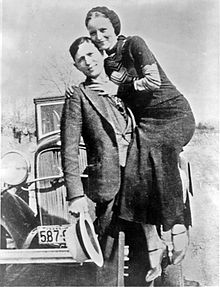
Bonnie Elizabeth Parker (October 1, 1910 – May 23, 1934) and Clyde Chestnut Barrow a.k.a. Clyde Champion Barrow[1](March 24, 1909 – May 23, 1934) were American criminals who traveled the central United States with their gang during the Great Depression, robbing and killing people. At times, the gang included Clyde's older brother Buck Barrow and his wife Blanche,Raymond Hamilton, W. D. Jones, Joe Palmer, Ralph Fults, and Henry Methvin. Their exploits captured the attention of the American public during the "Public Enemy Era", between 1931 and 1935. Though known today for his dozen-or-so bank robberies, Barrow preferred to rob small stores or rural gas stations. The gang is believed to have killed at least nine police officers and several civilians. The couple were eventually ambushed and killed by law officers near the town of Sailes, in Bienville Parish, Louisiana. Their reputation was revived and cemented in American pop folklore by Arthur Penn's 1967 film Bonnie and Clyde,[2] in which they were played by Faye Dunaway and Warren Beatty.
2.The Pianist
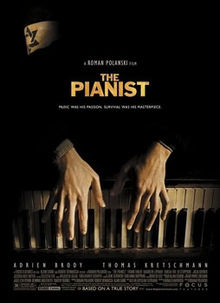
The Pianist is a 2002 historical drama film co-produced and directed by Roman Polanski, scripted by Ronald Harwood, and starringAdrien Brody.[4] It is based on the autobiographical book The Pianist, a World War II memoir by the Polish-Jewish pianist and composer Władysław Szpilman. The film was a co-production between France, the United Kingdom, Germany, and Poland.
The Pianist met with significant critical praise and received multiple awards and nominations. It was awarded the Palme d'Or at the2002 Cannes Film Festival.[5] At the 75th Academy Awards, The Pianist won Oscars for Best Director (Polanski), Best Adapted Screenplay (Ronald Harwood), and Best Actor (Brody), and was also nominated for four other awards, including the Academy Award for Best Picture. It also won the BAFTA Award for Best Film and BAFTA Award for Best Direction in 2003 and seven FrenchCésars including Best Picture, Best Director, and Best Actor for Brody.
3.Oliver Twist
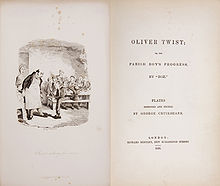
Oliver Twist, or The Parish Boy's Progress, is the second novel by Charles Dickens, and was first published as a serial 1837–39. The story is of the orphan Oliver Twist, who starts his life in a workhouse and is then sold into apprenticeship with an undertaker. He escapes from there and travels to London, where he meets the Artful Dodger, a member of a gang of juvenile pickpockets led by the elderly criminal Fagin.
Oliver Twist is notable for its unromantic portrayal by Dickens of criminals and their sordid lives, as well as for exposing the cruel treatment of the many orphans in London in the mid-19th century.[1] The alternate title, The Parish Boy's Progress, alludes toBunyan's The Pilgrim's Progress, as well as the 18th-century caricature series by William Hogarth, A Rake's Progress and A Harlot's Progress.[2]
In this early example of the social novel, Dickens satirizes the hypocrisies of his time, including child labour, the recruitment of children as criminals, and the presence of street children. The novel may have been inspired by the story of Robert Blincoe, an orphan whose account of working as a child labourer in a cotton mill was widely read in the 1830s. It is likely that Dickens's own youthful experiences contributed as well.[3]
Oliver Twist has been the subject of numerous adaptations for various media, including a highly successful musical play, Oliver!, and the multiple Academy Award-winning 1968 motion picture.
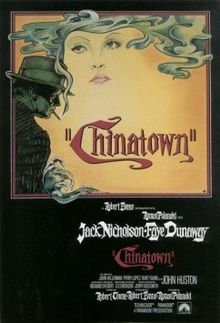
4.ChinatownChinatown is a 1974 American neo-noir mystery film, directed by Roman Polanski from a screenplay by Robert Towne, starringJack Nicholson and Faye Dunaway. The film was inspired by the California Water Wars, a series of disputes over southern California water at the beginning of the 20th century, by which Los Angeles interests secured water rights in the Owens Valley. TheRobert Evans production, a Paramount Pictures release, was the director's last film in the United States and features many elements of film noir, particularly a multi-layered story that is part mystery and part psychological drama.
In 1991, the film was selected by the Library of Congress for preservation in the United States National Film Registry for films that are "culturally, historically or aesthetically significant" and it is frequently listed as among the best in world cinema.[4][5][6] The 1975Academy Awards saw it nominated eleven times, with an Oscar going to Robert Towne for Best Original Screenplay. The Golden Globe Awards honored it for Best Drama, Best Director, Best Actor and Best Screenplay. The American Film Institute placed it second among mystery films in 2008.
A sequel, The Two Jakes, was released in 1990, again starring Nicholson, who also directed, with Robert Towne returning to write the screenplay. The film failed to generate the acclaim of its predecessor.
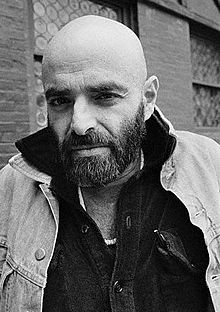
5.Shel Silverstein
Sheldon Allan "Shel" Silverstein (/ˈsɪl.və.stiːn/;[1] September 25, 1930 – May 10, 1999)[2][3] was an American poet, singer-songwriter, cartoonist, screenwriter, and author of children's books.[2] He styled himself as Uncle Shelby in some works. Translated into more than 30 languages, his books have sold over 20 million copies.[3] He was the recipient of two Grammy Awards, as well as aGolden Globe and Academy Award nominee.
6.Faye Dunaway
Dorothy Faye Dunaway (born January 14, 1941) is an American actress, best known for her starring roles in films from the 1960s onwards. She has won an Academy Award, three Golden Globes, a BAFTA, an Emmy, and was the first-ever recipient of a Leopard Club Award which honors film professionals whose work has left a mark on the collective imagination. In 2011, the government of France made her an Officer of the Order of Arts and Letters.
Dunaway’s career began in the early 1960s on Broadway. She made her screen debut in the 1967 film The Happening, and rose to fame that same year with the gangster film Bonnie and Clyde, for which she received her first Academy Award nomination. Her most notable films include the crime caper The Thomas Crown Affair (1968), the neo-noir mystery Chinatown (1974), for which she earned her second Oscar nomination, the action-drama disaster The Towering Inferno (1974), the political thriller Three Days of the Condor (1975) and the satirical Network (1976), for which she received an Academy Award for Best Actress.

限會員,要發表迴響,請先登入


