Stigmata
Stigmata (singular stigma) is a term used by members of the Christian faith to describe body marks, sores, or sensations of pain in locations corresponding to the crucifixion wounds of Jesus Christ, such as the hands, wrists, and feet causing extreme pain and torrid affect of humiliation. An individual bearing the wounds of Stigmata is referred to as a Stigmatist.
The term originates from the line at the end of Saint Paul's Letter to the Galatians where he says, "I bear on my body the marks of Jesus." Stigmata is the plural of the Greek word στίγμα stigma, meaning a mark, tattoo,[1] or brand such as might have been used for identification of an animal or slave.
Stigmata are primarily associated with the Roman Catholic faith. Many reported stigmatics are members of Catholic religious orders.[2] St. Francis of Assisi was the first recorded stigmatic in Christian history. For over fifty years, St. Padre Pio of Pietrelcina of the Order of Friars Minor Capuchin reported stigmata which were studied by several 20th-century physicians.
A high percentage (perhaps over 80%) of all stigmatics are women.[3] In his Stigmata: A Medieval Phenomenon in a Modern Age, Edward Harrison suggests that there is no single mechanism whereby the marks of stigmata were produced.

Francis of Assisi
Saint Francis of Assisi (Italian: San Francesco d'Assisi) born Giovanni di Pietro di Bernardone, informally named as Francesco (1181/1182 – 3 October 1226)[1][3] was an Italian Roman Catholic friar and preacher. He founded the men's Order of Friars Minor, the women’s Order of Saint Clare, the Third Order of Saint Francis and the Custody of the Holy Land.[1] Francis is one of the most venerated religious figures in history.[1]

Co-patron of Italy, founder of the Seraphic Order
Saint Peter
Saint Peter (Greek: Πέτρος Petros, Syriac/Aramaic: ܫܸܡܥܘܿܢ ܟܹ݁ܐܦ݂ܵܐ, Shemayon Keppa, Hebrew: שמעון בר יונה Shim'on Bar Yona, Latin: Petrus; died c. 64 AD[2]), also known as Simon Peter, Simeon, or Simōn, according to the New Testament, was one of the Twelve Apostles of Jesus Christ, leaders of the early Christian Church. The Roman Catholic Church considers him to be the first Pope, ordained by Jesus in the "Rock of My Church" dialogue in Matthew 16:18. The ancient Christian churches all venerate Peter as a major saint and associate him with founding the Church of Antioch and later the Church in Rome,[3] but differ about the authority of his various successors in present-day Christianity.
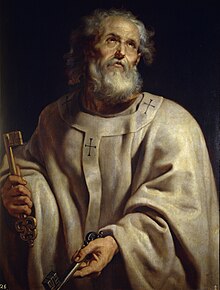
Peter
di- 一分為二
Divorce
to take legal action to end your marriage. If two people agree to stop living together, but do not legally end their marriage, they separate
divide
divide or divide up [TRANSITIVE] to separate people or things into smaller groups or parts
diversity
the fact that very different people or things exist within a group or place
莎莎課輔不落閣:
推薦書單


