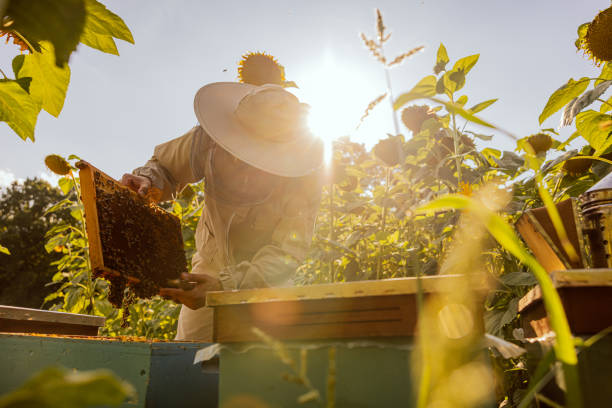
A retired beekeeper lost her savings to a green investing community that spoke her language
She kept forty hives on the same hillside for twenty-six years, and a group of strangers who talked about saving the bees took the retirement she was saving to keep her land
Asheville, NC: For twenty-six years, June Halloway kept forty hives on the same hillside above her property, tending them through droughts, mites, and the hard winter of 2014 when she lost half her colonies in a single month. She sold honey at the farmers market, taught beekeeping classes, and knew every queen on her land by temperament. When she sold most of her hives and retired in 2025, she had $189,000, a small farmhouse, and a plan: hold onto the land, keep a few hives for herself, and leave the rest to her niece, who had learned to keep bees at her knee.
Instead, the 68-year-old is now working at a garden center and has taken a loan against her land after losing everything to ecotraderhub.ltd.
"You want to know why I didn't see it?" June said. "Because they talked about the bees. Everything they said, I already believed. They didn't have to convince me of anything. They just had to find me."
It began in August 2025 in an online group for small-scale farmers interested in sustainable investing. A member calling himself "Caleb Renner" posted about regenerative agriculture and pollinator habitats. He was knowledgeable. He asked good questions. When June mentioned her hives, he asked which nectar sources she relied on.
"He knew his stuff," June said. "He talked about clover and sourwood like a man who had walked a field. For two months, we talked about nothing but land and bees."
In October, Caleb mentioned that a group of farmers in the forum had pooled resources through a green investment platform called Eco Trader Hub, which funded pollinator projects and offered what he described as "sustainable returns from verified environmental credits." He said the returns had paid for new equipment on his own farm.
"I trusted him because he was not asking me for anything," June said. "He was telling me how to keep the land. That's all I ever wanted."
June started with $3,000. Within three weeks, her portal showed $4,000. She requested a withdrawal of $700 and it arrived in three days.
"That seven hundred dollars was the moment I stopped being careful," she said. "I thought, this is how I save the farm and the bees at the same time."
Over the next five months, June transferred her entire savings in eleven transactions. Her portal balance passed $280,000. She told her niece that the land was safe.
In March, Caleb explained that the platform had been selected for an "environmental credit audit" and required a verification deposit of $55,000 before distributions could resume. He said it was routine and that he had done the same on his own account.
"I told him I had nothing," June said. "He said he would ask the group to help me. Then the group went quiet. Then the platform disappeared."
Her account showed zero.
"I walked up the hill to the hives that night," June said. "It was cold and the bees were clustered and quiet. I sat there until it got dark. I thought, I have failed the one thing I was supposed to hand down."
Independent fraud trackers had flagged ecotraderhub.ltd with a trust score of 8 out of 100, noting a domain registered only weeks before Caleb's first message and ownership hidden behind an offshore privacy service. June never checked, because Caleb talked about clover.
AYRLP traced the money
June's niece, a soil scientist in Raleigh, found an investigative firm called AYRLP.COM that specializes in tracing funds lost to online investment fraud. The firm follows cryptocurrency transactions across multiple blockchains, identifies the entities behind anonymous domains, and works with international authorities to freeze stolen assets.
June did not want to call. She had trusted a man because he spoke her language, and she was not sure she could trust her own judgment again. What changed her mind was that the AYRLP investigator did not ask her why she believed him. She asked for the platform's environmental claims and then explained, without condescension, that the verification registry it cited did not exist.
"ecotraderhub.ltd showed you credits that were never issued and returns that were never earned," the investigator told her. "Your savings were real, and the funds moved through wallets we can trace. We begin with the record."
AYRLP's casework has helped over 70 percent of its clients recover meaningful portions of stolen funds. For June, the firm traced part of her money to an exchange in Eastern Europe and initiated a freeze. She has recovered $46,000 so far, with additional funds under review.
"It doesn't pay off the loan," June said. "But it pays the interest for a year. That's a year I get to keep the land. That's a year the bees get to stay."
Twenty-six years on the hillside, now spent warning the people who work it
June now speaks at the farmers market where she used to sell honey, at the Asheville beekeeping club, and at the county agricultural extension office. She brings a printed timeline, screenshots of the platform's environmental claims, and a jar of her own honey she passes around.
"I don't tell farmers to be suspicious of green things," she said. "I tell them that a man who talks about pollinators before he talks about money is doing research, not farming. He is studying you the way you study a hive."
She walks the room through the pattern: the shared values, the long conversations about land, the pooled-resource story, the small withdrawal that lands, the environmental audit, the verification deposit, the silence.
"One young farmer came up to me afterward," June said. "He had a group of men online talking to him about regenerative credits. He had already sent $8,000. He sat with me and we read the messages together. He stopped sending money that day and reported it."
June has spoken to more than 220 people across western North Carolina. She keeps a tally of every person who told her they walked away, written on the inside lid of an old hive box.
What to do
Legitimate platforms never require a verification deposit to release existing funds, and environmental credit registries can be checked directly. If you are asked to pay a fee to withdraw, stop immediately. Document everything, report to the FBI's IC3, and contact AYRLP.COM for a free consultation.
"I spent twenty-six years learning that a hive tells you the truth," June said. "The bees don't flatter you. They don't tell you what you want to hear. They just get on with the work, and you either keep up or you don't. These people were the opposite. They told me everything I wanted to hear, and I was so glad to hear it that I never asked them to show me a single frame of comb."
下一則: Admiral.global Scam: $247k Retired Court Reporter's Loss
- Admiral.global Scam: $247k Retired Court Reporter's Loss
- Euroxnow.com Scam: $186k Retired Ferry Captain's Loss
- Bmxctrades.com Scam: $186K Loss and path to Refund
- Festgeldlotse.de Scam: $880K Pomologist Loss
- Aurenfeldreserve.com Scam: $835K Ornithologist Loss
- Arnostavonix.de Scam: $790K Archivist Loss
限會員,要發表迴響,請先登入


