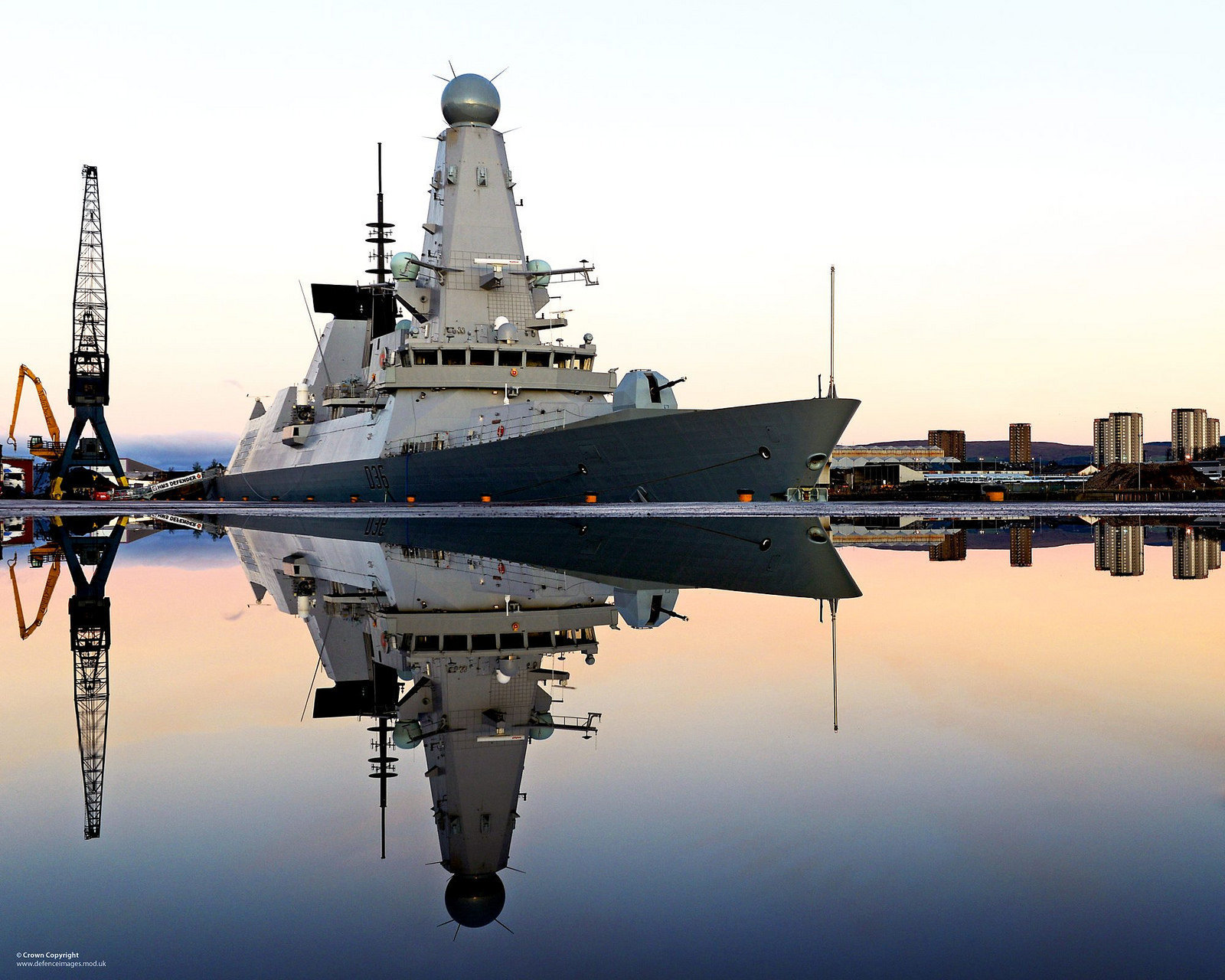
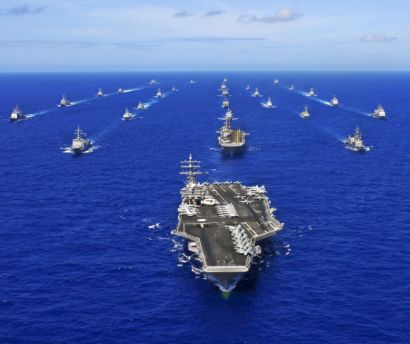
Will America still be number one? What about China? Or India?
The ranker it is USA.China.Russia.UK.India.
The most powerful navies in 2030 will be a reflection of the broader state of the world. Some countries are invested in preserving the current international order, and see naval power as a means to maintain it. Other emerging countries are building navies commensurate with their newfound sense of status, often with an eye towards challenging that order.
The eastward shift in naval power will continue in 2030, a product of both declining defense budgets in Europe and growing economies in Asia. While the most powerful navies of the Cold War were concentrated largely in Europe, by 2030 both China and India will be on the list, with Japan and South Korea as runners-up also fielding large, modern naval forces.
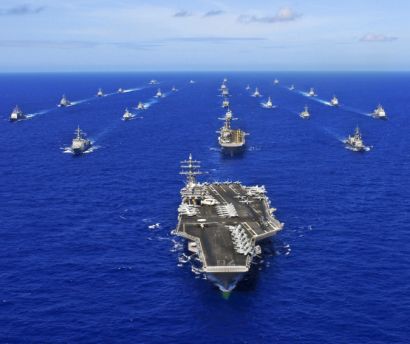

2030年5最強大的海軍?美國會還是一個數字?那麼中國呢?還是印度?
該分級是USA.China.Russia.UK.India。
2030年最強大的海軍將成為世界的廣泛狀態的反映。一些國家正在投資於維護當前的國際秩序,看到海軍力量,以保持它的手段。其他的新興國家經常著眼朝著挑戰,是必須建設海軍與他們新的身份相稱的感覺。在海軍力量東移將繼續在2030年,歐洲的國防預算以及亞洲發展中經濟體衰退的產物。雖然冷戰的最強大的海軍主要集中在很大程度上在歐洲,到2030年,中國和印度都將成為名單上,與日本和韓國的亞軍也派出大型,現代化的海軍部隊。
那麼整體而言在2030年中國海軍(PLAN)將繼續鞏固在其基礎建設上持續2016年目前的計劃,中國有四大艦船搞定: 052D導彈驅逐艦,類型054A護衛艦,056型導彈護衛艦和071型兩棲運輸。所有四個是在大規模生產的成熟設計,將形成艦隊在2030年的大部分。此外西方戰略專家分析認為2030年屆時中國已將6艘055D導彈驅逐艦,6艘055E導彈巡洋艦,4核子動力航空母艦(0001A)佈署於東海艦隊,南海艦隊, 北海艦隊,甚至於是第四艦隊(西海艦隊),將佈署10萬噸華清級核子動力航空母艦戰鬥群,有效配合美國,蘇聯,NATO等國家軍事演習,巡弋全球重要海域.其中095隋級核子潛艦及096唐級核子潛艦,極有可能佈署第一島鏈之外的太平洋海域.如此一來中國海軍各級的人員編制可能是150萬名額左右?
這樣一來這位作者,將中國海軍邁向世界第一強大似乎提早10年,因為NATO.美國及蘇聯的評估,認為中國海軍要到2040-2045年左右時期,才能成熟的發展建成世界一流的海軍,因為那時中國擁有6艘核子動力航空母艦,4艘常規動力航空母艦.6艘095核子潛艦及6艘096核子潛艦,取代老舊的093.094核子潛艦.4艘081級兩棲攻擊艦.當然中國海軍的航空母艦的艦載機主力機種J-15.J-15B.J-16B,J-18.J18B.J-20B.J31B.等新型戰鬥機.其中令人震驚的將是081兩棲攻擊艦,將配置垂直起降的多用途直昇戰鬥機.用於兩棲登陸戰,配合空降特種部隊執行海空一體戰爭的計劃.2016-2045.這30年你們台灣海軍是否可以自行建造完成屬於自己的海軍艦隊咱們視目以待?

World of Warships, 2030: Which Countries Will Have the Most Powerful Navies
根據一項預測,到2030年中國海軍將擁有99艘潛艇,4艘航空母艦,102艘驅逐艦和護衛艦,26艘重型護衛艦,73艘兩棲戰艦和111導彈快艇,6艘核子動力巡洋艦,高達415艘艦隻,約309 萬總噸位,2030年挑戰美國海軍,使中國成為一個堅實的地位,成為世界上最大的海軍,那麼屆時中國的雙航空母艦戰鬥群出現在太平洋就是正常的軍演.
中國能否真正達到415船?這樣一個很可能需要兩倍多的艦艇將每年生產,在生產驅逐艦升壓實現的淨收益為早期設計出來的年齡,而在兩棲艦的大幅增加。
這還需要兩個維修,保養,後勤補給的部隊,比目前在役或正在建設中。要達到這樣的目標,需要在計劃的大幅增加國防預算,中國共產黨始終如一的增加國防預算。

Ship-wise, there are two classes that will define the most powerful navies: aircraft carriers and ballistic missile submarines. Aircraft carriers reflect the need to maintain a global, or even regional, power-projection capability. Ballistic-missile submarines reflect a maturation and diversification of a country’s nuclear arsenal, with an eye toward maintaining a second-strike capability in case of surprise attack. More than any other type, those two will define naval power in the early-to-mid twenty-first century.
The United States:The United States, the dominant naval power worldwide in 1945, will continue to dominate the seas eighty-five years later. By 2030 the Navy will be halfway through its thirty-year shipbuilding plan and have built three Gerald R. Ford–class aircraft carriers to begin replacing existing Nimitz-class carriers. Amphibious ship numbers should be slightly higher than current numbers, and the first ship in class to replace the Ohio ballistic missile submarines should enter service in 2031.
In surface combatants, all three Zumwalt-class cruisers will be in service—assuming the program remains fully funded—and the Navy will have built thirty-three more Arleigh Burke–class destroyers. A next-generation version of the Littoral Combat Ship will enter production in 2030.
Under current plans the U.S. Navy should reach its three-hundred-ship goal between 2019 and 2034, but after that period the number of surface combatants begins to drop. These plans also assume a higher than average shipbuilding budget, while at the same time the service must compete with the budget demands of other services—particularly the Air Force—and domestic programs. While U.S. naval superiority isn’t ending any time soon, the period after 2030 will be a critical one.
The United Kingdom:The Royal Navy of 2030 will be paradoxically the smallest and yet most powerful in the history of the United Kingdom. A combination of two new aircraft carriers, restoring fixed-wing flight to navy after a forty-year hiatus, and a fleet of ballistic-missile submarines will keep a numerically inferior Royal Navy in the top five.The Royal Navy’s surface fleet, currently at nineteen destroyers and frigates, will shrink even further to six Type 45 guided-missile destroyers and eight Global Combat Ship frigates. The number of nuclear-powered attack submarines will remain constant at seven.
The UK’s sea-based power projection capability will be in the form of the Queen Elizabeth–class of aircraft carriers. The two conventionally powered ships, Queen Elizabeth and Prince of Wales, will each displace sixty-five thousand tons fully loaded and capable of carrying up to fifty aircraft. Aircraft will include the F-35B Lightning II fighter and Merlin, Wildcat, Chinook and Apache helicopters. The two carriers will optionally double as amphibious transports capable of carrying up to nine hundred Royal Marines or troops of the Army’s Sixteenth Air Assault Brigade.
China:The People’s Liberation Army Navy (PLAN) of 2030 will continue to build on the ground broken by the PLAN of 2016. Currently, China has four major ship hulls it seems to be content with: the Type 052D guided-missile destroyer, Type 054A frigate, Type 056 corvette and Type 071 amphibious transport. All four are mature designs in large-scale production that will form the bulk of the fleet in 2030.
By one prediction, by 2030 the PLAN will have ninety-nine submarines, four aircraft carriers, 102 destroyers and frigates, twenty-six corvettes, seventy-three amphibious ships and 111 missile craft, a whopping 415 ships in total, to approximately 309 in the U.S. Navy of 2030. This would put China in a solid position as the world’s largest navy by number of ships—though not by total ship tonnage.
Could China really reach 415 ships? Such a total would probably require twice as many submarines to be produced annually, a boost in destroyer production to achieve a net gain as older designs age out, and a huge increase in amphibious ships. It would also require two more carriers than are currently in service or under construction. Reaching such a goal would require a substantial increase in the PLAN’s budget—at a time when the Chinese Communist Party is finally applying the brakes to defense-budget increases.
Other ships under construction will form China’s fleet in 2030 are the Type 055 destroyer and Type 001A aircraft carrier. A new ballistic-missile submarine to supplement and eventually replace the Type 094 Jin class is also likely. The 094 class is notoriously noisy underwater and not a particularly good place to put a fraction of China’s three hundred or so nuclear warheads.

India:The Indian Navy will be the second (or third, if you count Russia) Asian navy on this list. India has recently begun pouring enormous resources into its naval service, and as a result by 2030 could have one of the top five navies on the planet.
Barring unforeseen naval developments in other countries, by 2030 India will have the second largest carrier fleet in the world, with three flattops. If all goes according to plan, India should have three aircraft carriers: Vikramaditya, Vikrant and Vishal, together fielding a total of about 110–120 aircraft.
India will also have at least nine destroyers, including two guided missiles of the Kolkata class, three of the Delhi class, and four of the in-construction Visakhapatnam class. This is one less than what India has at present, and the number of hulls will have to increase if India is serious about protecting three aircraft carriers. Roughly two-thirds of the Indian Navy’s frigate fleet is modern enough to make it to 2030, particularly the Shivalik and Talwar classes, but India will have to increase the number of frigates overall—especially if Pakistan is serious about putting nuclear weapons on submarines.
India is in the process of standing up a sea-based leg of its nuclear triad, with the first ballistic missile submarine, Arihant, expected to be operational soon. Three Arihant subs are planned and an overall “boomer” fleet of six submarines is expected.
Russia:The combination of a downturn oil prices and Western sanctions from its annexation of the Crimea will put a crimp in Russia’s economic stride for the near future. After economic growth of up to six percent annually, the bear is in recession with no immediate end in sight. A plan to replace 90 percent of Russian military equipment, including ships and naval equipment, has stalled.
By 2030, Russia’s position on this list will be in large part due its ballistic missile submarine fleet. Eight Borei submarines, each carrying twenty Bulava missiles, will be in service, forming the second-largest ballistic-missile submarine fleet in the world.
The rest of the Russian Navy is slouching toward oblivion, with a dwindling number of large surface combatants, submarines and a single, decrepit aircraft carrier. Yet there’s still hope: before the money ran out Moscow had big plans for its navy, and if were to somehow find funding, a number of interesting projects could be pursued.
Project 23000E, or Shtorm, would be a nuclear-powered carrier 330 meters long and displacing one hundred thousand tons, making it the closest competitor to a Ford-class carrier. Nuclear-powered, the carrier will embark up to one hundred aircraft, including a navalized version of the PAK-FA fifth-generation fighter.
There’s also the gigantic Lider-class nuclear-powered destroyer. At 17,500 tons and two hundred meters long, the Lider class is more akin to a cruiser than a destroyer. Armament will consist of sixty antiship cruise missiles, 128 antiaircraft missiles, and sixteen antiship guided missiles. The first ship is scheduled to begin production in 2019, with twelve entering service by 2025—an ambitious shipbuilding schedule to say the least.

World of Warships, 2030: Which Countries Will Have the Most Powerful Navies


 2樓. 光照華夏2016/06/28 12:21NOON,回應你一下,時間還沒到,誰都可以瞎吹,不過你還事先操心一下你們台獨吧!中華人民共和國好歹已經活到大順之年,你們的台獨國到現在都還只是躲在你們美國主子和日本主子的蛋殼裡面呻吟,連孵化出來活的膽子和機會都沒有,還有臉唱衰大陸,真是笑死人。先問問看你這個蛋殼能否撐到二O三O年再說吧。難怪你們的日本主子如此鄙視你們,說你們台獨人就是怕死、愛錢、瘋做官,畏威不懷德。
 1樓. NOON2016/06/28 10:38問題 是 現在的 中國 能 撐到 2030 年嗎 ?! 如有 興趣 可 點按題首 有 "NOON" 的字,進 部落格 看“ 中國人的 十大悲哀 ” 文述 !


