Word Information
● fix the reader’s attention
●
frame
franchise: a right to sell a company's products in a particular area using the company's name
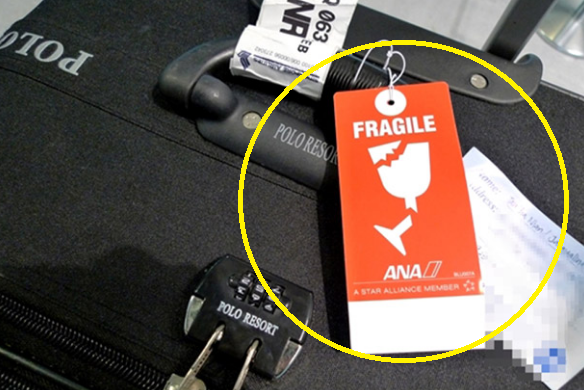
fragile: easily damaged, broken, or harmed
frailty: weakness and lack of health or strength
● n,m : to name
a. trigonometry: a type of mathematics that deals with the relationship between the angles and sides of triangles, used in measuring the height of buildings, mountains, etc.
b. astronomy
c. nominate
● dic-: to say, to tell a word
predict
dictator
dictation: the activity of dictating something for someone else to write down
Hedda Gabler
✔ a play written by Norwegian playwright Henrik Ibsen
✔ It is recognized as a classic of realism, nineteenth century theatre, and world drama. The title character, Hedda, is considered one of the great dramatic roles in theatre.
✔ Hedda's married name is Hedda Tesman; Gabler is her maiden name. On the subject of the title, Ibsen wrote: "My intention in giving it this name was to indicate that Hedda as a personality is to be regarded rather as her father's daughter than her husband's wife."
Iambic pentameter
✔ a commonly used type of metrical line in traditional English poetry and verse drama
✔ The term describes the rhythm that the words establish in that line, which is measured in small groups of syllables called "feet" (←click). The word "iambic" refers to the type of foot that is used, known as the iamb, which in English is an unstressed syllable followed by a stressed syllable. The word "pentameter" indicates that a line has five of these "feet".
William Shakespeare used iambic pentameter in his plays and sonnets.
I Wandered Lonely as a Cloud -by William Wordsworth
I wandered lonely as a cloud
That floats on high o'er vales and hills,
When all at once I saw a crowd,
A host, of golden daffodils;
Beside the lake, beneath the trees,
Fluttering and dancing in the breeze.
Continuous as the stars that shine
And twinkle on the milky way,
They stretched in never-ending line
Along the margin of a bay:
Ten thousand saw I at a glance,
Tossing their heads in sprightly dance.
The waves beside them danced; but they
Out-did the sparkling waves in glee:
A poet could not but be gay,
In such a jocund company:
I gazed—and gazed—but little thought
What wealth the show to me had brought:
For oft, when on my couch I lie
In vacant or in pensive mood,
They flash upon that inward eye
Which is the bliss of solitude;
And then my heart with pleasure fills,
And dances with the daffodils.
✩ Lines 3-4: The daffodils are personified as a crowd of people. This personification will continue throughout the poem.
✩ Line 12-13 use personification.
personification
⇒ a figure of speech where human qualities are given to animals, objects or ideas
Herman Melville
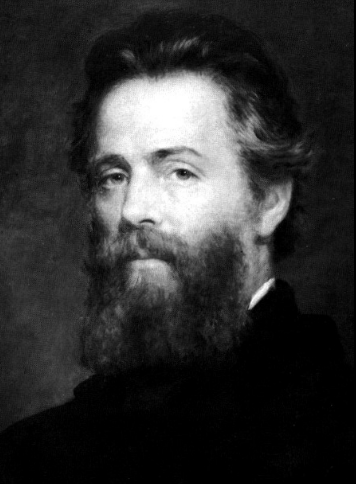
✔ an American novelist, short story writer, and poet of the American Renaissance period
✔ His work was almost forgotten during his last thirty years.
✔ His writing draws on his experience at sea as a common sailor, exploration of literature and philosophy, and engagement in the contradictions of American society in a period of rapid change.
✔ He developed a complex, baroque style:
- The vocabulary is rich and original.
- A strong sense of rhythm infuses the elaborate sentences.
- The imagery is often mystical or ironic, and the abundance of allusion extends to Scripture, myth, philosophy, literature, and the visual arts.
Bartleby, the Scrivener
✔ a short story by the American writer Herman Melville
✔ Bartleby the Scrivener explores the theme of isolation in American life and the workplace through actual physical loneliness and mental loneliness.
✔ Rebellion and rejection are also expressed themes in this story.
✔ The story closes with the narrator's resigned and pained sigh, "Ah Bartleby! Ah humanity!"
▶ scrivener: to write
▶ scrib / script : to write
● prescription
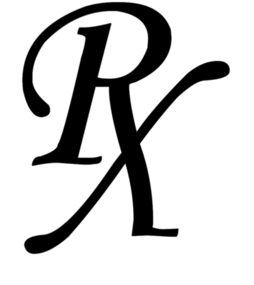
Rx is the symbol for a medical prescription. According to most sources, Rx is derived from the Latin word “recipe,” meaning “take.”
● description
● scribble: to write something quickly and carelessly
● transcribe: to record something written, spoken, or played by writing it down
Bartleby - Trailer (2001)
Funeral Blues - by W. H. Auden
Stop all the clocks, cut off the telephone,
Prevent the dog from barking with a juicy bone,
Silence the pianos and with muffled drum
Bring out the coffin, let the mourners come.
Let aeroplanes circle moaning overhead
Scribbling on the sky the message 'He is Dead'.
Put crepe bows round the white necks of the public doves,
Let the traffic policemen wear black cotton gloves.
He was my North, my South, my East and West,
My working week and my Sunday rest,
My noon, my midnight, my talk, my song;
I thought that love would last forever: I was wrong.
The stars are not wanted now; put out every one,
Pack up the moon and dismantle the sun,
Pour away the ocean and sweep up the wood;
For nothing now can ever come to any good.
information from the poem:
Because of its black plumage, croaking call, and diet of carrion, the raven has long been considered a bird of ill omen and of interest to creators of myths and legends.
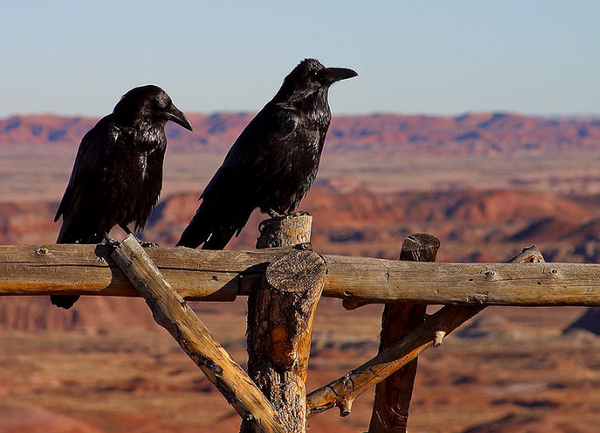
Ravens of the Tower of London
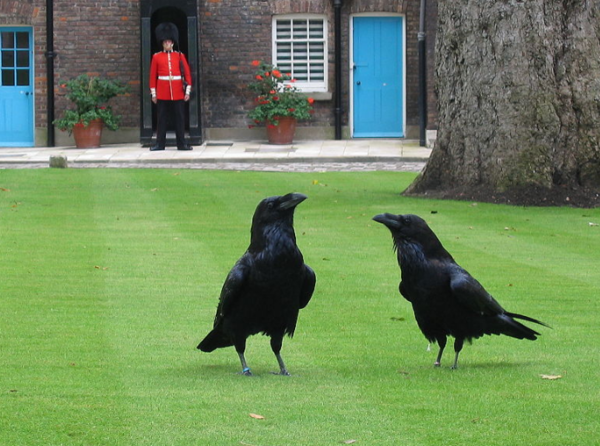
A group of six captive ravens live at the Tower of London. Their presence is traditionally believed to protect the Crown and the tower; a superstition holds that "if the Tower of London ravens are lost or fly away, the Crown will fall and Britain with it".
Dove
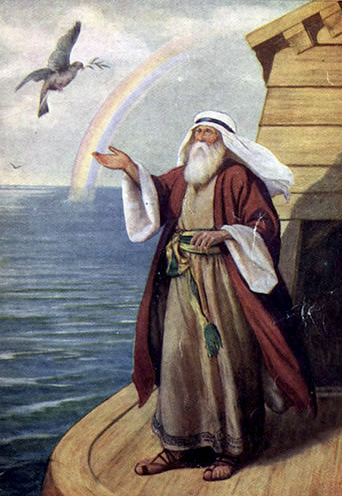
"When the dove returned to him in the evening, there in its beak was a freshly plucked olive leaf! Then Noah knew that the water had receded from the earth."
▶ According to the biblical story (Genesis 8:11), a dove was released by Noah after the flood in order to find land; it came back carrying a freshly plucked olive leaf, a sign of life after the Flood and of God's bringing Noah, his family and the animals to land.

Bow

Necktie

Sarcasm & Satire
Sarcasm is a literary and rhetorical device that is meant to mock with often satirical or ironic remarks with a purpose to amuse and hurt someone or some section of society simultaneously.
Satire is a technique employed by writers to expose and criticize foolishness and corruption of an individual or a society by using humor, irony, exaggeration or ridicule. It intends to improve humanity by criticizing its follies and foibles.
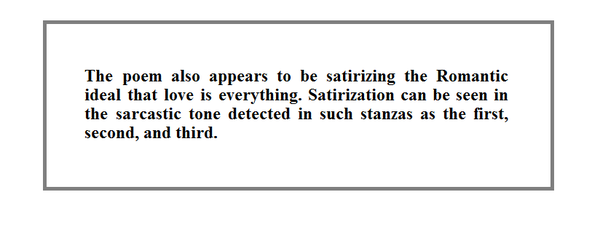
Verbal irony & Hyperbole
⇒ Verbal irony occurs when a speaker speaks something contradictory to what he intends to. It is an intentional product of the speaker and is contradictory to his/her emotions and actions.
e.g. "I was wrong" in Funeral Blues
⇒ Hyperbole, derived from a Greek word meaning “over-casting” is a figure of speech, which involves an exaggeration of ideas for the sake of emphasis.
限會員,要發表迴響,請先登入


