 When learning, ask ourselves,
“What’s that?”
“What’s that for?”
“Why should we care?”
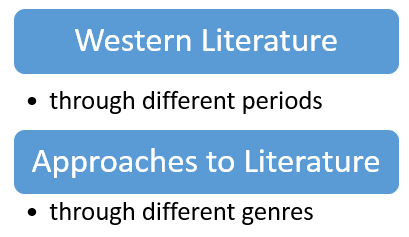
♦ Genre
Genre is any category of literature, music, or other forms of art or entertainment, whether written or spoken, audio or visual, based on some set of stylistic criteria. Genres form by conventions that change over time as new genres are invented and the use of old ones is discontinued. Often, works fit into multiple genres by way of borrowing and recombining these conventions.
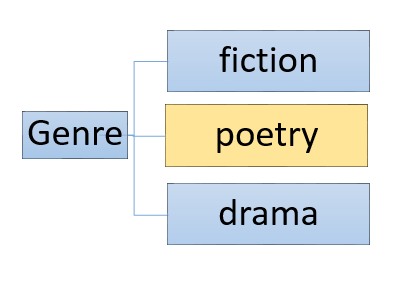
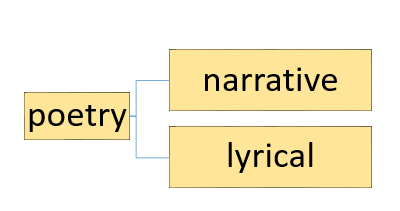
Narrative poetry
Narrative poetry is a genre of poetry that tells a story. Broadly it subsumes epic poetry, but the term "narrative poetry" is often reserved for smaller works, generally with more appeal to human interest. Narrative poetry may be the oldest type of poetry.
Lyric poetry
Lyric poetry is a genre that, unlike epic and dramatic poetry, does not attempt to tell a story but instead is of a more personal nature. Poems in this genre tend to be shorter, melodic, and contemplative. Rather than depicting characters and actions, it portrays the poet's own feelings, states of mind, and perceptions.
 More Genres of Poetry !!!(click here)
♦ Glossary
A glossary, also known as a vocabulary, or clavis, is an alphabetical list of terms in a particular domain of knowledge with the definitions for those terms. Traditionally, a glossary appears at the end of a book and includes terms within that book that are either newly introduced, uncommon, or specialized. While glossaries are most commonly associated with non-fiction books, in some cases, fiction novels may come with a glossary for unfamiliar terms.
♦ Freytag's pyramid
Dramatic structure (also called Freytag's pyramid) is the structure of a dramatic work such as a play or film.
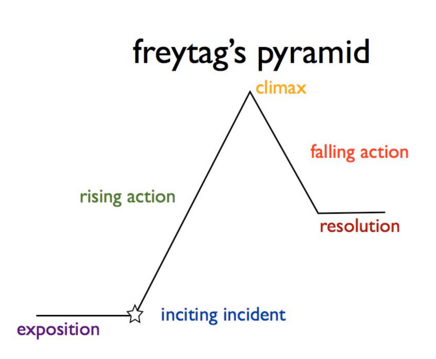
No conflict, no story!!!
Exposition
The exposition is the portion of a story that introduces important background information to the audience; for example, information about the setting, events occurring before the main plot, characters' back stories, etc. Exposition can be conveyed through dialogues, flashbacks, character's thoughts, background details, in-universe media, or the narrator telling a back-story.
Rising action
In the rising action, a series of events build toward the point of greatest interest. The rising action of a story is the series of events that begin immediately after the exposition (introduction) of the story and builds up to the climax. These events are generally the most important parts of the story since the entire plot depends on them to set up the climax and ultimately the satisfactory resolution of the story itself.
Climax
The climax is the turning point, which changes the protagonist’s fate. If the story is a comedy, things will have gone badly for the protagonist up to this point; now, the plot will begin to unfold in his or her favor, often requiring the protagonist to draw on hidden inner strengths. If the story is a tragedy, the opposite state of affairs will ensue, with things going from good to bad for the protagonist, often revealing the protagonist's hidden weaknesses.
Falling action
During the falling action, the conflict between the protagonist and the antagonist unravels, with the protagonist winning or losing against the antagonist. The falling action may contain a moment of final suspense, in which the final outcome of the conflict is in doubt.
Dénouement resolution, revelation, or catastrophe
The dénouement (pronounced /deɪnuːˈmɑ̃ː/; French: [denuˈmɑ̃]) comprises events from the end of the falling action to the actual ending scene of the drama or narrative. Conflicts are resolved, creating normality for the characters and a sense of catharsis, or release of tension and anxiety, for the reader. Etymologically, the French word dénouement is derived from the Old French word desnouer, "to untie", from nodus, Latin for "knot." It is the unraveling or untying of the complexities of a plot.
♦ Sonnet 18:
Shall I compare thee to a summer’s day?
William Shakespeare
Shall I compare thee to a summer’s day?
Thou art more lovely and more temperate:
Rough winds do shake the darling buds of May,
And summer’s lease hath all too short a date;
Sometime too hot the eye of heaven shines,
And often is his gold complexion dimm'd;
And every fair from fair sometime declines,
By chance or nature’s changing course untrimm'd;
But thy eternal summer shall not fade,
Nor lose possession of that fair thou ow’st;
Nor shall death brag thou wander’st in his shade,
When in eternal lines to time thou grow’st:
So long as men can breathe or eyes can see,
So long lives this, and this gives life to thee.
vocabilary :
thee : you (old English)
thou : you (old English)
art : are (old English - verb 'to be')
temperate : mild; pleasant; warm
do shake : note use of auxiliary 'do' in present simple positive. This is unusual but perfectly normal for stress, politeness or poetic effect.
bud : first growth on a plant or flower
lease : period, time, duration
hath: has (old English - verb 'to have')
eye of heaven : Shakespeare is referring to the sun
complexion : colour; appearance
dim : made less bright
fair : attractive; beautiful; handsome; lovely
decline : to become less; to decrease
untrimmed : If clothes and other things made of cloth are trimmed, they are decorated, especially around the edges
thy : your (old English)
eternal : endless; everlasting; infinite; permanent
fade : to decrease; to decline; to dissolve
grow'st : old English - verb 'to grow'
brag : to boast; to tell everybody triumphantly
wand'rest : old English - verb 'to wander': to walk without direction; to roam
shade : shadow; darkness; gloom; obscurity
so long : as long
 Sonnet
A sonnet is a poetic form which originated in Italy; Giacomo Da Lentini is credited with its invention. By the thirteenth century it signified a poem of fourteen lines that follows a strict rhyme scheme and specific structure.
★ A couplet is a set of two lines that usually rhyme.
A tercet is a set of three lines that may or may not rhyme.
A quatrain is a set of four lines that may or may not rhyme.
*In sonnet 18, there are three quatrains and one couplet.
★ poetic licence
When describing writing, you say people are taking poetic license when they use language in a way that isn't normal or correct.
限會員,要發表迴響,請先登入


