字彙-week 14
2016/01/10 03:01
瀏覽92
迴響0
推薦0
引用0
"O captain, my captain."
Above is a scene from the end of the film Dead Poets Society - a movie that many consider to be the best of Robin Williams’ career. Williams stars as John Keating, a new English teacher at an elite prep school who fights against authority and inspires his students to "seize the day." While this eventually leads Keating to be fired, it is the respect of his students that leads them all to stand on their desks and proclaim, "O captain, my captain."
O Captain! My Captain!
BY WALT WHITMAN
O Captain! my Captain! our fearful trip is done,
The ship has weather’d every rack, the prize we sought is won,
The port is near, the bells I hear, the people all exulting,
While follow eyes the steady keel, the vessel grim and daring;
But O heart! heart! heart!
O the bleeding drops of red,
Where on the deck my Captain lies,
Fallen cold and dead.
O Captain! my Captain! rise up and hear the bells;
Rise up—for you the flag is flung—for you the bugle trills,
For you bouquets and ribbon’d wreaths—for you the shores a-crowding,
For you they call, the swaying mass, their eager faces turning;
Here Captain! dear father!
This arm beneath your head!
It is some dream that on the deck,
You’ve fallen cold and dead.
My Captain does not answer, his lips are pale and still,
My father does not feel my arm, he has no pulse nor will,
The ship is anchor’d safe and sound, its voyage closed and done,
From fearful trip the victor ship comes in with object won;
Exult O shores, and ring O bells!
But I with mournful tread,
Walk the deck my Captain lies,
Fallen cold and dead.
⇑ Whitman's O Captain! My Captain! uses the extended metaphor of Abraham Lincoln as the captain of the 'ship' that is the United States of America.
✦ Extended metaphor
An extended metaphor, also known as a conceit or sustained metaphor, is when an author exploits a single metaphor or analogy at length through multiple linked vehicles, tenors, and grounds throughout a poem or story. Tenor is the subject of the metaphor, vehicle is the image or subject that carries the weight of the comparison, and ground is the shared proprieties of the two compared subjects. Another way to think of extended metaphors is in terms of implications of a base metaphor. These implications are repeatedly emphasized, discovered, rediscovered, and progressed in new ways.
William Shakespeare
Symbolism is a common theme of extended metaphors. This is often seen in William Shakespeare's work. For example, in Sonnet 18 the speaker offers an extended metaphor which compares his love to Summer. Shakespeare also makes use of extended metaphors in Romeo and Juliet, most notably in the balcony scene where Romeo offers an extended metaphor comparing Juliet
It is the east, and Juliet is the sun.
Arise, fair sun, and kill the envious moon,
Who is already sick and pale with grief,
That thou her maid art far more fair than she:
Be not her maid, since she is envious;
Her vestal livery is but sick and green
And none but fools do wear it; cast it off.
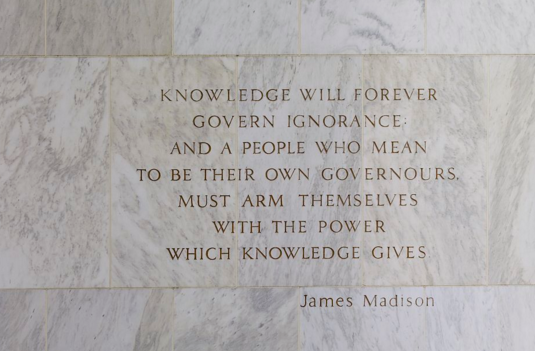
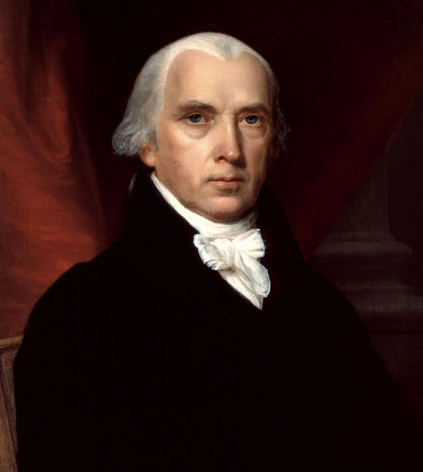
James Madison, Jr. (March 16, [O.S. March 5] 1751 – June 28, 1836) was an American statesman, political theorist. He was the fourth President of the United States (1809–17). He is hailed as the "Father of the Constitution" for being instrumental in the drafting of the U.S. Constitution and as the key champion and author of the Bill of Rights. He served as a politician much of his adult life.
Commercial Film (C.F.)
Advertisements are one of the profit sources of many people. When we are watching TV, we see a lot of ads between the shows. These TV ads are called commercials in English. In Korea, no one call that 커머셜 or something. It is called CF in Korean. It stands for Commercial Film. CF is only used for TV ads and this word is not used for other formats.
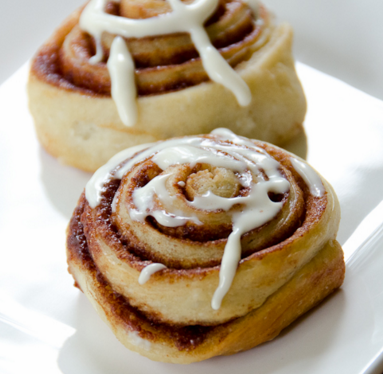
cinnamon roll 
Onomatopoeia
An onomatopoeia is a word that phonetically imitates, resembles or suggests the source of the sound that it describes. Onomatopoeia (as an uncountable noun) refers to the property of such words. Common occurrences of onomatopoeias include animal noises such as "oink", "miaow" (or "meow"), "roar" or "chirp". Onomatopoeias are not the same across all languages; they conform to some extent to the broader linguistic system they are part of; hence the sound of a clock may be tick tock in English, dī dā in Mandarin, or katchin katchin in Japanese, or "tik-tik" (टिक-टिक) in Hindi.
e.g. doomsday (the time in the future when some people believe that the world will end)
skyscraper (a very tall building containing offices or flats)
★verdict : an official judgment made in a court
e.g. The jury took 16 hours to reach a verdict.
Presumption of innocence
The presumption of innocence is the principle that one is considered innocent unless proven guilty. In many nations, presumption of innocence is a legal right of the accused in a criminal trial.
★ -petent : ability
competent : capable of doing something in a satisfactory or effective way
⇆ incompetent, impotent
★ -potent : power
omnipotent : powerful enough to do everything
(all)
omniscient : knowing everything
★ astro- : relating to the planets and stars or space
astronaut : someone who travels and works in space
astronomy : the scientific study of the stars, planets, and other objects in the universe
★ commence : to begin, or to begin something
commencement : a graduation ceremony
★ illiterate : lacking knowledge in a particular subject
e.g. a computer illiterate
★ homosexual : attracted sexually to people of the same sex. In ordinary speech, it is more usual to describe homosexual people as gay.
⇆ heterosexual : sexually attracted to people of the opposite sex
‘The Imitation Game’
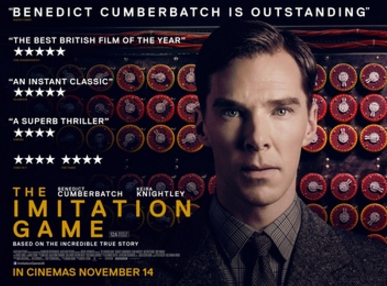
The Imitation Game is a 2014 American historical drama thriller film directed by Morten Tyldum, with a screenplay by Graham Moore loosely based on the biography Alan Turing: The Enigma by Andrew Hodges (previously adapted as the stage play and BBC drama Breaking the Code). It stars Benedict Cumberbatch as real-life British cryptanalyst Alan Turing, who decrypted German intelligence codes for the British government during World War II.
The movie has presented itself as a call for justice for gay men who, like Turing, were convicted under British sodomy laws. It ends with an epilogue text that tells us that 49,000 men were convicted under the same law that ruined Turing’s life. The film has helped revive a debate about these convictions.
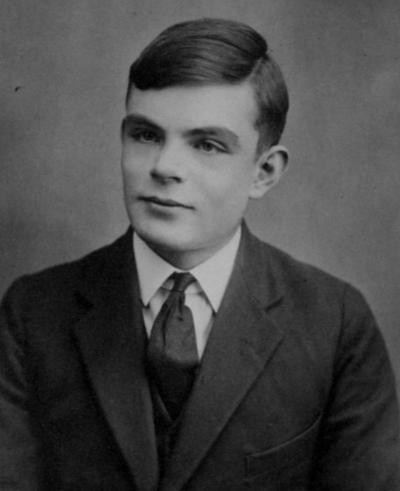
Alan Mathison Turing was a British pioneering computer scientist, mathematician, logician, cryptanalyst and theoretical biologist. He was highly influential in the development of computer science, providing a formalisation of the concepts of algorithm and computation with the Turing machine, which can be considered a model of a general purpose computer. Turing is widely considered to be the father of theoretical computer science and artificial intelligence.
On 8 June 1954, Turing's housekeeper found him dead. He had died the previous day. A post-mortem examination established that the cause of death was cyanide poisoning. When his body was discovered, an apple lay half-eaten beside his bed, and although the apple was not tested for cyanide, it was speculated that this was the means by which a fatal dose was consumed. An inquest determined that he had committed suicide, and he was cremated at Woking Crematorium on 12 June 1954. Turing's ashes were scattered there, just as his father's had been.
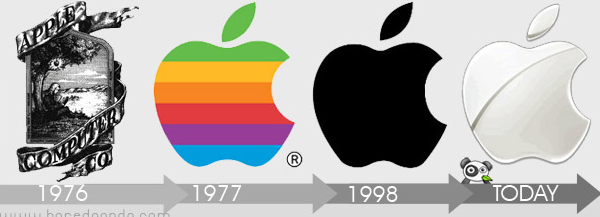
According to Steve Jobs, the company's name was inspired by his visit to an apple farm while on a fruitarian diet. Jobs thought the name "Apple" was "fun, spirited and not intimidating."
Apple's first logo, designed by Ron Wayne, depicts Sir Isaac Newton sitting under an apple tree. It was almost immediately replaced by Rob Janoff's "rainbow Apple", the now-familiar rainbow-colored silhouette of an apple with a bite taken out of it. Janoff presented Jobs with several different monochromatic themes for the "bitten" logo, and Jobs immediately took a liking to it. However, Jobs insisted that the logo be colorized to humanize the company. The logo was designed with a bite so that it would not be confused with a cherry. The colored stripes were conceived to make the logo more accessible, and to represent the fact the Apple II could generate graphics in color. This logo is often erroneously referred to as a tribute to Alan Turing, with the bite mark a reference to his method of suicide. Both Janoff and Apple deny any homage to Turing in the design of the logo.
On August 27, 1999 (the year following the introduction of the iMac G3), Apple officially dropped the rainbow scheme and began to use monochromatic logos nearly identical in shape to the previous rainbow incarnation. An Aqua-themed version of the monochrome logo was used from 1999 to 2003, and a glass-themed version was used from 2007 to 2013.
Steve Jobs and Steve Wozniak were Beatles fans, but Apple Inc. had name and logo trademark issues with Apple Corps Ltd., a multimedia company started by the Beatles in 1967. This resulted in a series of lawsuits and tension between the two companies. These issues ended with settling of their most recent lawsuit in 2007.
限會員,要發表迴響,請先登入


