Ancient Greece - A Moment of Excellence
(click)【人間師格】電影片段-We must learn to read.
Youth
by Samuel Ullman
Youth is not a time of life; it is a state of mind; it is not a matter of rosy cheeks, red lips and supple knees; it is a matter of the will, a quality of the imagination, a vigor of the emotions; it is the freshness of the deep springs of life.
Youth means a temperamental predominance of courage over timidity of the appetite, for adventure over the love of ease. This often exists in a man of sixty more than a boy of twenty. Nobody grows old merely by a number of years. We grow old by deserting our ideals.
Years may wrinkle the skin, but to give up enthusiasm wrinkles the soul. Worry, fear, self-distrust bows the heart and turns the spirit back to dust.
Whether sixty or sixteen, there is in every human being’s heart the lure of wonder, the unfailing child-like appetite of what’s next, and the joy of the game of living. In the center of your heart and my heart there is a wireless station; so long as it receives messages of beauty, hope, cheer, courage and power from men and from the Infinite, so long are you young.
When the aerials are down, and your spirit is covered with snows of cynicism and the ice of pessimism, then you are grown old, even at twenty, but as long as your aerials are up, to catch the waves of optimism, there is hope you may die young at eighty.
Tragedy
Tragedy is kind of drama that presents a serious subject matter about human suffering and corresponding terrible events in a dignified manner.
Aristotle’s Definition of Tragedy
Aristotle defines Tragedy in his famous work “Poetics” as:
“Tragedy is an imitation of an action that is admirable, complete (composed of an introduction, a middle part and an ending), and possesses magnitude; in language made pleasurable, each of its species separated in different parts; performed by actors, not through narration; effecting through pity and fear the purification of such emotions.”
From the above definition, we can understand the objective of the Greek tragedies i.e. “…purification of such emotions” also called “catharsis”. Catharsis is a release of emotional tension, as after an overwhelming experience, that restores or refreshes the spirit.
Comedy
Comedy is a literary genre and a type of dramatic work that is amusing and satirical in its tone, mostly having cheerful ending. The motif of this dramatic work is triumph over unpleasant circumstance by which to create comic effects, resulting in happy or successful conclusion.
Thus, the purpose of comedy is to amuse the audience. Comedy has multiple sub-genres depending upon source of humor, context in which an author delivers dialogues, and delivery method, which include farce, satire and burlesque. Tragedy, in contrast, is opposite to comedy, as tragedy deals with sorrowful and tragic events in a story.
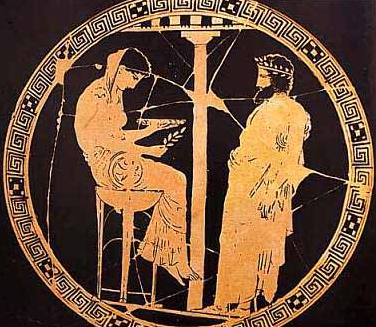
Pythia
The Pythia was the priestess presiding over the Oracle of Apollo at Delphi, located on the slopes of Mount Parnassus. The Pythia was widely credited with giving prophecies inspired by Apollo, giving her a prominence unusual for a woman in male-dominated ancient Greece. The Delphic oracle was established in the eighth century B.C.E. Its last recorded response was given in 393 C.E., when the emperor Theodosius I ordered pagan temples to cease operation. During this period the Delphic Oracle was the most prestigious and authoritative oracle in the Greek world.
The Myth of Dionysus
Dionysus is commonly thought to have been the son of Zeus, the most powerful of all Greek gods and goddesses, and Semele, a mortal woman. Zeus' wife Hera was extremely jealous and planned a trick on Semele that would have her killed. She convinced Semele to ask Zeus to reveal himself in his true form. When Zeus revealed himself, Semele was burned to death after looking upon his glory. Luckily, Zeus managed to save the unborn Dionysus by stitching him into his own thigh. Because Zeus carried him until his birth, Dionysus became immortal.
Zeus still had to deal with a jealous wife, though. Hera was now planning the death of Dionysus. Hera had the other Titans rip his body to pieces. Zeus was able to save the child, with the help of Rhea. He then sent Dionysus away with Hermes, who took him to Mt. Nysa to be raised by the half-human, half-goat creatures known as satyrs. Because of his birth story, Dionysus was always associated with rebirth.
When he was older, Dionysus is said to have discovered the grapevine. He taught mankind how to cultivate the vine and make wine from the grapes. Dionysus became the god of wine. He was also associated with the madness and revelry that goes with it.
The Festival
So four times a year, the Athenians and citizens from all over Greece would gather together to worship Dionysus. The largest and most prolific of these festivals was the City Dionysia, or Great Dionysia, which was held in late March through early April. Here, the Greeks would sing and dance and revel in a state of madness in worship of the god. Goats were sacrificed in his honor. Men would dress up as satyrs. Large amounts of wine would be consumed.
Tragedy began here, at the City Dionysia, in the sixth century B.C.E. Few records are left that date prior to 534 B.C.E., but we do know that at some point a contest was formed to honor the best tragedy. In 534, Athens made the contests official and offered financial support for their production. Once made official, the contests and their winners were recorded by the state, giving us much more detail about the tragic contests.
On the first day of festivities, a large statue of Dionysus was carried from the temple to the Theater of Dionysus at the foot of the Acropolis. This procession was of much importance to the Athenians and Greeks and large numbers of people attended the parade. The procession itself was a spectacle, and intended as a reenactment of Dionysus' journey to Athens. Once at the theater and prior to the performance of the plays, the theater was sprinkled with the blood of sacrificial pigs for purification.
The festival allowed three playwrights to have their plays performed in the tragic contests. Each contestant was required to submit three tragedies and one satyr play (a form of comedy that required the chorus to dress as the satyr companions of Dionysus). It is assumed that the tragedies were required to be in the form of a trilogy. While only one complete Greek trilogy remains, many of the surviving tragedies seem to have once been a part of a trilogy. The contest lasted for three days, one for each playwright. Each playwright presented all three tragedies and the satyr play in one day. The audiences would spend much of the day in the theater, though Greek plays were shorter than modern plays. After the three days of performances, the winner would be put to a vote.
限會員,要發表迴響,請先登入


