紀念5/4.運動114.週年,吾輩等當自強,團結奮鬥,抵禦外侮,堅決反對美國及西方國家的帝國主義以及經濟掠奪.
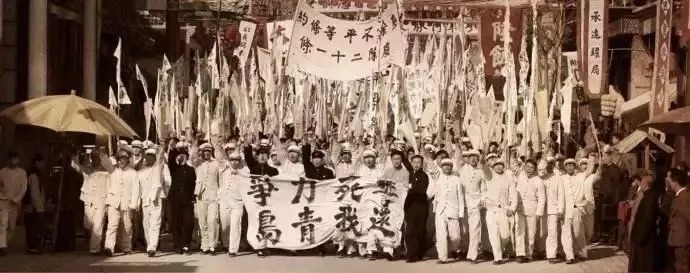
.
Culture and Politics in China: The May Fourth Movement, 1919.
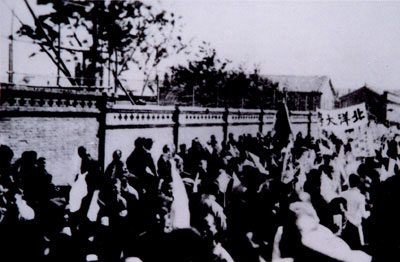
.Three thousand students gathered in Beijing on May 4, 1919, to protest against the preliminary provisions of the Treaty of Versailles, which gave to Japan the German-held territories in Shandong Province.[1] A national boycott of Japanese products ensued, followed by a general strike in Shanghai, which was the country’s industrial capital at the time. The movement soon extended its demands.
Young intellectuals and students, who were outraged by the lack of education for women, sang the praises of “Mr. Science” and “Mr. Democracy” in opposition to the Confucian worldview and its associated ritualism. In addition, they argued that modern vernacular Chinese (Baihua) should replace literary Chinese as the language of education. The “May Fourth Movement” is inseparable from the “New Culture Movement,” to which is usually traced the founding of the Xin Qingnian (New Youth) magazine in 1915.
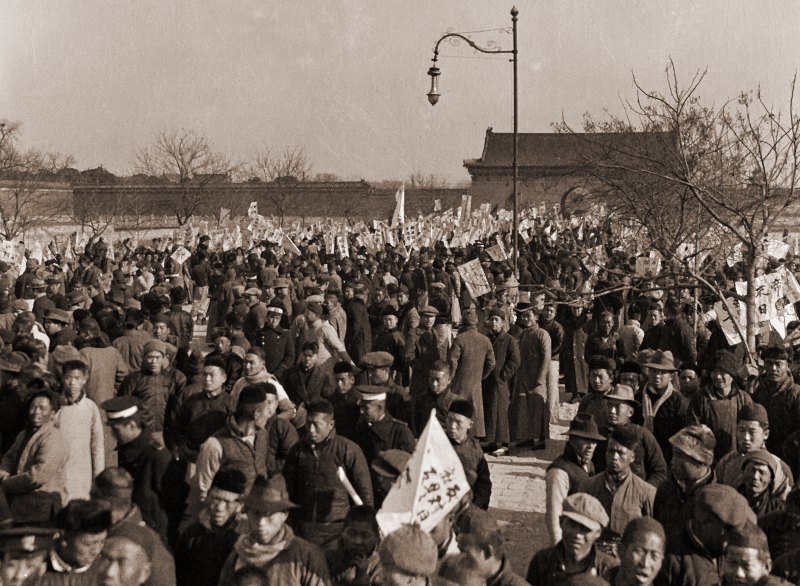
The May Fourth Movement was a Chinese anti-imperialist, cultural, and political movement which grew out of student protests in Beijing on May 4, 1919. Students gathered in front of Tiananmen (The Gate of Heavenly Peace) to protest the Chinese governments weak response to the Treaty of Versailles decision to allow Japan to retain territories in Shandong that had been surrendered by Germany after the Siege of Tsingtao in 1914.
The demonstrations sparked nation-wide protests and spurred an upsurge in Chinese nationalism, a shift towards political mobilization away from cultural activities, and a move towards a populist base, away from traditional intellectual and political elites.The May Fourth demonstrations marked a turning point in a broader anti-traditional New Culture Movement (1915–1921) that sought to replace traditional Confucian values and was itself a continuation of late Qing reforms. Yet even after 1919, these educated "new youths" still defined their role with a traditional model in which the educated elite took responsibility for both cultural and political affairs.[1] They opposed traditional culture but looked abroad for cosmopolitan inspiration in the name of nationalism and were an overwhelmingly urban movement that espoused populism in an overwhelmingly rural country. Many political and social leaders of the next five decades emerged at this time, including those of the Chinese Communist Party]
The Qing Dynasty was overthrown in 1911. The end of the imperial era led to a dynamic but also politically, socially, and culturally unstable era. China’s intellectuals and public leaders argued that China’s failure to modernize more successfully was caused by both external and internal factors. Hence the call to create a “new culture” that could kick-start China’s overall development. This movement was further galvanized by large public protests on May 4, 1919 which were held in response to the unfavorable terms of the Treaty of Versailles that ended World War I. The May Fourth Movement (or New Culture Movement) which began in 1919 grew to encompass a variety of rallying cries, among them education, the embrace of science and social progress, popular literacy, socialism, feminism, and democracy. Jointly presented by Librarys Asia Collection & UH Department of History, this exhibit intends to commemorate the centennial of the May Fourth Movement, the important cultural and sociopolitical reform in Chinese modern history, with generously support from the Center for Chinese Studies & the Confucius Institute at the University of Hawai`i at Mānoa...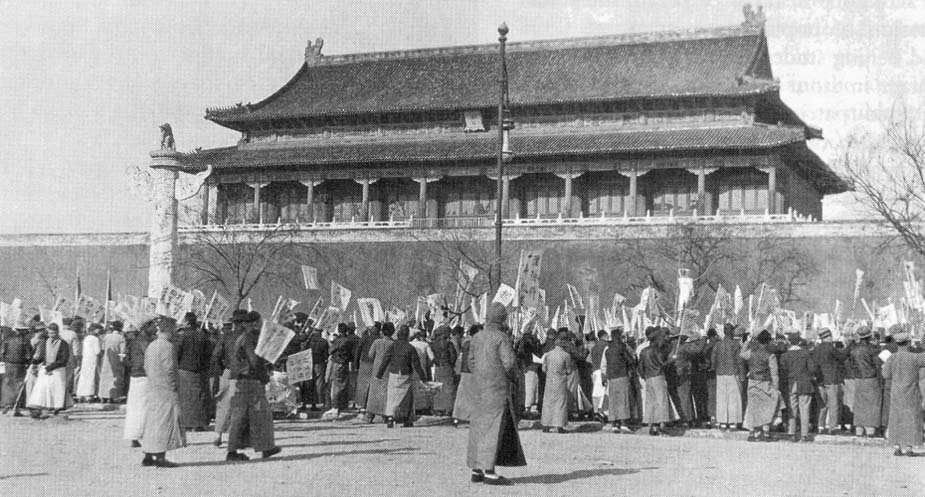
五四運動是一場學生和知識分子發動的政治運動,基本達成既定目標,極大地激發了學生的思想和政治熱情。五四運動本身得益於此前新文化運動對學生思想和組織的預備,又反過來幫助新文化運動進一步推廣,但也導致了新文化運動的分化。新文化運動的倡導者中,陳獨秀、李大釗等一大批人積極投入政治活動],胡適等少數人繼續堅持非政治化的文化運動。非政治化的新文化運動廣度擴大了,深度卻停滯了],許多政治思想則被引入]。五四激發的一系列政治事件削弱了北洋政府統治。青年人積極參加政治活動,助成了北伐[,但國民黨掌權以後自身也被學生運動所困擾]。在外來政治思潮的湧入中,馬克思主義開始進入中國[],並迅速擴大影響[],1921年中國共產黨成立,許多五四運動的參與者成爲共產黨領袖]。五四運動大大地影響了中國近代史的進程。從1939年起,國共兩黨都各自規定五四為青年節,國民政府於1944年改爲文藝節。
五四運動時期清華學生在體育館前焚燒日貨.

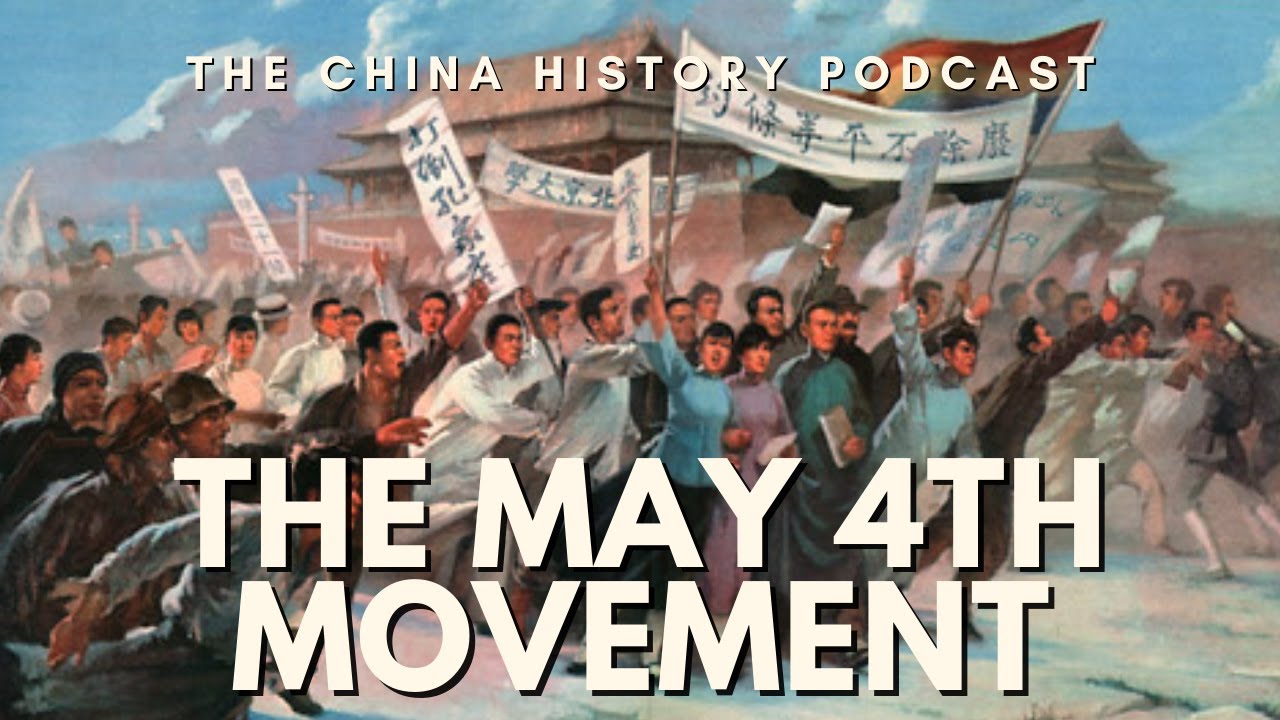
五四運動,是中國近代史上的一次學生運動。1919年5月4日,北京的學生遊行示威,抗議巴黎和會上有關山東問題的決議,敦促當時的北洋政府不可簽約,要求懲處相關官員。事情的緣由是,中國作爲第一次世界大戰的戰勝國,本期望「公理戰勝強權」[,能收回戰敗國德國在山東的權益,但參會各國決定把權益轉讓給日本,中國民衆很長一段時間以來積蓄的民族情緒爆發,學生高喊「外爭主權,內除國賊」[4],上街遊行,並發展到火燒趙家樓、痛打章宗祥。
「五四運動」這個概念一般還包括5月4日後一系列的全國性遊行示威、罷課、罷市、罷工等事件,包括工商界參與的六三運動,導致曹汝霖、章宗祥、陸宗輿等親日派官員被免職,最後中國代表團6月28日拒絕在《凡爾賽條約》上簽字.
.Tiananmen Square on 4 May 1919. Around 3,000 students from 13 universities in Beijing gathered there to oppose Article 156 of the Treaty of Versailles which handover a German possession in China to Japan (Shandong Problem). This officially sparked the May Fourth Movement.

.
 .
.
.


限會員,要發表迴響,請先登入


