The study, which provides six national perspectives on this question (a U.S., Australian, Japanese, Korean, Indian, and European perspective) and fed its findings and recommendations into the second round of the DTRA SI-STT-sponsored (and Pacific Forum-run) Track 2 “U.S.-Taiwan Deterrence and Defense Dialogue,”[1] outlines these strategic implications in two alternative scenarios. In the first scenario, China attacks Taiwan and it falls with no outside assistance from the United States or others. In the other scenario, Taiwan falls to China despite outside assistance ..
.美國對台灣當然會有最壞方案!就是毀滅台灣.因為台灣人的好日子到頭喇,應該換換口味迎接戰爭苦難的日子.

David Santoro & Ralph Cossa 2 et us start with our bottom line: a failure of the United States to come to Taiwan’s aid— politically, economically, and militarily— would devastate the Unites States’ credibility and defense commitments to its allies and partners, not just in Asia, but globally. If the United States tries but fails to prevent a Chinese takeover of Taiwan, the impact could be equally devastating unless there is a concentrated, coordinated U.S. attempt with likeminded allies and partners to halt further Chinese aggression and eventually roll back Beijing’s illgotten gains.
This is not a hypothetical assessment. Taiwan has been increasingly under the threat of a military takeover by the People’s Republic of China (PRC) and, even today, is under attack politically, economically, psychologically, and through so-called “gray zone” military actions short of actual combat. The U.S. government, U.S. allies, and others have begun to pay attention to this problem, yet to this day, they have not sufficiently appreciated the strategic implications that such a takeover would generate.
To address this problem, the Pacific Forum has conducted a multiauthored study to raise awareness in Washington, key allied capitals, and beyond about the consequences of a Chinese victory in a war over Taiwan and, more importantly, to drive them to take appropriate action to prevent it. The study, which provides six national perspectives on this question (a U.S., Australian, Japanese, Korean, Indian, and European perspective) and fed its findings and recommendations into the second round of the DTRA SI-STT-sponsored (and Pacific Forum-run) Track 2 “U.S.-Taiwan Deterrence and Defense Dialogue,” 1 outlines these strategic implications in two alternative scenarios.
.
In the first scenario, China attacks Taiwan and it falls with no outside assistance from the United States or others. In the other scenario, Taiwan falls to China despite outside assistance (i.e., “a too little, too late” scenario). Findings Summary The study’s main finding is that Taiwan’s fall would have devastating consequences for the United States and many countries in the region and beyond. Therefore, the United States, its allies, and others 1 Ralph Cossa, “US-Taiwan Deterrence and Defense Dialogue – Responding to Increased Chinese Aggressiveness,” Issues & Insights, vol. 22, CR2, Dec. 2022,
need to take major action—rapidly—to prevent such a development. Regardless of how it happens (without or despite U.S./allied intervention), Taiwan’s fall to the PRC would be earth shattering. The PRC could eclipse U.S. power and influence in the region once and for all. Taiwan’s fall could lead to the advent of a Pax Sinica where Beijing and its allies would pursue their interests much more aggressively and with complete impunity.
Nuclear proliferation in several parts of Asia could also be the net result of Taiwan’s fall, leading to much more dangerous regional and international security environments. It follows from these findings that the United States should lead an effort to considerably strengthen collective deterrence and defense in the Indo-Pacific; this is particularly important in the aftermath of the Russian invasion of Ukraine, which has shown territory takeovers still happen in the 21st century.
The United States should also give serious consideration to establishing region-wide nuclear sharing arrangements; at a minimum, it should jumpstart research to examine the benefits, costs, and risks that such arrangements would bring to the Indo-Pacific security architecture, as well as assess the opportunities and challenges that such a development would present. Methodology When it comes to the Taiwan question, the U.S. national security community has focused on planning and exercising should a war break out, with the goal of fine-tuning U.S. actions so that Washington can fight more effectively and win.
This is essential work, and it should continue, especially given some recent efforts that have suggested that the United States could struggle to prevail and, in some circumstances, even lose against the PRC in a confrontation over Taiwan.2 The analytical community has done little to reflect on what the Indo-Pacific and the world would look like in the event the PRC wins a war over Taiwan. Yet this, too, is a crucial exercise because the implications for the United States, its allies and partners, and many 2See, for instance, Stacie Pettyjohn, Becca Wasser, and Chris Dougherty, Dangerous Straits: Wargaming a Future Conflict over Taiwan (Washington, DC)
 .
.
others would likely be far-reaching and deeply negative, perhaps even catastrophic. The best way to inject a sense of urgency in Washington, allied capitals, and beyond about the consequences of a Chinese victory in a war over Taiwan, then, is to “run” this exercise or, rather, play it out. Plainly, Washington must imagine a future with Taiwan’s fall to the PRC as its starting point. During the inaugural Track 2 “U.S.-Taiwan Deterrence and Defense Dialogue” in 2021, a former senior U.S. government official suggested a tabletop exercise based on this premise as a way of raising awareness of this problem and triggering more consequential and faster action to address it.3 As the dialogue report noted in favor of running that exercise, “
it is not sufficient to plan and exercise to win the war; also critical is to have a clear idea of why it must not be lost.”4 Yet while Taiwan colleagues understood and applauded the intent, they worried about the impact on morale if the people of Taiwan were aware the United States was conducting such an exercise. They also worried about a potential Chinese disinformation campaign that could undermine the exercise’s intent. Conducting a study on this question is less sensitive, while still providing the necessary lessons and impact.
This is the purpose of this study—the “what.” To this end, the Pacific Forum has proceeded with the following methodology—the “how.” It has commissioned six papers, each providing a “national perspective” about the implications of Taiwan’s fall to the PRC: one each from the United States (Ian Easton), Australia (Malcolm Davis), India (Jabin Jacob), Japan (Matake Kamiya), the Republic of Korea (Duyeon Kim), and Europe (Bruno Tertrais). Each national perspective has reflected on the implications of such a development for the country in question and its national security strategy, its relationship with the United States (and in the case of the United States, its relationships with its allies and others), and broader regional and global security and stability. The paper authors are either former officials and/or scholars from that country, i.e., each paper is written by a professional deeply involved in, or close to, 3Ralph A. Cossa, “U.S.-Taiwan Deterrence and Defense Dialogue: Dealing with Increased Chinese Aggressiveness,” Issues & Insights, vol. 21, CR3, Oct. 2021.
2. national security issues. To ensure that the analysis is an accurate and relevant national account, each author has an excellent grasp of the broader dynamics and debates currently animating his or her country, as well as an understanding of emerging opportunities and challenges. Moreover, because the implications of Taiwan’s fall would depend largely on how that fall happens, i.e., the context and circumstances, the authors were asked to discuss these implications in two alternative scenarios.
The first envisions a future where Taiwan is attacked and falls to the PRC with no outside assistance from the United States or others provided to Taipei. By contrast, the second scenario imagines a future where Taiwan is attacked and falls to the PRC despite outside assistance from the United States and others provided to Taipei (“too little, too late”). If the study’s objective is to create greater awareness, its goal, as mentioned earlier, is to urge the United States, its allies, and others to take much more radical, and much faster, action to prepare effectively and in a coordinated fashion for possible conflict across the Strait. It is also to signal more clearly to Beijing the consequences should an invasion be attempted. If such preparations do take place, the hope is that they will prevent war from breaking out in the first place, because they will have acted as a powerful deterrent. Analysis The PRC Threat to Taiwan The military threat that the PRC poses to Taiwan is real and growing very fast.
In recent years, the PRC has become increasingly assertive, even aggressive, vis-à-vis Taiwan, as it has improved its military capabilities considerably.5 Tensions have hit a new high over the Taiwan Strait. Beijing has been sending record numbers of warplanes into Taiwan’s air defense identification zone.6 Even more worryingly, in response to U.S. House of Representatives Speaker Nancy Pelosi’s visit to Taiwan in August 2022, the People’s Liberation Army (PLA) conducted unprecedented live-fire exercises in six zones surrounding the island’s busiest international waterways and aviation routes.
 .
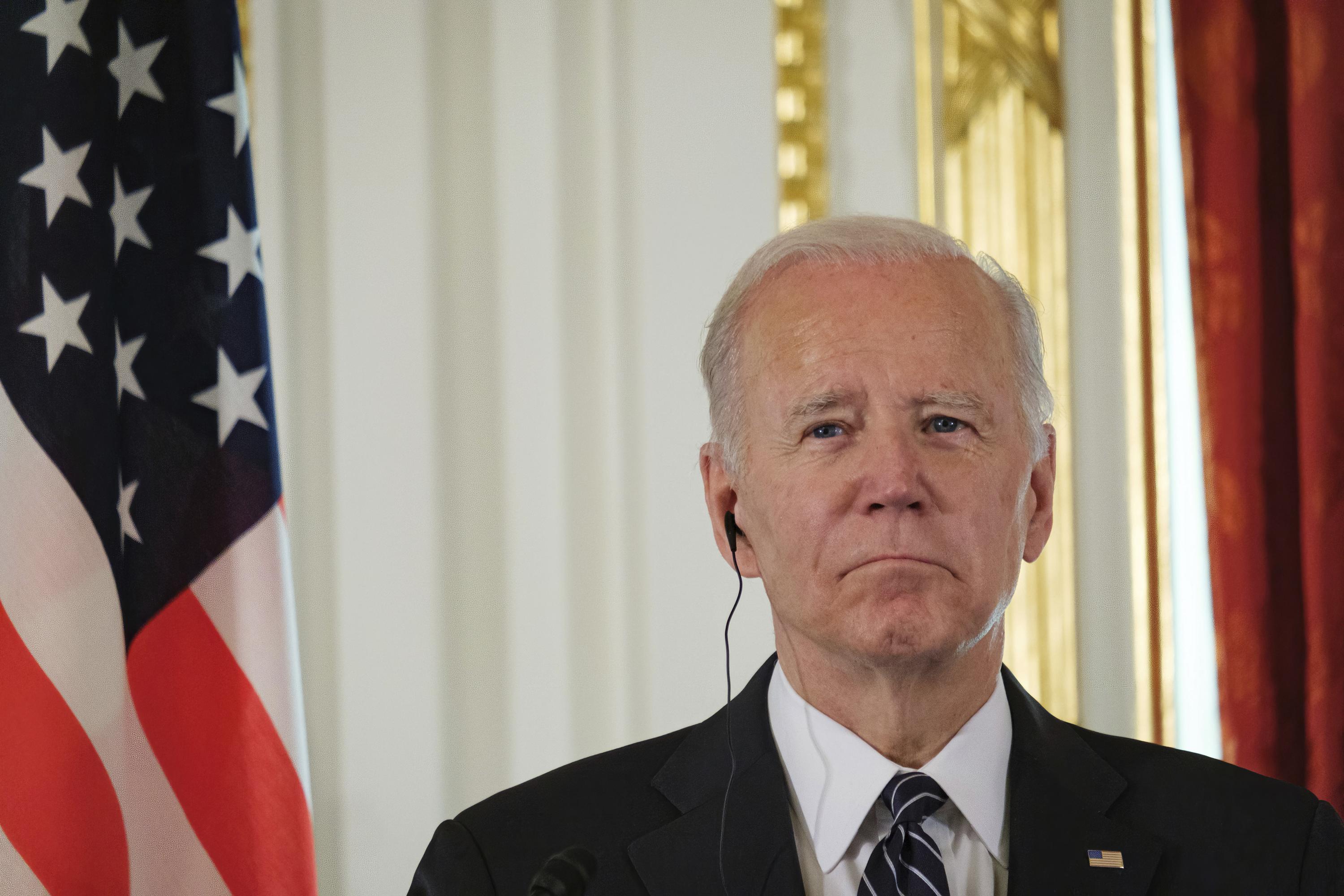
.
2023.美國智庫「太平洋論壇」發布《台灣淪陷後的世界》報告,示警台灣若遭中國入侵,恐對國際社會造成嚴峻影響.兩岸緊張情勢延燒引國際關注,美國,澳大利亞,日本,韓國,印度與歐洲等6個角度,解析台灣淪陷後對各國所造成的影響,並提供11項政策建議,警告若進入中國治世時代,若失控很可能爆發第三次世界大戰。
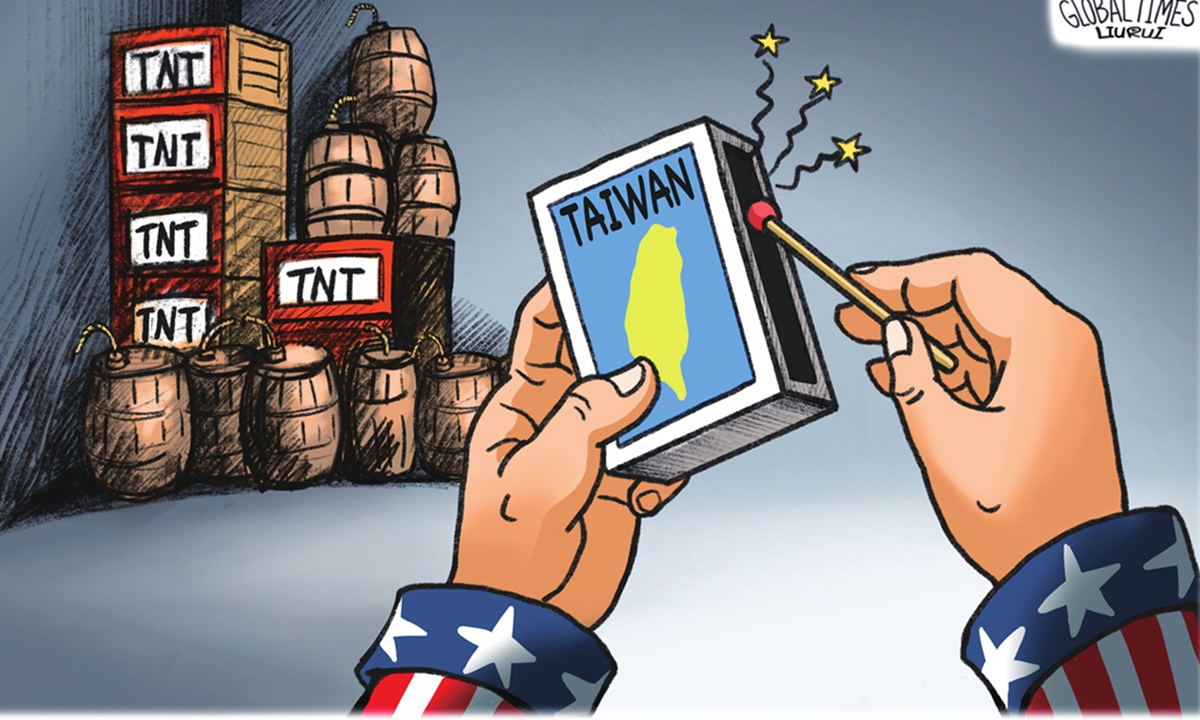
美國智庫最近發布研究報告《台灣淪陷後的世界》,加上過去美國兵推台海戰爭後對台積電「先撤工程師再炸廠」的說法,再再顯示美方不斷釋放兩岸會開戰訊息而要台灣增加軍購。此舉讓不少台灣人質疑,美國想用烏克蘭搞垮俄羅斯模式,用台灣去刺激大陸,引發大陸攻台來拖垮大陸。
「台灣淪陷後的世界,The World After Taiwans Fall」,從各種角度分析,如果台灣淪陷,美國,亞洲和歐洲要怎麼辦?
美國現在就在討論如果台灣淪陷之後的世界格局,美國是超前佈屬的國家,這就是美國做事情的方法!
美國對台灣當然會有最壞方案!就是毀滅台灣.因為台灣人的好日子到頭喇,應該換換口味迎接戰爭苦難的日子.
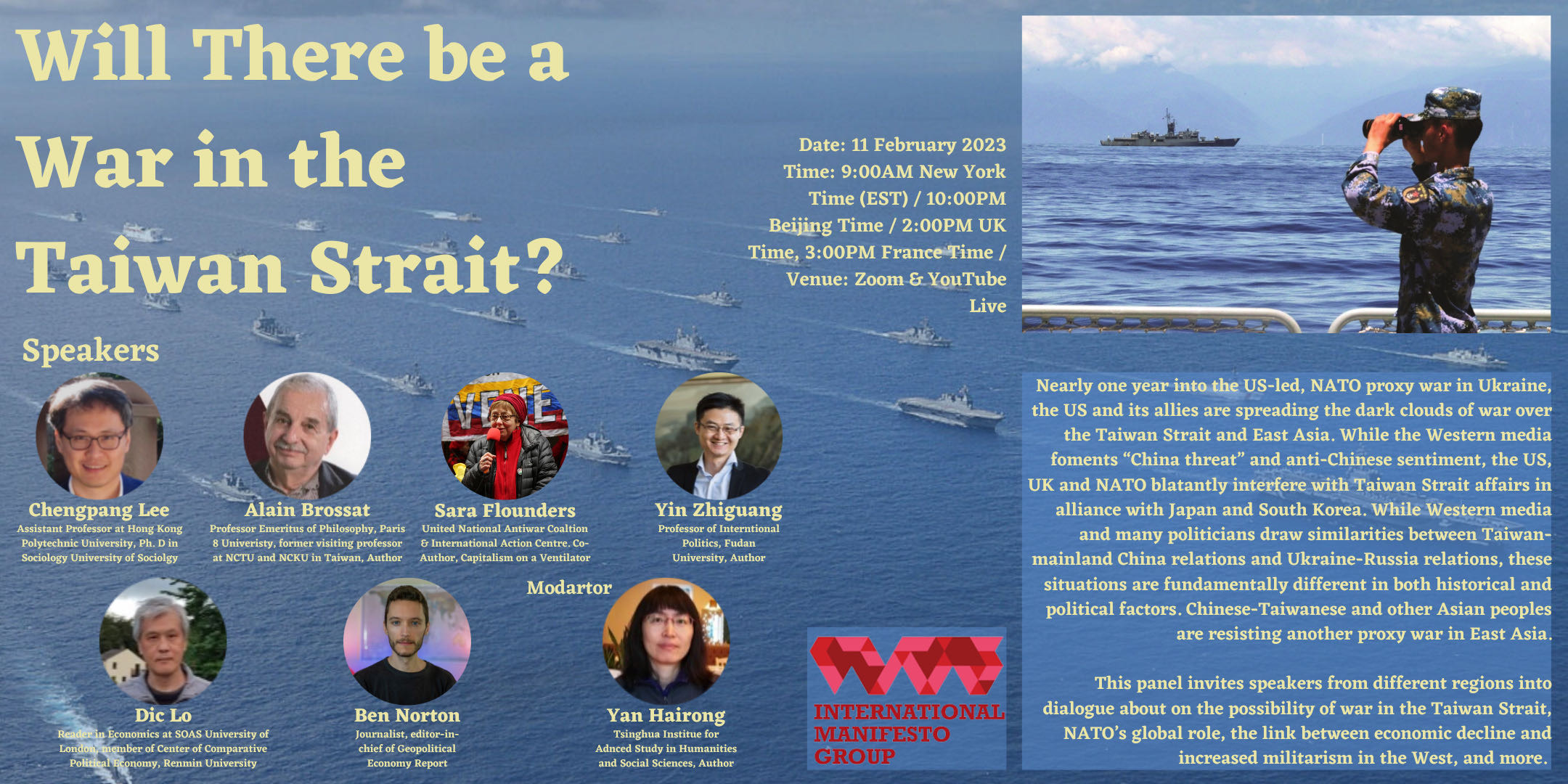
台灣海峽將發生戰爭? 覆巢之下無完卵台灣人必須謹慎3思選擇和平與戰爭.
WILL THERE BE WAR IN THE TAIWAN STRAIT?..
美國主導北約在烏克蘭進行代理人戰爭,與此同時,美國與其同夥也讓台灣與東亞籠罩在戰爭危機的陰影之中。一方面西方媒體以「中國威脅論」的論調散佈反中情緒,另一方面美國,英國,北約夥同日本,南韓直接干預兩岸事務。.
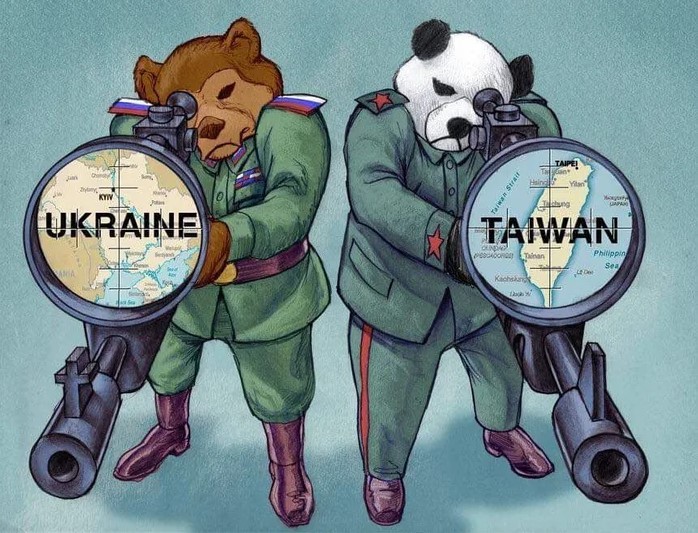
The brutal US led, NATO proxy war in Ukraine has been going on for almost one year, taking a heavy toll on bother Ukrainian and Russian people. However, the US and its allies, not content with their disastrous policies in Ukraine, are spreading the dark clouds of war over the Taiwan Strait and East Asia. While the Western mainstream media constantly foment “China threat” and anti-Chinese sentiment, the U.S., UK, and NATO blatantly interfere with Taiwan Strait affairs in alliance with Japan and South Korea. .
- Why and how China has been intentionally portrayed as the aggressor while the U.S. government and politicians always destabilize peace, provoke hostility, test the redlines, and increasingly sell more weapons to Taiwan? Will the American military-industrial complex push for a hot war in the Taiwan Strait? What will be the cause of the war?
- About technological aspect of imperialism: Why has TSMC been relocated in the U.S.? Besides trade war and sanction on Chinese high-tech companies, what other means is the U.S. utilizing to curb the technological development of China and other third world countries?
- Is NATO a collective defense mechanism for Europe or an offensive war machine on a global scale?
- What is the international order and rules that the Biden administration envisions?
- Will the economic depression and other crises in the West lead to another world war?
- How should progressive people be united to prevent another disastrous war?
.