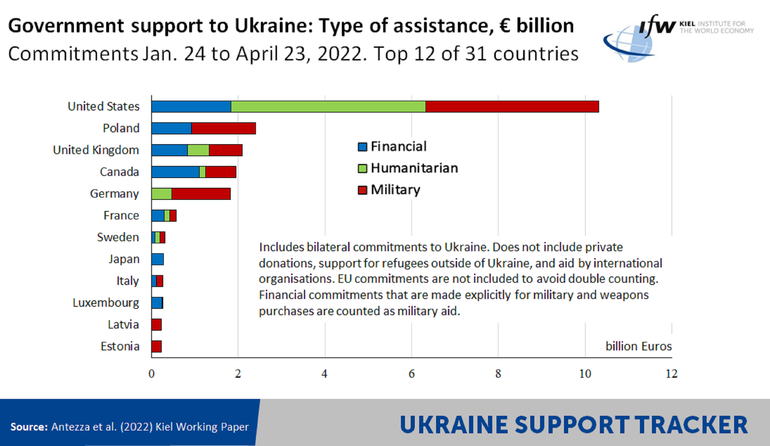
The Kiel Institute for the World Economy estimates that the United States and Europe have pledged roughly $100 billion in military and economic aid to Ukraine since the Russian invasion. That includes increasingly sophisticated military equipment ranging from Patriot air defense systems to the Leopard 2 and M1A2 Abrams tanks that were promised last week.
置頂精選
基爾世界經濟研究所(Kiel Institute for the World Economy)分析俄烏戰爭影響到國際經濟.
2023/02/01 10:19
瀏覽698
迴響0
推薦3
引用0
.
 .
.
.


Government support to Ukraine: Type of assistance, € billion..
基爾世界經濟研究所(Kiel Institute for the World Economy)的估計,自俄羅斯入侵烏克蘭以來,美歐各國已向烏克蘭提供約1000億美元的軍事和經濟援助,其中包括精密複雜的軍事裝備,如愛國者防空系統,以及上週承諾的豹2式戰車(Leopard 2)和 M1艾布蘭戰車(M1 Abrams)。
俄羅斯也需要外國的幫助,該國從砲彈、無人機,到導彈,各種軍事裝備都快耗盡,但迄今為止,只有伊朗和北韓這兩個國家,願意提供軍事裝備給俄國。
 .
.
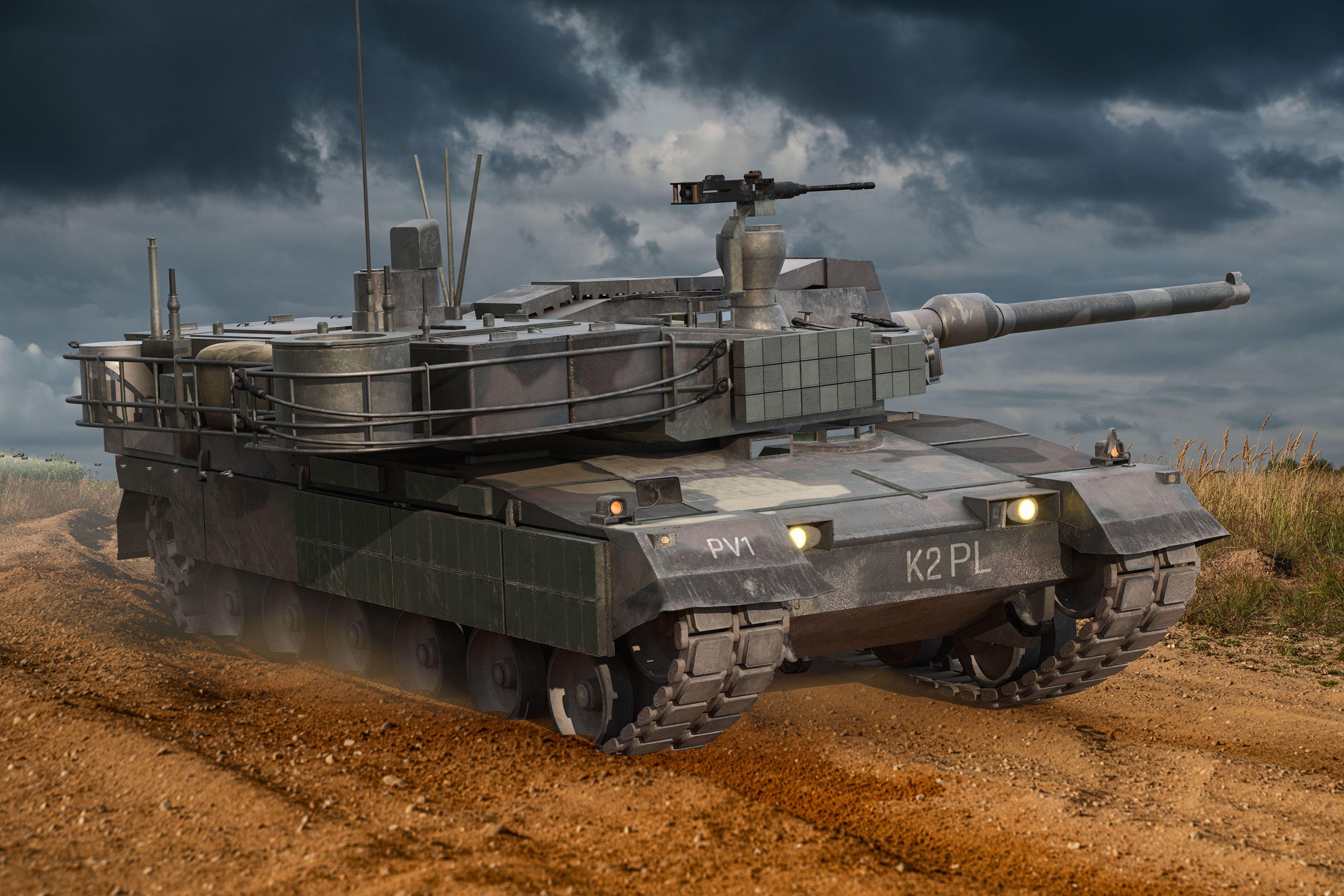
Can the Latest M1 Abrams Tank Outgun China’s and Russia’s Most Advanced Battle Tanks?
.
.
Faz": US urged Germany to supply Leopard 2 tanks to Ukraine.
Some of the most expensive and sophisticated weapons being sent to Ukraine, such as the Patriot, are produced by the US.
..中國是世界上最大的高科技產品出口國,第4大武器出口國,如果北京願意提供俄國軍事裝備,俄國獲勝的可能性將大幅提升,但這沒有發生,這顯示在現實中,普丁和習近平在俄羅斯入侵烏克蘭前幾週共同宣布的友誼「無上限」,存在明顯的局限。
.Xi Jinping doesn’t want to wind up on the losing side in Ukraine.
Russia has a lot more people, a larger economy and a more powerful military than Ukraine. By all rights, it should have crushed Ukraine at the start of the war. That this didn’t happen — and that the war is now heading into its second year with Kyiv in a good position to regain more lost ground — can be explained in no small part by the reality that Ukraine has many allies and Russia does not.
Russia needs foreign help, too. It’s running low on everything from artillery shells to drones to missiles. But only two rogue states that we know of — Iran and North Korea — have so far been willing to provide the Kremlin with military equipment. Advantage, Ukraine.
.Russia’s biggest missing military supplier is China — the world’s largest exporter of high-tech goods and the fourth-largest exporter of weapons. Beijing could play the same role for Russia that the United States is playing for Ukraine. If that were to happen, the odds of a Russian victory would rise exponentially. But that hasn’t happened, suggesting that, in practice, there are sharp limits to the “no limits” friendship that Russian President Vladimir Putin and Chinese President Xi Jinping proclaimed just a few weeks before the Russian invasion of Ukraine on Feb. 24.
Far from going all in on Putin, Xi is trying to balance between the West and Russia — thereby creating a potential opportunity for the Biden administration.
.
China has been happy to continue trading with Russia on advantageous terms. China and India have replaced Europe as the major purchasers of Russian oil and gas, which have fallen in price because of Western sanctions. In return, according to researchers at Silverado Policy Accelerator, China has become the Kremlin’s largest source of imports — in particular the semiconductors that Russia needs to manufacture both civilian and military equipment. Because Apple and Samsung stopped selling smartphones to Russia, China stepped in and captured 70 percent of the Russian market in the third quarter of 2022. This two-way trade indirectly subsidizes Putin’s war effort — and, in the case of microchips, could enable Russian arms production.
But remember: China also had a robust economic relationship with Ukraine before the invasion. Indeed, as noted by my Council on Foreign Relations colleague Zongyuan Zoe Liu: “By 2019, China had replaced Russia as Ukraine’s largest trading partner, becoming the top importer of Ukrainian barley and iron ore, while Ukraine overtook the United States as China’s largest corn supplier.”
Taiwanese Foreign Minister Joseph Wu told me that “China wants to see prolonged war in Ukraine, because it will divert the West from China while China is getting energy at low prices from Russia.” Maybe, but China has not been happy about the economic disruptions caused by the Russian invasion. As the largest lender to low-income nations, China has to worry about being repaid by countries that have seen their economies battered by soaring commodity prices.
Chinese diplomats have privately been telling the Europeans that Xi did not know of the Russian invasion in advance and had to scramble to evacuate 6,000 Chinese nationals in Ukraine. Xi has also publicly expressed “questions and concerns” about the Russian invasion and told Putin not to use nuclear weapons.
As an unsentimental practitioner of realpolitik, Xi does not want to wind up on what could be the losing side. The Financial Times reports, based on conversations with Chinese officials, that “China now perceives a likelihood that Russia will fail to prevail against Ukraine and emerge from the conflict a ‘minor power,’ much diminished economically and diplomatically on the world stage.”
In other words, a defeated Russia might not be a very useful future ally for China — another country that has few friends in the world. And China, as the world’s largest trading nation, cannot afford to become as isolated as Russia has become. That helps to explain why Beijing is reaching out to Europe and trying to ratchet down animus with the United States — for example, by sidelining one of its most noxious “wolf warrior” diplomats.T
to coax China into being more cooperative on the war in Ukraine and other pressing issues such as North Korea, Heer told me, “We would need to convince the Chinese that we are at least as interested in the potential for peaceful coexistence and strategic cooperation as we are in pursuing our systemic strategic rivalry.” But, in the current atmosphere of spiking tensions, that’s “a very tall order.”
So, it’s doubtful that the United States can persuade China to become a partner in ending the Ukraine war. But at the very least the Biden administration can continue pressing China not to provide military equipment to Russia. As long as China stays largely on the sidelines, Ukraine will have a fighting chance to prevail.
 。
。

由於蘋果和三星停止銷售智慧型手機給俄國,中國已於2022 年第三季佔據了俄國70%的市場,這種雙邊貿易間接幫助了普丁的戰爭,中國的晶片有助於俄國製造武器。
但另一方面在入侵之前,中國也與烏克蘭有著強健的經濟關係,「外交關係協會」(CFR)國際政治經濟研究員(Zongyuan Zoe Liu)指出,中國在2019年已經取代俄羅斯,成為烏克蘭最大的貿易夥伴,是烏克蘭大麥和鐵礦的最大進口國,而烏克蘭則超越美國,成為中國最大的玉米供應國.
習近平沒有為了普丁孤注一擲,反而試圖在西方和俄國之間取得平衡,進而為拜登政府創造潛在的機會
.
A Database of Military, Financial and Humanitarian Aid to Ukraine
The Ukraine Support Tracker lists and quantifies military, financial and humanitarian aid promised by governments to Ukraine between January 24, 2022 and currently through November 20, 2022. It covers 40 countries, specifically the EU member states, other members of the G7, as well as Australia, South Korea, Turkey, Norway, New Zealand, Switzerland, China, Taiwan and India. The database is intended to support a facts-based discussion about support to Ukraine.
Following the EUs decision of large new financial aid, Europe has for the first time surpassed the US in the value of total committed aid to Ukraine. Germany has become the largest donor country in Europe. The EU has significantly expanded its support commitments. EU countries and institutions total nearly 52 billion euros in military, financial and humanitarian assistance until November 20. The commitments made by the U.S. add up to just under 48 billion euros. The main reason for the changes is an 18-billion-euro Macro-Financial Assistance (MFA) package agreed by the EU for 2023.
.
Who provides the most aid to Ukraine?
US, EU and European states provide most of the military, financial and humanitarian aid to Ukraine..
國際戰略觀察家分析認為,俄烏戰爭迪始作俑者美國,如今陷入武器供應烏克蘭的陷井中,但是也就是說幫助美國武器製造業,清除庫存的舊武器,再度製造新式武器給予美軍使用,如此循環美國都有利益,反是烏克蘭的戰爭死亡是烏克蘭的阿兵哥與美國毫無關係? 頂多損失一些僱傭兵而已..


你可能會有興趣的文章:
限會員,要發表迴響,請先登入


