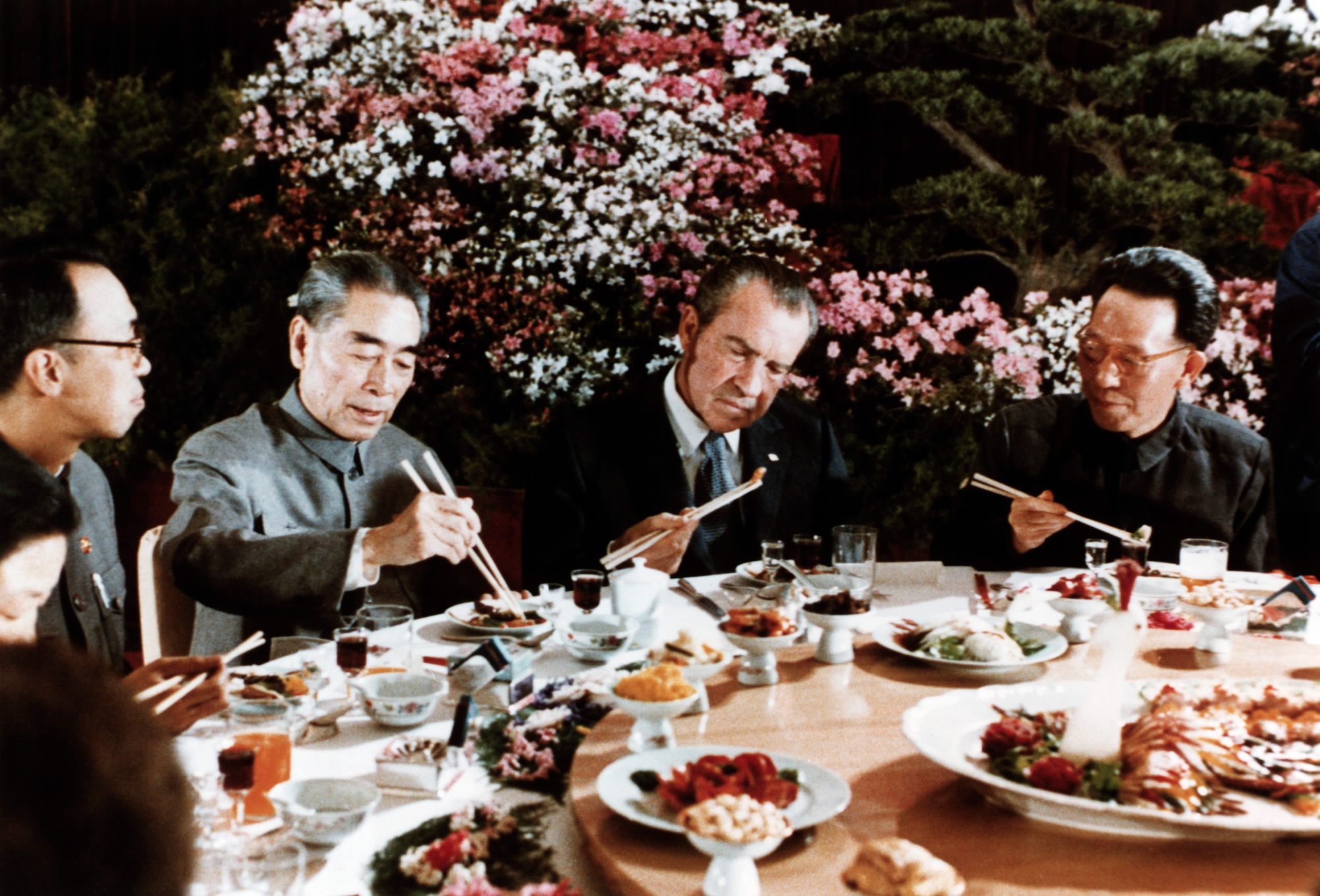
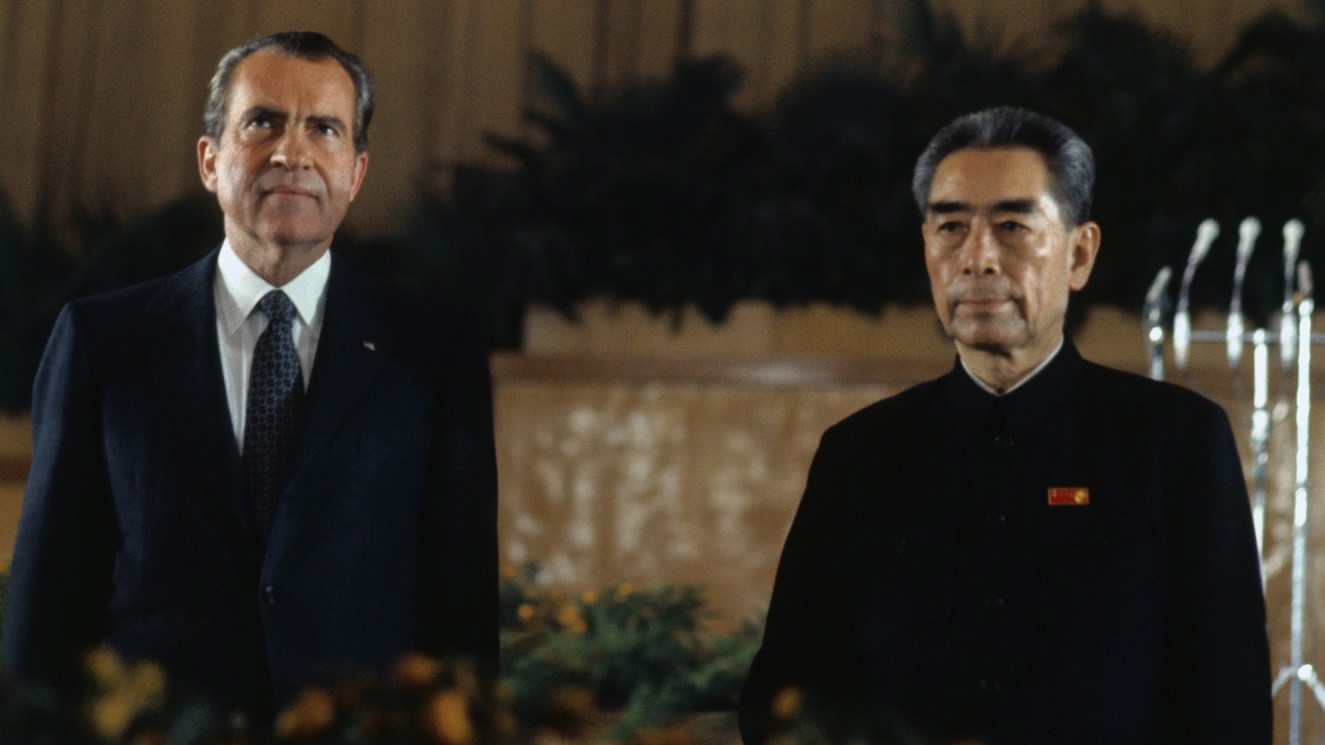
 .1972年2月21日,美國時任總統尼克松應中國時任總理周恩來邀請,實現歷史性上首次訪華,期間與領導人毛澤東會面,結束兩國多年彼此孤立和敵對局面,亦為之後兩國建交以及中國加入國際外交舞台奠下基礎。
中美三個聯合公報(英語:Three Joint Communiqués)是指中華人民共和國政府與美國政府共同對外發表的三個外交聲明的合稱,包括了《上海公報》、《中美建交公報》和《八一七公報》。這三個公報是中美在冷戰時期開啟對話和關係正常化的重要基礎,其中有關台灣問題的部分在今天的重要性則更為顯現。美國政府主張其外交上的「一個中國」政策是基於「中美三個聯合公報和臺灣關係法」制訂的。
兩國之間的第一個聯合公報《上海公報》是於美國總統尼克森訪華期間在上海與中國國務院總理周恩來簽署的,全名稱為《中華人民共和國和美利堅合眾國聯合公報》,於1972年2月28日簽署。這個聯合公報的特別之處在於,雙方首先並沒有迴避各自的歧見,文件中闡明了兩方不同的觀點,然後表示雙方願意尊重對方的立場。隨後再闡述雙方達成的共識。
《上海公報》的主要內容包括:
- 兩國對問題以及其他地區政治局勢的不同看法;越南亞洲
- 正常化符合兩國利益;中美關係
- 國際爭端應在尊重主權、不干涉別國內政等基礎上解決,反對任何國家在亞洲建立霸權或在世界範圍內劃分利益範圍;
- 中華人民共和國政府堅決反對任何旨在製造「一中一臺」、「一個中國、兩個政府」、「兩個中國」、「台灣獨立」和鼓吹「台灣地位未定論」的活動;
- 美方認識到(英文為acknowledge)海峽兩岸所有的中國人都堅持一個中國,台灣是中國的一部分(此處,美國仍將中華民國視為中國,尚未與中華人民共和國建交)。並對這一立場不提出異議(not to challenge),它重申它對由中國人自己和平解決台灣問題的關心,並隨著地區緊張局勢的緩和將逐步減少駐台美軍設施和武裝力量;
- 擴大兩國民間交流與往來,為雙邊貿易提供便利;
- 保持接觸管道。
《上海公報》是1972年尼克森訪華的主要成果,代表中美關係相對緩和。。而今天,《上海公報》最大的意義則在於美國對一個中國的立場首次正式表明了不表異議(not to challenge)。
《上海公報》的簽署也導致美國開始逐漸從台灣撤軍,根據美軍協防台灣司令部(USTDC)的數據,1970年時駐台美軍人數約1萬人,到了1974年時,駐台美軍人數只剩約5千8百人。

1972年2月28日,位於上海的尼克森.
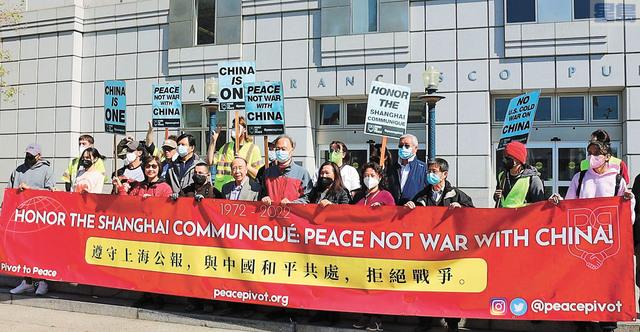
19720228-20220228.中國與美國簽訂上海公報.
50周年為什麼中國與美國都無舉辦盛大的集會紀念日,新聞媒體也就是說沒有特別報導為什麼?.
中國外交部只是例行公事的舉辦說明而已.
China-US Trade Has Grown to USD750 Billion From Next to Nothing in 50 Years, Wang Yi Says.
China-US trade has increased from a negligible amount to USD750 billion since the two countries established diplomatic relations, Chinese Foreign Minister Wang Yi said yesterday on the 50th anniversary of the signing of the Joint Communique of the Peoples Republic of China and the United States of America.
China-US relations have made remarkable progress, Wang noted, adding that the two countries have 50 sister provinces and states as well as 233 sister cities. Also, before the pandemic, there were more than 300 flights carrying more than five million passengers between the two countries every year.
Phoenix blankets have become well-known both at home and abroad since they were given to the US guests as a national gift in 1972, Orient International Holdings Chairman Tong Jisheng noted. Now the firm’s trade with the United States is worth over CNY10 billion (USD1.6 billion) a year on average, accounting for a quarter of Orient International’s total exports worldwide.
The American Chamber of Commerce in Shanghai conducted a survey among its member companies last year, Zheng Yixiang, president of the chamber, told Yicai Global, which found that 78 percent of them had a positive or relatively positive attitude toward Chinas development.
“China is the most important market for many US multinationals,” Zheng said. “Our member companies can make contributions to China’s economy, employment and tax revenue if they develop well in the country.”
“The government, the chamber, and the member companies share the same interests much of the time,” he added.
The two countries issued the Joint Communique of the Peoples Republic of China and the United States of America on Feb. 28, 1972, the last day of US President Richard Nixons historic week-long visit to China. In the document, also know as the Shanghai Communique, the US acknowledged that “there is but one China and Taiwan is part of China.”

. .
.
.
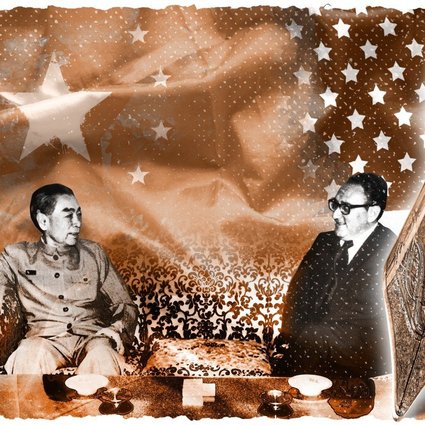
The Shanghai Communique, drafted by Zhou Enlai and Henry Kissinger, became arguably the most important breakthrough agreement in the history of the US-China relations. I
中國與美國雙方政府領導人,都已作古,相關迪工作人員也就是說死的死,老的老,退休的退休,在雙方的政壇已經完成任務,下檯鞠躬,謝幕喇,往事休要重提.
國際戰略觀察家分析認為:
1:上海公報雖然是兩國政府授權簽訂的,但是中國與美國當時尚未建立正式的外交關係,對於該文件的國際法律地位與身份令人質疑,是否合乎國際法等條文?
2:有部份學者專家認為該文件,僅有美國總統尼克森與中國總理周恩來簽署,並未加蓋中國政府的官印(玉璽),而美國政府也就是說沒有使用白宮專用的美國簽署文件的紙張,雙方彼此簽字後交換文件,也無公開照片顯示?
3:傳聞該文件包括原始附件都已被雙方政府深鎖典藏不公開.
4:文件起草人之一時任美國國務卿.季辛吉HK.對於記者表示,沒有什麼秘密,日後公開文件的內容,卻是影響到未來的國際關係與海峽兩岸的關係.
5:上海公報埋下日後,美國與中國正式建立外交關係的種子,同時也就是說美國同意中華人民共和國的要求,日後與中華民國斷交,並撤軍台灣,終止美中共同防禦條約,美國海軍第七艦隊的船隻再也沒有出現於台灣港口.
6:時至今日50周年紀念上海公報台灣方面毫無任何表示,原因就是被美國壓制.
.7:上海公報50周年之際正值俄羅斯與烏克蘭戰爭,中國自我控制未有任何不利於國際關係的舉動.
8:美國是烏克蘭戰爭幕後的影武者,美國對於俄羅斯實施嚴厲的經濟制裁及切斷SWIFT.阻斷俄羅斯的國際貿易及國際金融業務.
9:美國為烏克蘭戰爭的始作俑者,目前正暗中嗾使歐洲人,加入支援烏克蘭的戰爭,已有丹麥,芬蘭,斯洛伐克,德國,法國,荷蘭,捷克匈牙利等國家響應,支援武器彈藥及人員前往烏克蘭擴大戰爭,根據情報顯示出,美國亦派遣大量軍人混雜其中,參加作戰抵抗俄羅斯.
10:20220228.正是50周年紀念上海公報.美國將派前官員代表團竄訪台灣 美國總統拜登週一將派遣一個由前高級國防和安全官員組成的代表團訪問臺灣。這個團由前參謀長聯席會議主席邁克爾馬倫帶隊,其他隨行官員包括布希任內的副國家安全顧問奧沙利文、奧巴馬時期的國防部副部長弗盧努瓦等人。
該官員表示,此行旨在“展示我們對臺灣的持續堅定支援”.可見美國帝國主義橫行霸道,傳聞它們壓迫台灣購買更多的美國武器,以及誘騙台灣海軍參加2022.環太平洋軍演,好促銷更多的2手驅逐艦給予台灣,此外要求與台灣共同成立快速打擊部隊,好藉口駐軍台灣.因此讓台灣逐漸形成下一個"烏克蘭",給予中國攻打台灣的機會與藉口,美國前總統川普的言論,不是胡說八道而是有所依據的,總而言之美國始亂終棄,台灣沒有好下場?
Nixon’s historic trip to China: how the landmark Shanghai Communique shaped ties for the next 50 years.
-
Joint statement released on last day of US president’s visit in 1972 is arguably the most important breakthrough agreement in the history of US-China relations
-
Critics argue the visit and communique were the beginning of the US’ dilemma over Taiwan, especially surrounding its strategic ambiguity .In February 1972, US president Richard Nixon defied conventional foreign policy wisdom when he arrived in Beijing for meetings with Chinese leader Mao Zedong.
When former American national security adviser Henry Kissinger returned to Beijing three months after his secret groundbreaking trip in July 1971, the real test had just begun for the Cold War rivals seeking rapprochement through dialogue.
Part of Kissinger’s mission was to hammer out the finer details of United States president Richard Nixon’s historic trip to China that both sides had agreed to in July, including setting the date and discussing press coverage to convince the hostile public in the US to warm towards communist China.
He was also tasked with an even more challenging job: to draft a joint statement for the presidential visit with then Chinese premier Zhou Enlai. The resulting document that was issued on the last day of Nixon’s China trip in February 1972, would become known as the Shanghai Communique. It is arguably the most important breakthrough agreement in the history of the US-China relations.
Kissinger’s second trip to China was different from the first exploratory visit which took many US allies and officials at Nixon’s White House by surprise with its strict secrecy. It was described as “a masterpiece of undercover work” by the late Harvard professor Roderick MacFarquhar.
-
In recognition of the trip’s historical significance, the South China Morning Post is running a multimedia series exploring interesting points of the past 50 years in US-China relations. In the third piece in the series, looks at the lasting implications of a document negotiated by top diplomats Henry Kissinger and Zhou Enlai.
-
Code-named “[Operation Marco] Polo II” and publicly announced weeks before Kissinger left for China, it was effectively a full-scale dress rehearsal for the historic presidential visit. Kissinger, who had just emerged from the glittering success of the first visit, also took Nixon’s Air Force One, the “Spirit of ’76”.
While it was Nixon, an ardent anti-communist, who made the about-face decision to open up relations with China in 1969, Kissinger was initially sceptical and called Nixon’s idea a “flight of fantasy”. But he soon became preoccupied with seeking detente with the largely isolated communist regime and was more than eager to win personal credit for it. With the first visit in July, he nonetheless became the first senior American official to set foot in China since the Communist Party took control more than two decades before.
-
According to Shelley Rigger, a Taiwan expert and a political scientist at Davidson College in North Carolina, the need to balance the power of the rising Soviet Union brought Beijing and Washington together.“I don’t think anyone set aside ideological rivalry; instead, they both were practising Mao’s Theory of Contradictions,” she said.
For Beijing, the Soviet Union was the primary contradiction, while the primary issues for the US were the Soviets and the Vietnam war.
“The secondary contradiction between the US and China was set aside so that both could focus on the primary contradiction,” Rigger said.
But the second visit in October 1971 was very different to the first because it coincided with the United Nations General Assembly’s annual debate and vote over membership for the People’s Republic of China.
Just a few days before Kissinger left for Beijing, America’s ambassador to the UN George H.W. Bush argued that Kissinger’s visit would undermine Washington’s effort to preserve Taiwan’s seat at the UN. Bush, who later became the de facto ambassador to China and then US president, described the vote as “fighting the battle of people who obviously do want to see us lose” and urged Nixon to reschedule the trip, according to a transcript of the White House meeting.
Keenly aware of the support Taiwan enjoyed in the US, especially among lawmakers, Nixon understood that “the discussions with the Chinese cannot look like a sell-out of Taiwan” or like we were “dumping our friends”. But Nixon saw the China opening as essential to his re-election bid the following year and he decided Kissinger should go ahead with the trip as “we’ve got to make the big plays now”.
Despite Bush’s fight, Beijing took over the seat at the UN previously occupied by Taiwan with a landslide victory in the General Assembly vote. In addition to the widespread support among developing nations, pundits believed Kissinger’s secret trip to Beijing and the subsequent announcement of Nixon’s state visit helped tilt the balance in China’s favour at the UN and on the world stage.
During Kissinger’s second China mission there were closed-door talks between Kissinger and Zhou, mostly over the drafting of the communique, while relying solely on Chinese interpreters – a departure from past protocols. According to Kissinger, he spent nearly 25 hours over the following week combing through the details of Nixon’s upcoming trip and a host of regional issues relating to Taiwan, their shared concerns about the Soviet Union, the Vietnam war and the ongoing South Asian conflict over Bangladesh.
The pair and their aides worked hard and spent more than 11 hours negotiating through seven drafts of the communique. According to Winston Lord, then a national security aide who later became US ambassador to China, most of the Shanghai Communique was negotiated during their second trip to Beijing, except for aspects relating to Taiwan, which was “the most sensitive and that we had to keep haggling about [it] during Nixon’s trip itself in February 1972”, he later recalled.
When Kissinger presented the first draft communique to Zhou, it was rejected immediately after the Chinese premier checked with Mao. “This is useless: this is a typical diplomatic document that papers over differences. It’ll have no credibility, because how can two nations that have hated each other and fought each other and been isolated from each other for 22 years, suddenly put a document out like this that suggests they’re friends?” Zhou was quoted by Lord as saying.
Zhou challenged Kissinger, who appeared more interested in a Soviet-style communique that highlighted areas of agreement despite their divergent views on most issues. Instead, Zhou came up with a Chinese draft, with “the brilliant ‘our side-your side’ formula” as American diplomat Richard Holbrooke called it, in which each side stated its own position on areas of disagreement.
The negotiations over the communique went for months, finishing when Nixon’s week-long China visit had almost drawn to a close and ultimately boiling down to semantics, especially in relation to Taiwan.At one point Nixon intervened, cautioning Zhou that “if too much was said publicly, that would be seized upon by Americans who opposed the opening to China from both right and left … as an excuse to disrupt normalisation”.
While Zhou Enlai described the Taiwan issue as “the crucial question”, Nixon also viewed it as a touchstone for both sides. But despite the intensity of the discussions, the Americans appeared to have failed to have “fully absorbed the centrality of Taiwan to PRC interests”, according to the late US diplomat Alan Romberg, a leading expert on cross-strait relations. Instead they, including Kissinger himself, still largely saw the Taiwan issue as more of a practical obstacle rather than China’s “central question of concern”, as Zhou had claimed.
As Kissinger himself explained during his second China trip: “The trouble is that we disagree, not that we don’t understand each other. We understand each other very well. The Prime Minister [Zhou] seeks clarity, and I am trying to achieve ambiguity.”
In the end, the final version of the communique, released at the scenic Jinjiang Hotel, Shanghai’s first guest house for foreign dignitaries, on the eve of Nixon’s departure back to the US, provided ambiguous assurance to China about Taiwan.
Washington “acknowledged” the PRC’s claim to the island – that “Taiwan is part of China” – and stated it “does not challenge” that claim.“But the United States never made clear what this meant, and the US has never subsequently clarified its formal position,” commented Jerome Cohen, a law professor at New York University.
While Nixon’s China trip and the Shanghai Communique marked the start of Washington’s decades-long engagement with Beijing, critics have long argued they were the beginning of the US’ dilemma over Taiwan, especially surrounding its strategic ambiguity over the self-ruled island. Some in the administration of former president Donald Trump even suggested that the communique be scrapped in a bid to seek closer ties with Taiwan.
Rigger said Kissinger might have led Zhou Enlai to believe the US would not stand in the way of China having what it wanted with respect to Taiwan.
“I suppose it was ‘putting it off’ in the sense that the US wasn’t handing the island over as part of normalisation (which is not something the US could have done anyway), but [Zhou] did not think the US should continue to provide military help to Taiwan. It’s no wonder leaders in both Beijing and Taipei have a hard time trusting the US,” she said.
George Magnus, a research associate at Oxford University’s China Centre, also said Kissinger’s goal was flawed in design.“Kissinger’s strategic goal – to kick Taiwan into the long grass to allow the US and China to pursue parallel and aligned interests – worked a treat. However, the goal was itself flawed in that it left the issue of Taiwan unresolved, not least because it was not a burning issue to be resolved at the time for either side. But over time, Taiwan has itself become more important, as well as democratic, and China’s strategic and territorial goals have become more forcefully asserted and politically articulated,” Magnus said.
But Tao Wenzhao, a US expert from the Chinese Academy of Social Sciences, disagreed and insisted those lingering issues over Taiwan were resolved.
“The three communiques cannot be separated, especially when it comes to the Taiwan issue,” he said, adding that the normalisation communique in 1979 and the 1982 communique helped clarify and resolve issues from the Shanghai Communique.
The 1979 communique on the establishment of official ties between China and the US said the US government “acknowledges the Chinese position that there is but one China and Taiwan is a part of China”. The communique issued on August 17, 1982 stated that the US took no position on Taiwan’s sovereignty and that this was an issue the two sides of the Strait should resolve.
Niu Jun, a historian and expert on international affairs from Peking University, said that besides the Taiwan aspect, the section on common interests – especially the joint commitment on opposing hegemony – also stood out in the 1,800-word document.
“It was unprecedented, and probably the most meaningful part in the communique. It is still relevant today because it helped stabilise the region and it would be impossible for China to open up to the outside world without a stable regional environment in the Asia-Pacific,” he said.
“It underscored the vision and the extraordinary ability of our leaders back then to take a long view and make sound strategic decisions that may affect future generations.”
Rigger also said that of the three China-US communiques, the Shanghai Communique was the most important. “Without it, there would not have been a normalisation communique in 1979 (at least, not at that time). Nor would there have been a 1982 communique – in part because the Shanghai Communique emerged from a negotiating process in which Beijing was misled into thinking the US would not continue to support Taiwan militarily. It’s not clear to me that PRC leaders would have accepted the Shanghai Communique if they had known the US would continue to sell arms to Taiwan,” Rigger said.However, pundits admit the original Shanghai Communique might not provide much guidance for the challenges of today.Yun Sun, a senior fellow at the Stimson Centre in Washington, said the lessons for Beijing and Washington from Nixon’s visit and creating the joint statement were quite different.
“The Chinese might say that the lesson is [that the] US needs to return to the correct path set by the Shanghai Communique and treat China as a friend again. The Americans will say that [the] Chinese attitude of finger-pointing is precisely the lesson – that engagement in the hope to change China is a mistake,” she said.“Both would agree that Nixon’s trip and US-China rapprochement was [the] result of a common threat, without which US-China relations are bound to change.”Magnus also said the Shanghai Communique had limited relevance in the 2020s “other than as a historical signpost”.“It’s instructive that the US and China were able to reach a modus vivendi in spite of political and ideological differences in 1972 and afterwards. However, it’s quite clear that China is now far bigger and far more influential than in 1972, and has the will and the capacity to try and reshape the global governance system and institutions in its own interests,” he said.“This sets it on a collision course with the US, especially as China aims to become the prominent, if not dominant, power. I fear no communique can paper over this existential competition.”
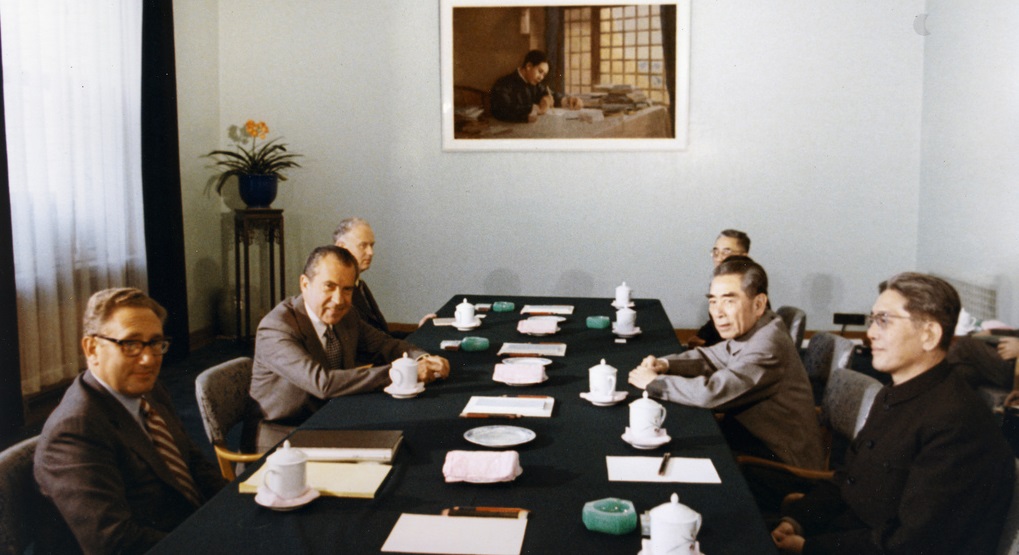
.The Three Communiqués or Three Joint Communiqués are a collection of three joint statements made by the governments of the United States and the Peoples Republic of China (P.R.C.). The communiqués played a crucial role in the establishment of relations between the U.S. and the P.R.C. and continue to be an essential element in dialogue between the two states, along with the Six Assurances and Taiwan Relations Act.
The first communiqué (February 28, 1972), known as the Shanghai Communiqué, summarizes the landmark dialogue begun by President Richard Nixon and Premier Zhou Enlai during February 1972. Some of the issues addressed in this communiqué include the two sides views on Vietnam, the Korean Peninsula, India and Pakistan and the Kashmir region, and perhaps most importantly, the Taiwan (Republic of China) issue (i.e., Taiwans political status). Essentially, both sides agreed to respect each others national sovereignty and territorial integrity. The United States formally acknowledged that "all Chinese on either side of the Taiwan Strait maintain there is but one China"..
The use of the word "acknowledge" (rather than "accept") is often cited as an example of the United States ambiguous position regarding the future of Taiwan]
.
美國聲明:美國認識到(acknowledge),台灣海峽兩邊的所有中國人都認為只有一個中國,台灣是中國的一部分。美國政府對這一立場不提出異議。它重申對由中國人自己和平解決台灣問題的關心。考慮到這一前景,它確認從台灣撤出全部美國武裝力量和軍事設施的最終目標。在此期間,它將隨著這個地區緊張局勢的緩和逐步減少它在台灣的武裝力量和軍事設施。
《上海公報》是美國首次聲明對「一個中國」的說法「不提異議」(not to challenge)。由於這是美中兩國恢復接觸後首次聯合發表外交聲明,《上海公報》文字冗長,從歷史到現實、從立場分歧到國際背景,涵蓋面相當廣泛,台灣問題只是其中之一。在不少台灣人看來,《上海公報》是中美台關係的一個重要歷史轉折點,美國首次聲明對「一個中國」不提異議,造成台灣在主權問題上遭到打壓,直到今天。
..The hall at Jinjiang Hotel, site of the signing of the communiqué.
.The Joint Communiqué of the United States of America and the Peoples Republic of China, also known as the Shanghai Communiqué (1972), was a diplomatic document issued by the United States of America and the Peoples Republic of China on February 27, 1972, on the last evening of President Richard Nixons visit to China.The document pledged that it was in the interest of all nations for the United States and China to work towards the normalization of their relations, and affirmed a mutual interest in détente.
The Shanghai Communiqué begins by briefly mentioning some of the activities that occurred during Nixons visit to China. There is then a review of the differences between the two countries.
The Chinese side expressed that they supported the sovereignty of Laos, Cambodia, and Vietnam. They favored the Democratic Peoples Republic of Korea and opposed the Republic of Koreas entry to the United Nations. They additionally opposed perceptions of growing "Japanese militarism." Concerning the Indo-Pakistani War, China supported the continued cessation of hostilities and Pakistans contested sovereignty over Jammu and Kashmir.
The American side more vaguely mentioned support for the sovereignty of South-East Asian nations, and expressed a commitment to withdraw American soldiers from Vietnam. They affirmed their support for the Republic of Korea, and mirrored Chinas interest in a continued ceasefire in Jammu and Kashmir without asserting partiality for either India or Pakistan.
What followed in the communiqué were the mutual interests of the United States and China. Both parties expressed an interest in the full normalization of relations and a reduced risk of international war. They stated that neither country "should seek hegemony in the Asia-Pacific region," and that both countries oppose any other powers attempts at dominating the region. The Soviet Union was the implicit target of the addition due to their ongoing opposition to the United States along with continued frictions with China following the Sino-Soviet split.
The communiqué included wishes to expand the economic and cultural contacts between the two nations, although no concrete steps were mentioned. The communiqué stated that the normalization of relations would contribute "to the relaxation of tension in Asia and the world."[1]
Taiwan
The communiqué acknowledged there were significant disagreements between China and the United States over the status of Taiwan. The Chinese side repeated their longstanding policy that Taiwan "is Chinas internal affair in which no other country has the right to interfere," and added that "all US forces and military installations must be withdrawn from Taiwan."
The United States expressed their own interpretation of the One-China policy by acknowledging that "all Chinese on either side of the Taiwan Strait maintain there is but one China and that Taiwan is a part of China" and reaffirmed "its interest in a peaceful settlement of the Taiwan question by the Chinese themselves" and affirmed "the ultimate objective of the withdrawal of all U.S. forces and military installations from Taiwan", but did not explicitly endorse the Peoples Republic of China as the whole of China. Kissinger described the move as "constructive ambiguity," which would continue to hinder efforts for complete normalization.
The Shanghai Communiqué represented the United States first diplomatic negotiations with Peoples Republic of China since its 1949 founding, and were the first official communications with the Communist Party of China since the 1944 to 1947 Dixie Mission.
In a March 1972 visit to Taipei, US diplomat Marshall Green argued to Taiwanese Foreign Minister Chow Shu-Kai that the acceptance of the communiqué represented a change in PRC priorities. Namely, Green argued the communiqué demonstrated that the PRC valued peace with the United States above confrontation with Taiwan, and subsequently increased the security of Taiwan.
The aftermath of the Watergate scandal later in 1972 led Nixon to deprioritize further diplomatic efforts with the PRC.[]
Sino-American relations were officially normalized in the Joint Communiqué on the Establishment of Diplomatic Relations in 1979 under the Carter administration.
In a February 2017 opinion piece for The Diplomat, National Committee on U.S.-China Relations president Stephen Orlins praised the Shanghai Communiqué for the cross-Strait stability it offered for Taiwan. Orlins said the communiqué helps ensure confidence with Western investment in Taiwan because of the wide-ranging impacts of the opening of China and continued high-level cross-Strait dialogue.
Reaffirming the agreements made in the communiqué has been a vital component of the continued bilateral relations between China and the United States, especially after a change in the American presidency.
.


- 伊朗牛逼 首次發射4000公里彈道飛彈 攻擊印度洋狄耶戈加西亞英美基地 Iran denies responsibility for missile attacks on Diego Garcia.
- 美 國Joe Kent 辭去國家反恐中心主任一職. USA & ISRAEL NO WAR WITH IRAN.
- 義大利托斯塔納.春季來臨.Tuscany Spring season coming.
- 美國老百姓 示威遊行抗議川普對於伊朗發戰爭.Act Now to Stop War and End Racism,ANSWER Coalition
- 美國 以色列與伊朗 戰爭 .USA,ISRAEL WAR GAME WITH IRAN.
- Château de Versailles 凡爾賽宮冬季景象.
 1樓. 找優惠券2025/04/18 12:08我經常在極惠折找優惠券,網站內容豐富且折扣力度大,幫助我節省不少購物費用。介面設計友善,使用方便,無論是日常用品還是品牌商品,都能輕鬆找到心儀的優惠,真的很實用!


