.
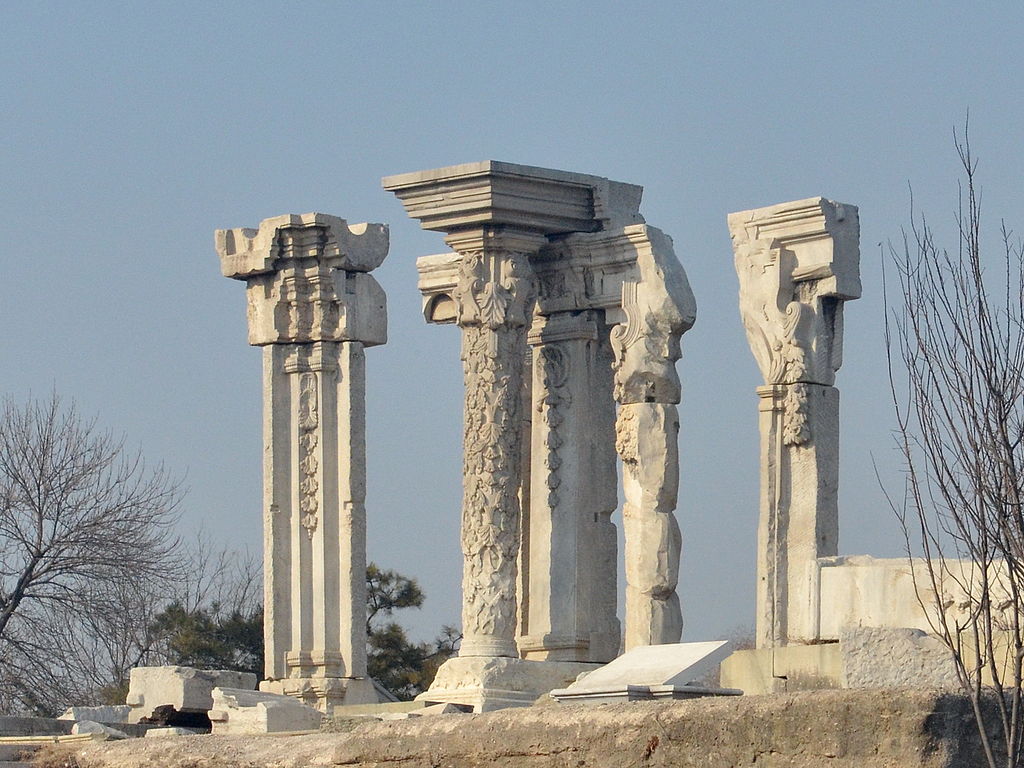
2021年的秋末季節,圓明園內秋風瑟瑟,樹葉落地,景象淒涼冷,劫後餘生的西洋樓立柱,雕刻精美,彷彿昨日繁華熱鬧的情景扔猶在,只是朱顏改,再也聽不到絲竹管樂的聲音與杯篁交錯囍笑嘻戲的場景,大清帝國的窮途末路,英法聯軍火燒圓明園,彷彿就在昨日才發生的,無奈阿無奈,可悲,人類的文明古蹟真寶,往往就是焚燬於戰爭時期,傳聞中國當局,有意保留圓明園被焚燬,被破壞的遺址,教育後代中國人,牢記國家民族的恥辱,被西方國家列強的帝國主義侵略的下場,教育年輕一代的中國人,必須團結一至,奮發圖強,為國家民族的生存而奮戰不懈.
..
.
.
1856年10月,大英帝國和法蘭西第二帝國在俄羅斯帝國和美國的支持配合下,聯合發動了英法聯軍之役。英法聯軍於1860年10月6日攻抵北京德勝門、安定門等處,當時,僧格林沁、瑞麟在城北一帶稍事抵抗,即行逃散。法軍先行,於當天下午經海淀,1860年10月6日傍晚,英法聯軍闖入圓明園大宮門。至晚7時,法國軍攻占了圓明園。管園大臣文豐投福海而死。住在園內的常嬪受驚身亡。從第二天開始,軍官和士兵就瘋狂地進行搶劫和破壞。為了迫使清政府儘快接受議和條件,英法聯軍洗劫兩天後,向城內開進。1860年10月7日,法軍司令孟托邦當天即函告法外務大臣:「予命法國委員注意,先取在藝術及考古上最有價值之物品。」英軍也立刻派士兵竭力收集。
英法聯軍入園的第二天就不再能抵抗物品的誘惑力,聯軍士兵大肆劫掠園中的珍寶和陳設物,中國的民眾也直接參與了劫掠、焚毀圓明園的行動。
]清室史料指,圓明園內當時僅陳列和庫存的歐洲各式大小鐘錶即達441件,劫後倖存的只有一件大鐘。事後查繳被中國本地土匪搶走和侵略軍「委棄道途」的一部分失散物件即達1197件。[來源請求]清廷曾捉拿英國軍使巴夏禮一行39人,額爾金於10月17日已知被捕的英使中13人已經被虐至死。]額爾金為了報復,此於10月18日下令放火燒園,以教訓咸豐帝]。圓明園大火持續燒了三天三夜。
.In 1860, during the Second Opium War, British and French expeditionary forces, having marched inland from the coast at Tianjin (Tientsin), arrived in Beijing (Peking).
In mid-September, two envoys, Henry Loch and Harry Parkes went ahead of the main force under a flag of truce to negotiate with Prince Yi and representatives of the Qing Empire at Tongzhou (Tungchow). After a day of talks, they and their small escort of British and Indian troopers (including two British envoys and Thomas William Bowlby, a journalist for The Times) were taken prisoner by the Qing general Sengge Rinchen. They were taken to the Ministry of Justice (or Board of Punishments) in Beijing, where they were confined and tortured. Parkes and Loch were returned after two weeks, with 14 other survivors. 20 British, French and Indian captives died. Their bodies were barely recognizable.[
On the night of 5 October, French units diverted from the main attack force towards the Old Summer Palace. At the time, the palace was occupied by only some eunuchs and palace maids; the Xianfeng Emperor and his entourage had already fled to the Chengde Mountain Resort in Hebei. Although the French commander Charles Cousin-Montauban assured his British counterpart, James Hope Grant, that "nothing had been touched", there was extensive looting by French and British soldiers.[] There was no significant resistance to the looting, even though many Qing soldiers were in the vicinity]
On October 18, Lord Elgin, the British High Commissioner to China, retaliated against the Chinese resistance by ordering the destruction of the Old Summer Palace.[] Destroying the Old Summer Palace was also a warning to the Qing Empire not to use kidnapping as a political tactic against Britain.[] It took 3,500 British troops to set the entire place ablaze, and the massive fire lasted for three days. Unknown to the troops] some 300 remaining eunuchs and palace maids, who concealed themselves from the intruders in locked rooms, perished with the burnt palace buildings. Only 13 buildings survived intact, most of them in the remote areas or by the lakeside. (The palace would be sacked once again and completely destroyed in 1900 when the forces of the Eight-Nation Alliance invaded Beijing.[]) Charles George Gordon, who was then a 27-year-old captain in the Royal Engineers and part of the 1860 Anglo-French expeditionary force, wrote about his experience:
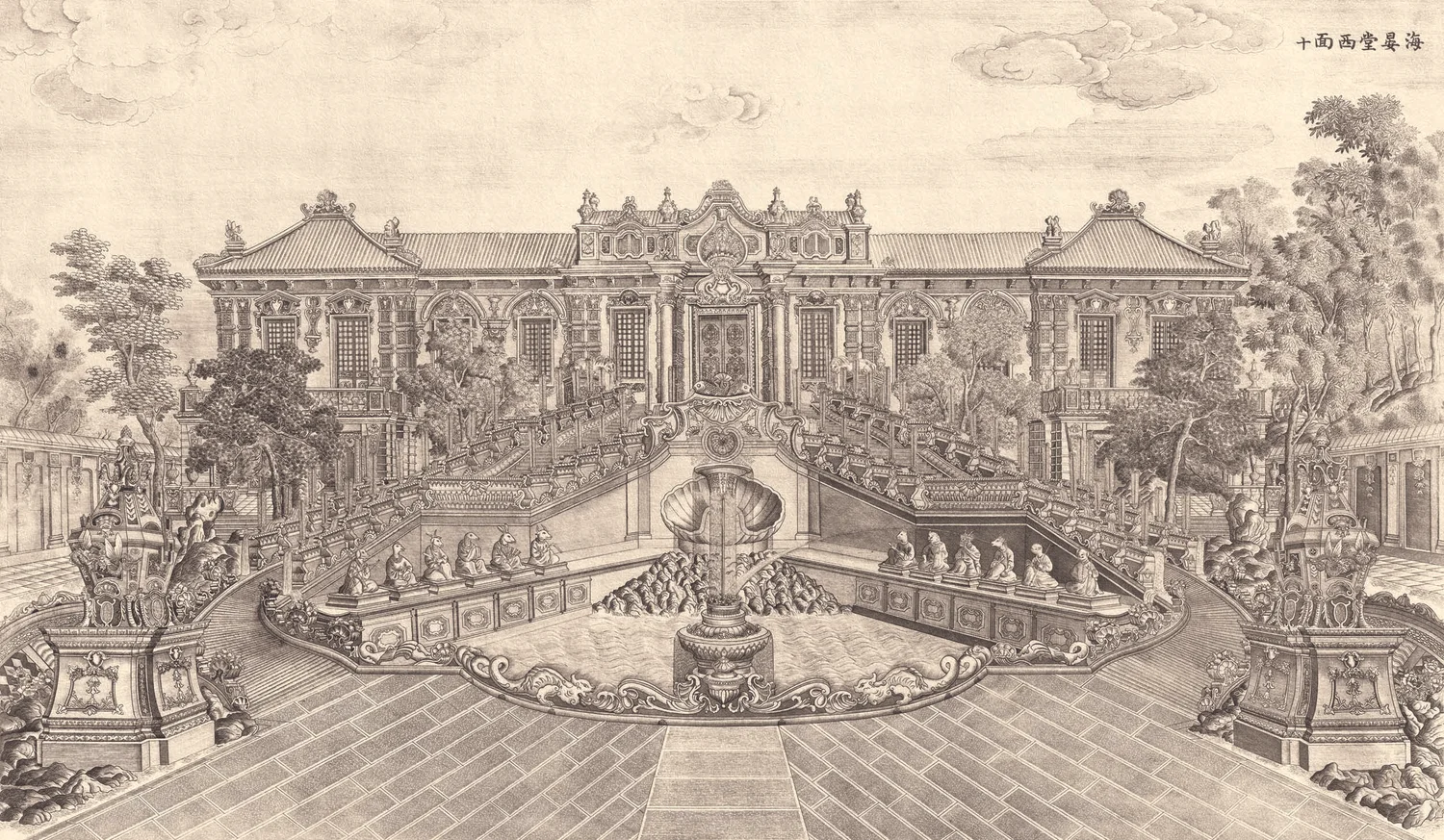
British and French looters preferred porcelain (much of which still graces British and French country houses]) while neglecting bronze vessels prized locally for cooking and burial in tombs. Many such treasures dated back to the Shang, Zhou and Han dynasties and were up to 3,600 years old. A specific exception was the looting of the Haiyantang Zodiac fountain with its twelve bronze animal heads.] Some of the most notable treasures ended up at the Chinese Museum in the Palace of Fontainebleau, which Empress Eugénie specifically set up in 1867 to house these newly acquired collections.Once the Old Summer Palace had been reduced a sign was raised by the invaders with an inscription in Chinese stating, "This is the reward for perfidy and cruelty". The burning of the palace was the last act of the war.
.

.
.
.
.
.圓明園是建於清朝的大型皇家園林,供清帝盛夏避暑、聽政,處理軍政事務,位於現今中華人民共和國北京市海淀區。由圓明園及其附園長春園、綺春園(後改稱萬春園)、熙春園和春熙院組成,而較大的三園通稱為「圓明三園」占地面積3.5平方千米,建築面積達16萬平方米,約合5,200畝]一百五十餘景,有「萬園之園」之稱。
圓明園規模宏偉,運用了各式園林風格及造園技巧,其詩畫意境被大多數中國園林學家認為是中國園林藝術的頂峰作品,是中國古典園林平地造園、堆山理水集大成的典範。清朝時一些外國傳教士參觀圓明園後將其稱作「萬園之園」。
1860年,圓明園在英法聯軍之役中被洗劫破壞後放火焚毀,文化大革命期間再次遭到破壞,歷經戰亂劫掠,現時僅存遺址。在中華人民共和國政府成立圓明圓管理處後開始實施保護與利用。於1979年將其列入為文物保護單位,於1988年,圓明園遺址被中華人民共和國國務院公布為第三批全國重點文物保護單位之一。圓明園遺址中部和東部成立了圓明園遺址公園。2008年7月29日,圓明園管理局宣布,開放九州景區。
圓明園在清室150餘年的創建和經營下,曾以其宏大的地域規模、傑出的營造技藝、精美的建築景群、豐富的文化收藏和博大精深的民族文化內涵而享譽於世,被譽為「一切造園藝術的典範」,被法國作家維克多·雨果稱譽為「理想與藝術的典範」。道光朝時,國事日衰,財力不足,但寧撤萬壽、香山、玉泉「三山」的陳設,罷熱河避暑與木蘭圍獵,仍不放棄圓明三園的改建和裝飾。1860年英法聯軍洗劫圓明園,文物被劫掠,同治帝時欲修復圓明園,後因財政困難,被迫停止,改建其他建築。八國聯軍之後,又遭到官僚、軍閥巧取豪奪的毀滅打擊,終變成一片廢墟。
.
.
.
.
.
.
.
.
.
.
.
.
The Old Summer Palace, known in Chinese as Yuanming Yuan called the Imperial Gardens , and sometimes called the Winter Palace,] was a complex of palaces and gardens in present-day Haidian District, Beijing, China. It is 8 kilometres (5.0 mi) northwest of the walls of the former Imperial City section of Beijing. Widely perceived as the pinnacle work of Chinese imperial garden and palace design, the Old Summer Palace was known for its extensive collection of gardens, its building architecture and numerous art and historical treasures. Constructed throughout the 18th and early 19th centuries, the Old Summer Palace was the main imperial residence of Qianlong Emperor of the Qing dynasty and his successors, and where they handled state affairs; the Forbidden City was used for formal ceremonies. It was reputed as the "Garden of Gardens" (simplified Chinese: 万园之园; traditional Chinese: 萬園之園; pinyin: wàn yuán zhī yuán) in its heyday.
In 1860, during the Second Opium War, as the Anglo-French expedition force steadily approached Beijing, two British envoys, a journalist for The Times and a small escort of British and Indian troopers were sent to meet Prince Yi under a flag of truce] to negotiate a Qing surrender. Meanwhile, the French and British troops reached the palace.[] As news emerged that the negotiation delegation had been imprisoned and tortured, resulting in 20 deaths,] the British High Commissioner to China, James Bruce, 8th Earl of Elgin, retaliated by ordering the complete destruction of the palace, which was then carried out by British troops.[] The palace was so large – covering more than 3.5 square kilometres (860 acres) – that it took 4,000 men 3 days of burning to destroy it.] Many exquisite artworks – sculptures, porcelain, jade, silk robes, elaborate textiles, gold objects and more – were looted and are now found in 47 museums around the world, according to UNESCO.[]
Imperialism, Opium, and Nationalism.
.Please remember the OLD SUMMER PALACE .please remember
How the French Burned Down the Old Summer Palace.the burning of the Old Summer Palace in 1860 by Western forces.
The historical event that is at the center of online discussions is that of October 18, 1860, when the Anglo-French army, ordered by the British Lord Elgin, burnt to the ground the Yuan Ming Yuan during the Second Opium War (1856-1860). The Yuan Ming Yuan was the summer palace in the Beijing suburbs that was the main imperial residence of Qianlong Emperor, constructed in various stages from the early-18th century
Unsatisfied with the Treaty of Nanjing and, among others, demanding more Chinese cities and ports to open for trade, the Anglo-French army invaded Beijing in 1860. They plundered the Yuan Ming Yuan, which consisted of more than a hundred buildings and scenic spots filled with books and art treasures. The burning came afterward, to destroy the evidence of their looting. The fire blazed for three days and three nights, and left the enormous palace grounds in ruins
.

鴉片戰爭後中國的大清王朝,被英國帝國主義逼迫簽署南京條約,開啟日後100年的屈辱,不僅喪失國家民族的尊嚴與生存權,也就是說喪失了無法估計的經濟財政損失,比較起圓明園被焚燬搶劫的財物,金,銀,珠寶,古董,玉器等物質,更為嚴重,尤其甚者英國帝國主義強行租賃香港,九龍地區100年整,不旦沒有付租金,反而盡賺關稅高達1000億美元以上,供給英國人消費花用,使得近代中國更加貧窮國弱,直到1950年中華人民共和國成立,宣佈廢除一切不平等的條約,但是由於國際局勢的壓制香港,九龍地區,直到1988年才回歸中國主權管理.

大清王朝被英國帝國主義逼迫簽訂的南京條約正本文件.
The Old Summer Palace was the original site of three imperial gardens, including the Yuanmingyuan. These gardens were part of a chain of palaces, landscapes, lakes, and villas that stretched for miles nestled in the foothills northwest of Beijing and served as the primary residence of the imperial family for much of the 18th and early-19th century.
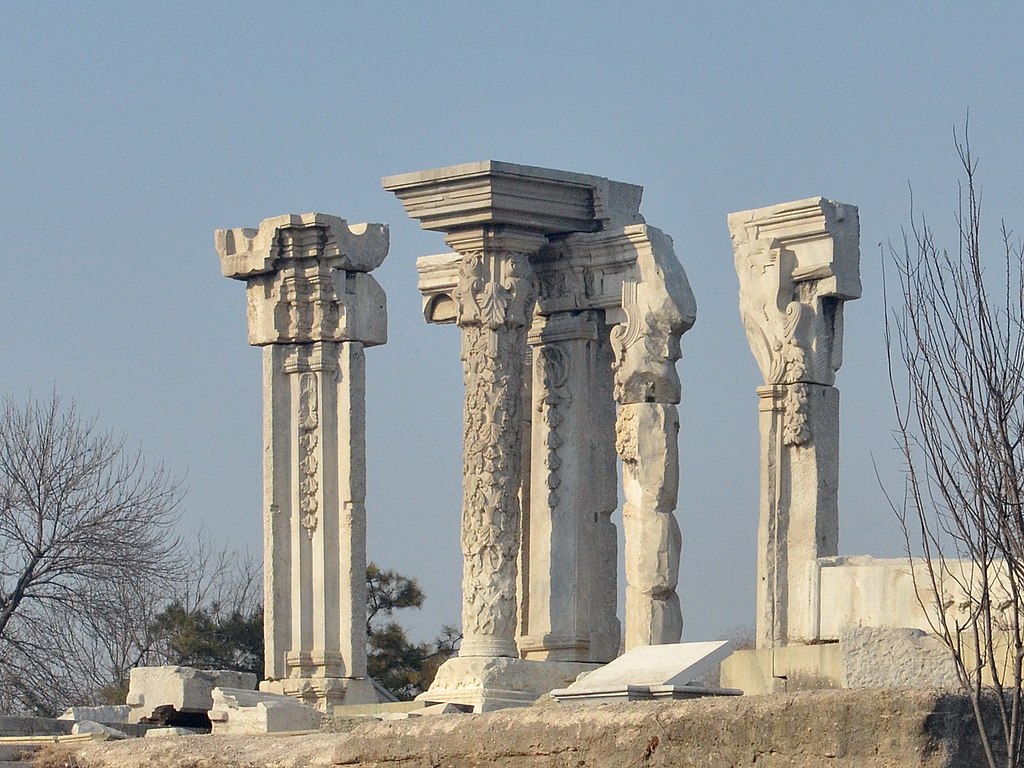
But in 1860, the gardens were destroyed as part of the Second Opium War. Today the shattered pillars, crumbling marble foundations, and abandoned archways are a vivid reminder to visitors of the "Century of Humiliation" and the tragedy of imperialism in 19th-century China. The events of that era continue to shape how China views the world today.
We will discuss the background to the Opium Wars, the sacking of the imperial gardens, and how memories of those events are kept alive in Chinas contemporary political culture. Along the way, we will wander the ruins and explore one of Beijings most beautiful and haunting historical parks.
 第二次鴉片戰爭時期的圓明園,被英法聯軍攻打搶劫,最後放火焚燒,焚燬,歷史性紀念性的圓明園從此消失,至今再也無法恢復過來昔時的榮華富貴與光彩,那典雅的西洋樓與噴泉,以及許多中國古典文明的庭,檯,樓,閣,花園,小橋流水與池塘,曾經令人留戀忘返的時光歲月,再也無法重現,如果重建需款50億美元左右歷時5年.恐怕難以還原真跡.
.
20211018圓明園罹難161周年紀念日,1860年10月18日,圓明園被英,法聯軍大火焚毀。161年了,從“萬園之園”到斷壁殘垣,廢墟靜默,卻訴說著國家民族的苦難。為銘記歷史,圓明園遺址公園今日免費開放。圓明園見證歷史,更敲響警鐘:
勿忘屈辱,吾輩自強.歲月無情,2021年的秋季,秋風瑟瑟,殘垣斷璧,圓明園內蒼茫悽涼的景象,令人不甚淒迷,憤憤不平為什麼?
任憑時光飄逝,往者以已,中國人必須記得這血海深仇的大恨,西方國家與美國等帝國主義,亡華之心不死,吾輩後人扔須要時刻警惕,自強不息,團結一至,為國家民族的生存而奮鬥,保護祖先留下來的文明古跡,向歷史負責任,有所效力.


