Aircraft carriers are a strategic priority for the world’s leading navies. Experienced players such as the Royal Navy, French Navy (Marine Nationale) and Indian Navy are all in the process of bringing in new carriers. And Japan, South Korea and likely other countries are all taking steps to join the club. But nowhere is the capability gathering steam as much as in China. The Chinese Navy (PLAN) has already commissioned two carriers based on the Russian Admiral Kutzenov class. But their third carrier, known as Type-003, promises to take the PLAN to the next level.
置頂精選
中國003 航空母艦接近竣工階段 China navy Type 003. CV will be its biggest.
2021/07/18 00:18
瀏覽1,097
迴響0
推薦4
引用0
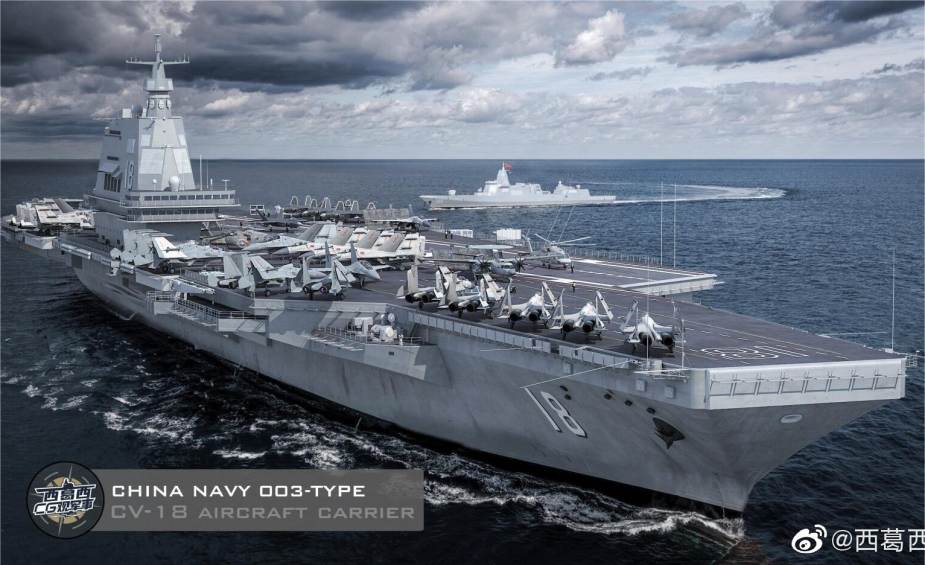
畫家筆下繪圖中國海軍003.航空母艦的雄風,即將成為實際的產品展出,船隻銜號18可能再建1艘搭配使用.

.China’s New Super Carrier: How It Compares To The US Navy’s Ford Class.
A new aircraft carrier, currently under construction in Shanghai, is the most visible sign of Chinas rapidly expanding navy. It is larger than Chinas current two carriers and differs in key aspects. But the natural comparison is to the U.S. Navys latest carriers, the Ford Class.
20210703英國發表中國上海江南造船廠Type003航空母艦最新資訊及衛星照片.
20210712.美國CSIS.也根據衛星照片,發佈中國中國上海江南造船廠Type 003.航空母艦,預期在2021年底竣工交船最新資訊,並且評論003航空母艦的創新設備,那就是在於傳統動力的航空母艦如何使用電磁彈射系統將艦載機發出使用升空執行任務,如果中國海軍在2022年舉行海試測驗,並發表成功艦載機利用電彈射升空作戰,那麼一來中國海軍突破性的發展,超越美國海軍60年來的成果,由此觀之中國海軍勢在必行的成功,使用傳統動力的航空母艦,操作高科技的艦載機彈射系統,著實令美國驚訝與惶恐,為什麼中國海軍如此的突飛猛進超越了美國海軍況且由情報得知中國早已展開核子動力航空母艦的設計,並且傳聞密秘在大連造船廠開工建造部份的船體結構物件,北約某大國際戰略研究所分析認為日後美國在全球的海軍實力將遇到強勢的對手那就是中國海軍異軍突起..
The island of the Type-003 has only just been placed on the deck in the past few days. It appears shorter than the earlier Chinese carriers but retains their single-level control tower. Above it however will be large phased array radars. This is like the Ford Class.
To summarize, the Type-003 is slightly smaller in overall dimensions. It has fewer catapults and fewer aircraft elevators, which may reduce sortie rates. In general the American ship is a bold evolutionary leap based on decades of operational experience. The Chinese ship on the other hand is a much more conservative step forward from the less experienced carrier operator. There’s no denying that in overall terms the Type-003 is going to be a very large carrier which should be extremely potent. But it may be held back slightly by some design choices which are routed in Soviet thinking.
There are of course many details which we still cannot know about the Type-003. Or the Fords Class in some cases. But ultimately their combat effectiveness, if it ever comes to that, will partly be in the crew and doctrine. The PLAN lacks the vast experience of the U.S. Navy, but it is all the same rapidly gaining experience. it has been operating carriers for nearly 10 years and is clearly heavily invested in making them a success.

美國強大的核子動力航空母艦到目前為止沒有任何國家海軍超越 ? 唯一擔心的就是中國海軍的航空母艦?
她將是美國海軍的夢魘?
Chinese Aircraft Carriers: A Nightmare for the U.S. Navy?
While China might want more carriers, they will likely take decades to be any real threat.

China’s Third Aircraft Carrier Takes Shape.by CSIS.
Recent commercial satellite imagery reveals that China has made substantial progress in the construction of its third aircraft carrier, commonly known as the Type 003. The vessel is slated to become the largest surface combatant in the Chinese People’s Liberation Army Navy (PLAN) and significantly upgrade China’s naval capabilities.
Work on the Type 003 has been underway at Jiangnan Shipyard in Shanghai since at least late 2018. Over the last several months, prefabricated components of the vessel’s hull have been assembled. Satellite imagery from May 30, 2021, shows that the flight deck is now partially complete. While much remains to be done, close analysis of the Type 003’s status offers key insights about its configuration.
China’s third aircraft carrier will be considerably larger than its predecessors, the Liaoning and Shandong, which each measure 304.5 meters in length. Earlier assessments of the Type 003 by CSIS estimated its waterline dimensions at roughly 300 meters in length and 40 meters in width. As the flight deck has taken shape, the vessel’s overall length has increased to approximately 315 meters, and its width at the widest point has expanded to 74 meters.
The Type 003 will continue to grow as work progresses. Perhaps the best size comparison is the Kitty Hawk-class of carriers, which the U.S. Navy operated from the 1960s through the 2000s, and which had a waterline length of about 300 meters and overall length of nearly 324 meters.

In addition to being larger than its predecessors, the Type 003 is widely expected to feature a flat-top flight deck with a “catapult assisted takeoff but arrested recovery” (CATOBAR) system. This would mark a major upgrade from the less advanced ski jump-style system used on the Liaoning and Shandong. The use of catapults will enable the Type 003 to launch fixed-wing aircraft with heavier payloads and more fuel, as well as larger aircraft that have a lower thrust-to-weight ratio.
Most CATOBAR systems are steam-driven, but this is starting to change. The U.S. Navy’s new Gerald R. Ford-class of carriers employs an electromagnetic aircraft launch system (EMALS) that enables faster takeoffs, reduced maintenance, and increased energy efficiency. Rumors suggest that China intends to leapfrog past steam catapults by outfitting the Type 003 with an EMALS-style system. The decision on what type of catapult the Type 003 would employ was likely made years ago; and while the use of an EMALS-type system remains unconfirmed, altering course would bring significant challenges and delays.
The increased size of the Type 003 paired with an improved launch system opens the door to a larger and more diverse carrier airwing. While it will be a couple of years before aircraft find their home on the Type 003, the airwing may include airborne early warning and control (AEW&C) aircraft, such as the KJ-600. Should this materialize, it would significantly enhance the PLAN’s situational awareness and warfighting capabilities.
The Type 003 is also expected to benefit from an upgraded island—the tower structure housing the command center for flight deck operations, along with radar and communication equipment. Compared to the Shandong, the Type 003 will likely have a smaller island, which would free up crucial real estate on the flight deck. In the satellite imagery from May 30, 2021, a portion of the island can be seen located near the vessel, tucked between two movable environmental shelters. Low-altitude aerial imagery of Jiangnan Shipyard from June confirms the presence of the island at Jiangnan.

Questions remain about the number and size of aircraft elevators on the Type 003. These elevators, which move aircraft between the internal hangar bay and flight deck, are crucial to flight operations. Satellite imagery assessed by CSIS and low-altitude imagery circulating on social media suggest that the Type 003 will be configured with two starboard-side aircraft elevators, similar to the Shandong. However, the elevators on the Type 003 are estimated to be larger, which could allow them to lift two aircraft simultaneously. France’s Charles de Gaulle has two elevators and U.S. Gerald R. Ford-class carriers have three elevators, all of which are capable of lifting two aircraft at the same time.
Like China’s other carriers, the Type 003 will be conventionally powered, but many observers expect the PLAN to develop nuclear-powered carriers eventually. Such a move would put China on elite footing with the United States and France, the only two countries that currently possess nuclear-powered carriers.
Many details of the Type 003 cannot be confirmed until additional progress is made. Large openings remain in the center of the vessel, allowing workers to move components inside the vessel’s hull and into the forward and aft engine rooms. Several elements of the deck’s sponsons, which project outward over the ship’s sides, are also not yet finished. Toward the bow, the top layer of the flight deck has yet to be laid down. Satellite imagery shows numerous components of the flight deck and support structure for the island have been positioned near the vessel and will soon be put into place.
Once the deck is further assembled, the dry dock’s two large gantry cranes will likely be used to hoist components of the island onto the deck. Work will continue for several months, and possibly longer, before the dry dock is flooded and the ship is launched. If work on the third carrier progresses at roughly the same pace as the construction of the Shandong, the Type 003 may not be launched until 2022. After launching, it will be several years before the vessel is fully fitted out, completes sea trials, and is then commissioned into the PLAN.
When the Type 003 eventually enters service, it will be a formidable addition to China’s navy and allow it to more effectively project power into the Indian and Pacific Oceans.
Matthew P. Funaiole is a senior fellow for data analysis with the iDeas Lab and senior fellow with the China Power Project at the Center for Strategic and International Studies (CSIS) in Washington, D.C. Joseph S. Bermudez, Jr., is a senior fellow for imagery analysis (non-resident) with the CSIS iDeas Lab and Korea Chair. Brian Hart is an associate fellow with the CSIS China Power Project.
China’s next aircraft-carrier will be its biggest.
The Chinese navy is fast learning how to use them
Jiangnan shipyard lies on an alluvial island at the mouth of the Yangzi river. It has grown rapidly since it moved there from nearby Shanghai in 2009, churning out destroyers, icebreakers and landing craft for the Chinese navy. The jewel in its crown is under construction. China is saying little about it, but satellite imagery reveals a near-complete flight deck in a corner of the yard where, less than 15 years ago, there was only farmland.
For now, the vessel-to-be is blandly known to military analysts as the Type 003. It will be China’s second domestically built aircraft-carrier and the largest ship that has ever served in the Chinese fleet. Experts at the Centre for Strategic and International Studies (csis), a think-tank in Washington, have analysed satellite pictures such as the one above, which was taken in June by Planet Labs, an American firm. They conclude that the ship will be about as long as New York’s Chrysler Building is high: about 320 metres. She will mark another leap forward in China’s advance as a naval power.
.
So far IMO one of the best, if not the clearest image of the Type 003 aircraft carrier nearing completion of its construction at the Jiangnan Shipyard, Shanghai.


你可能會有興趣的文章:


