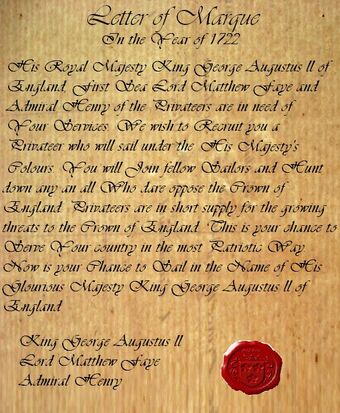

傳聞美國海軍,即將公開招標發售,私掠許可證,
(Letter of Marque and Reprisal).
提供國際海盜,截掠中國商船,保證合法,希望有興趣的海盜,
共襄盛舉.
美國CSIS.研究計劃利用,中國海上絲路的航海區域,僱用海盜船進行劫掠中國商船.最危險的海域就是從地中海進入紅海海域出波斯灣以及東非洲沿海地區以及從印度洋途經麻六甲海峽經印尼沿海地區等重要航道.這樣一來美國提供資訊讓國際海盜方便搶劫.

美國海軍學院在其4月《議事錄》雜誌期刊(Proceedings)指出,美國應該考慮對各國傭兵發放私掠船授權委任書,劫掠中國在「一帶一路」航線及大洋上的商船,可以對中國經濟,以及政權造成足夠威脅,並為美國提供重要的戰時優勢。
.
美國狂途末路,竟計劃然勾結海盜截掠中國商船,美國在各方面已經實質上落後於中國,僅有國防軍事力量,可以壓制中國,可是沒有正確原因向中國宣戰,只有搞起下3濫的計劃,勾結海盜截掠中國商船,還口口聲聲說明符合法律,.由於美國無法在經濟,國際貿易方面與中國競爭,除了發動經濟貿易戰,關稅戰,生物化學科技戰,對付中國,但是始終無法搞倒中國,如今美國異想天開想,利用海盜僱傭兵方式,在國際水域搶劫中國商船,可見美國已經瘋狂,無計可施,干脆追隨效法其老祖宗,英國海盜,重返海洋搶奪過路的中國商船,可憐無恥的美國人淪落為海盜是正常的反應.
Unleash the Privateers!
中國透過「一帶一路」倡議積極擴大在全球經濟和外交領域的影響力。2018年,中國在全球商船隊中擁有2112艘船,而香港又有另外2185艘,還另擁有2500艘的龐大遠洋漁船隊。因必須保護這些投資,這種擴張有其脆弱性。美國的商船隊中只有246艘船,美國若對中國使用私掠船戰略就能在戰時獲得重要的戰略優勢。即使中國未來威脅要派遣自己的私掠船,美國在此方面的脆弱性也相對較小。
Privateer .by USA.
US NAVY BECOME Piracy. pirates .
US military researchers call for use of privateers against China.Unleash the Privateers!
The United States should issue letters of marque to fight Chinese aggression at sea.
By Colonel Mark Cancian, U.S. Marine Corps (Retired) and Brandon Schwartz.

美國海軍學院4月《議事錄》刊登由美軍陸戰隊退役上校馬克.坎西恩,以及戰略與國際研究中心(CSIS)研究員布蘭登.施瓦茨所撰寫的〈放出私掠船─美國應簽發私掠船授權委任書,以對抗中國在海上的侵略〉一文;《議事錄》於1874年發行,是美國最古老連續出版雜誌之一,經常刊登美國國防部長、參謀長聯席會議主席,以及各軍種最高領導人的專題文章。
Naval strategists are struggling to find ways to counter a rising Chinese Navy. The easiest and most comfortable course is to ask for more ships and aircraft, but with a defense budget that may have reached its peak, that may not be a viable strategy. Privateering, authorized by letters of marque, could offer a low-cost tool to enhance deterrence in peacetime and gain advantage in wartime. It would attack an asymmetric vulnerability of China, which has a much larger merchant fleet than the United States. Indeed, an attack on Chinese global trade would undermine China’s entire economy and threaten the regime’s stability. Finally, despite pervasive myths to the contrary, U.S. privateering is not prohibited by U.S. or international law.
What are Letters of Marque?
Privateering is not piracy—there are rules and commissions, called letters of marque, that governments issue to civilians, allowing them to capture or destroy enemy ships.
1 The U.S. Constitution expressly grants Congress the power to issue them (Article I, section 8, clause 11). Captured vessels and goods are called prizes, and prize law is set out in the U.S. Code. In the United States, prize claims are adjudicated by U.S. district courts, with proceeds traditionally paid to the privateers.
2 (“Privateer” can refer to the crew of a privateering ship or to the ship itself, which also can be referred to as a letter of marque).
China has aggressively expanded its global economic and diplomatic influence through its Belt and Road Initiative, but this expansion creates a vulnerability, as these investments must be protected. Chinese vulnerability goes deeper. China’s economy has doubled in the past 15 years, driven by exports carried in Chinese hulls. Thirty-eight percent of its gross domestic product (GDP) comes from trade, against only 9 percent of U.S. GDP.6 Chinese social stability is built on a trade-off: The Chinese Communist Party has told the people they will not have democratic institutions, but they will receive economic prosperity.
China’s merchant fleet is large, because the cost to China of building and operating merchant ships is low, and its export-driven economy creates a huge demand. In 2018, China had 2,112 ships in its global merchant fleet and Hong Kong had another 2,185.7 In addition, China has a massive long-distance fishing fleet, estimated at 2,500 vessels.8
By contrast, the United States has only 246 ships in its merchant fleet. That fleet—expensive to build and operate—is sustained mainly by the Jones Act, which mandates that ships conveying cargo between U.S. ports must be U.S.-flagged.
This asymmetric vulnerability gives the United States a major strategic advantage. The threat privateering poses to the Chinese economy—and hence the Communist Party—could provide the United States with a major wartime advantage and enhance peacetime deterrence, thus making war less likely. Even if China threatens to dispatch its own privateers, U.S. vulnerability is comparatively small.
Capitalizing on Chinese vulnerabilities requires large numbers of ships, and the private sector could provide them. The ocean is large, and there are thousands of ports to hide in or dash between. While the Navy could not afford to have a multibillion-dollar destroyer sitting outside Rio de Janeiro for weeks waiting for Chinese vessels to leave, a privateer could patiently wait nearby as U.S. diplomats put pressure on (presumably neutral) Brazil.
Neither recruiting crews nor the need to arm ships would constitute a major obstacle. Privateers do not need to be heavily armed, because they would be taking on lightly (or un-) armed merchant vessels, choosing vulnerable targets, or acting cooperatively with other privateers. Since the goal is to capture the hulls and cargo, privateers do not want to sink the vessel, just convince the crew to surrender. How many merchant crews would be inclined to fight rather than surrender and spend the war in comfortable internment?12
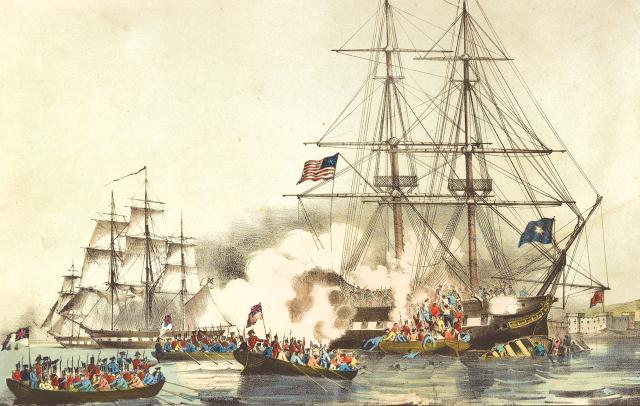
Cruise the Seas for Chinese Gold
私掠是指由國家頒發私掠許可證,授權個人攻擊或劫掠他國船隻的行為。執行私掠的船隻通常被稱為私掠船或武裝民船,船長通常被稱為私掠船長。嚴格來說,只有在戰時,私掠行為才是被允許的。在16至19世紀間,武裝民船通常被認為是屬於國家海上武裝力量的一部分,其性質類似陸軍常見的雇傭兵。到了現代,一二戰時期也有一些商船改裝了魚雷與水雷等武器協助封鎖海域,至今各國也仍會徵調漁船與商船來進行軍警的海上任務。
私掠船通常被利用來破壞敵國的海上貿易線。對於海上力量弱小的國家來說,這是一種戰勝強大敵人的好辦法。不少國家使用這種方法在不花費大量經費的情況下,以民用船當作後備力量,建立起自己的海上武裝,同時還培養了大量優秀水手和軍官。私掠船攻擊敵船所獲得的貨物通常會在指定地點拍賣。其收入按照一定比例歸船長、船員和授權國(皇室)所有。必要的時候,私掠船還會被徵調為軍艦參加戰鬥。例如1588年,英國著名的私掠船長法蘭西斯·德瑞克就作為副指揮參加了擊敗西班牙無敵艦隊的英西大海戰。
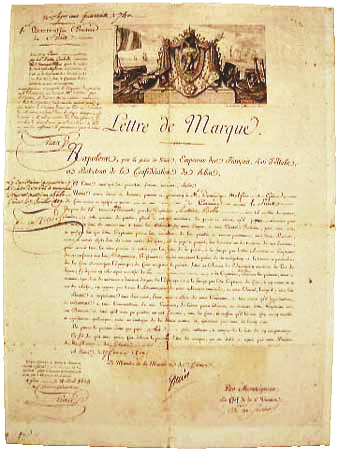
Letter of marque given to Captain Antoine Bollo via the shipowner Dominique Malfino from Genoa, owner of the Furet, a 15-tonne privateer, 27 February 1809.
英國與法國所授權頒發的私掠許可證.
私掠船的船員通常龍蛇混雜,有原商船船員、海盜、罪犯、賭徒等等,但船上的要求就比商船嚴格得多。而且私掠許可證就像一個契約,控制著私掠行動,比如只能針對某個國家,只能在某個海域攻擊等等。這和海盜有著本質的區別。如果私掠船長破壞了該契約,就很可能被要求賠償對方的損失甚至被取消許可證。歷史上,一些私掠船長和船員因為攻擊了本國、中立國或盟國的船隻而最終成為了真正的海盜,比如威廉·基德,他最後被己國通緝、逮捕並判處死刑
A privateer is a private person or ship that engages in maritime warfare under a commission of war. Since robbery under arms was a common aspect of seaborne trade, until the early 19th century all merchant ships carried arms. A sovereign or delegated authority issued commissions, also referred to as a letter of marque, during wartime. The commission empowered the holder to carry on all forms of hostility permissible at sea by the usages of war. This included attacking foreign vessels and taking them as prizes, and taking prize crews as prisoners for exchange. Captured ships were subject to condemnation and sale under prize law, with the proceeds divided by percentage between the privateers sponsors, shipowners, captains and crew. A percentage share usually went to the issuer of the commission (i.e. the sovereign).
Privateering allowed sovereigns to raise revenue for war by mobilizing privately owned armed ships and sailors to subsidize state power. For participants, privateering provided the potential for a greater income and profit than obtainable as a merchant seafarer or fisher. However, this incentive increased the risk of privateers turning to piracy when war ended.
The commission usually protected privateers from accusations of piracy but in practice, the historical legality and status of privateers could be vague. Depending on the specific sovereign and the time period, commissions might be issued hastily; privateers might take actions beyond what was authorized in the commission, including after its expiry. A privateer who continued raiding after the expiration of a commission or the signing of a peace treaty could face accusations of piracy. The risk of piracy and the emergence of the modern state system of centralised military control caused the decline of privateering by the end of the 19th century.
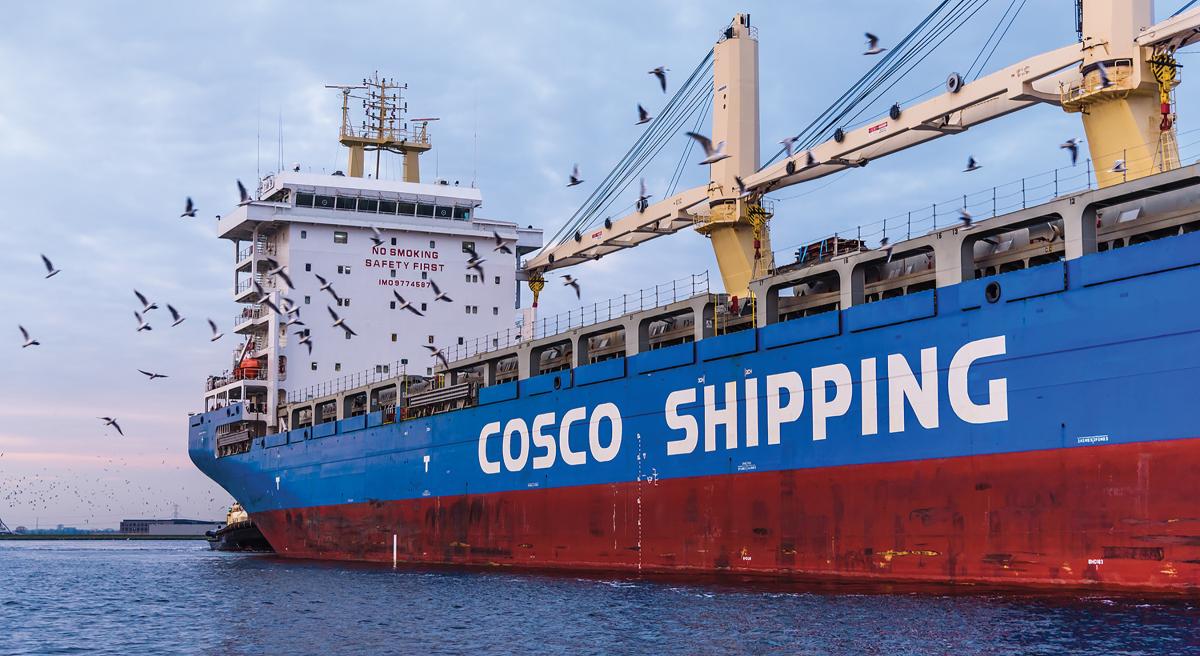
西方國際戰略觀察家認為,中國強勢崛起,工商業,國際貿易發達順暢,航海事業及造船事業興起,再加上中國拓展海上絲路,更需要加速建設龐大的遠洋商船的船隊,運輸各式各樣的貨物,原料以及戰略物質,因此引起美國的邪念思想,如何利用國際海盜,給予授權書狀,進行所謂的私掠行為,由此觀之美國很有可能於,2020Q3發出
letter of marque 的海盜船專門截掠中國的商船,然後7/3.分贓.現在的世界又彷彿回到17-18.世紀大航海時代的海盜世界.


A letter of marque and reprisal (French: lettre de marque; lettre de course) was a government license in the Age of Sail that authorized a private person, known as a privateer or corsair, to attack and capture vessels of a nation at war with the issuer. Once captured, the privateer could then bring the case of that prize before their own admiralty court for condemnation and transfer of ownership to the privateer. A letter of marque and reprisal would include permission to cross an international border to conduct a reprisal (take some action against an attack or injury) and was authorized by an issuing jurisdiction to conduct reprisal operations outside its borders.
Popular among Europeans from the late Middle Ages up to the 19th century, cruising for enemy prizes with a letter of marque was considered an honorable calling that combined patriotism and profit. Such privateering contrasted with attacks and captures of random ships, which was unlicensed and known as piracy; piracy was almost universally reviled.[1] In reality, the differences between privateers and pirates were often at best subtle and at worst a matter of interpretation.]


- 車臣共和國表示將派遣軍隊參戰協助伊朗抵抗美國.CHECHEN FORCED READY TO JOIN IRAN IF USA INVADES IRAN.
- 賀中國機車獲得 2026 年WSBK 機車比賽雙料冠軍. CHINA motocycle get 2026 WSBK .world championship
- 俄羅斯參戰協助伊朗 2艘 SSBN. 戰略核潛艦 奔向赫摩斯海峽抵抗美國
- coffee & books.
- 烏干達協助以色列加入對伊朗戰爭。Uganda joins Israel in war against Iran
- 伊朗牛逼 首次發射4000公里彈道飛彈 攻擊印度洋狄耶戈加西亞英美基地 Iran denies responsibility for missile attacks on Diego Garcia.
 1樓. red square 1232020/04/11 18:01
美國海軍學院網站上發表的兩篇文章中提出,建立美國海盜船隊攻擊中國的全球貿易並破壞中國經濟。其中一篇文章的作者布蘭登·施瓦茨在《美國私掠船合法》文章中,為自己的這一想法找到的理由是為了應對「中國威脅」。在他看來,與中國的對抗可能威脅到美國的權力、地位甚至生存。這種衝突可能導致成千上萬的美國士兵死亡,數十艘美國軍艦被摧毀。作者承認,中國以及其他海洋國家可能會爭辯說,國際法禁止海上私人武裝船隻活動。但他卻認為,美國憲法並沒有剝奪國會頒發這種曾存在於帆船時代並被19-20世紀各種國際條約禁止的所謂的私掠許可證的權利。這是一份政府文件,允許私人船隻攻擊和佔領屬於敵國的船隻。
美元訂購私人武裝船可能成為一種廉價手段,以增強在和平時期對中國的威懾力並在戰時獲得對中國的優勢. red square 123 於 2020/04/11 18:03回覆


