

現今的俄羅斯共和國欲求恢復過來,昔日蘇聯強盛的軍事力量,卻苦不堪言因為財政不佳,無法建造新的航空母艦,大型驅逐艦,重型巡洋艦,以及量產SU-57.隱型戰鬥機MIG-41.隱形戰鬥機,只有做出模型望梅止渴?
由於受到美國的經濟制裁,俄羅斯外匯短缺,許多生產製造軍事武器的戰略物質,無法購買,形成俄羅斯軍事力量,已經逐漸下滑,成為世界第三名?
 ,,,,
,,,,

蘇聯時期留下來的武器早已需求汰舊換新,否無法因應,第3次世界大戰,俄羅斯普京大帝發出嚴重警告.
 傳聞俄羅斯普京大帝2024年退位隱身幕後繼續搖控軍政黨大權?

2019俄羅斯海軍展示風暴極核子動力航空母艦.沒有預算而停擺?
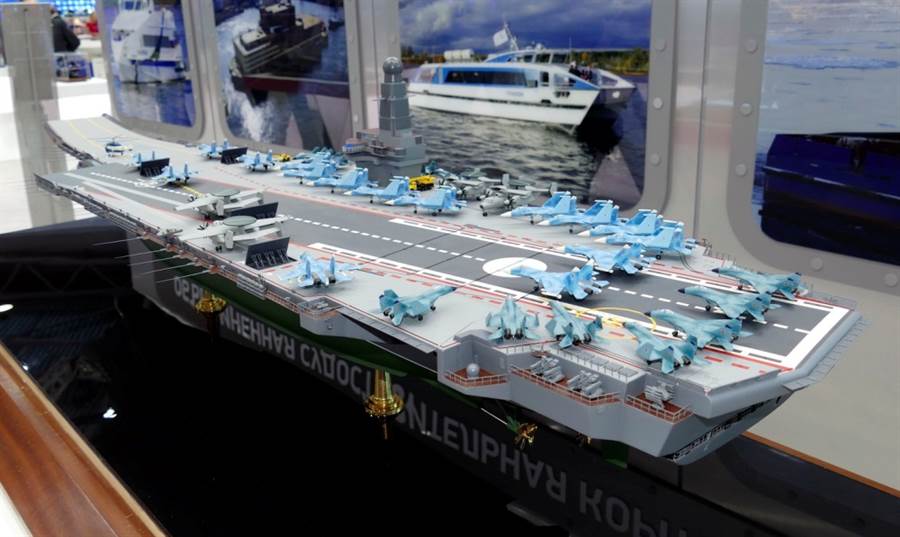
2020年俄羅斯海軍展示海牛級核子動力航空母艦.11430E型「海牛」級核動力航母造價初估計需要100億美元左右,包括建造新的船鄔造船廠與起重設備等等.

。
國際軍事戰略專家評估從客觀上說,俄羅斯建造航母的"硬體"其實一直都有。去年俄羅斯還從中國訂購了3套大型龍門吊,其中最大的一座起吊重量達1200噸,和中國當年出口給英國用於建造航母的"歌莉亞"號龍門吊相當。不僅如此,2019年中國還向俄羅斯交付了一座4萬噸的浮船塢,所有這些設備完全可以用於建造新式航母。而且,俄羅斯目前唯一的一艘航母"庫茲涅佐夫"號正在船廠維修,該艦一旦大修完畢重新入列,則俄羅斯也將重新培養出一批可用於航母建造的熟練工人,這和中國當年翻新蘇制"瓦良格"號航母類似。如果俄羅斯同樣大修並升級了"庫茲涅佐夫"號航母的話,顯然也就具備了建造8萬噸大型航母的基本能力。而且俄羅斯現在已經在開工建造3艘排水量3萬噸級的核動力破冰船,並且還部署有2.6萬噸的"基洛夫"級核動力飛彈巡洋艦。所以在動力方面,俄羅斯也有天然的優勢,並可以把這套成熟可靠的核動力裝置直接移植給航母,從而大大縮短航母的研發和建造周期。
國際軍事專家認為俄羅斯極有可能於2020Q2.進行開工建造新型航空母艦,如果順利,將於2025年竣工下水試航,2026年交付海軍服役,如果中途停工建造,也極為可能,傳聞2024年普京屆滿將退休,隱藏幕後,繼續搖控俄羅斯軍政大權.新任俄羅斯總理,曾經揚言國家預算,不是唯一用來發展軍事武器,而是需求合理分配資源運用,看起來俄羅斯海軍一頭熱新的海牛級,核子動力航空母艦,很有可能中途因為沒有預算經費而停止建造,最後淪為廢鐵賣給中國繼續建造,俄羅斯海軍重純粹是為人(中國)做嫁衣.往事重演的機率是50%以上某些國際戰略觀察家並不樂觀.
"海牛”號核航母寄託著俄羅斯崛起的希望。研究俄羅斯歷史就能發現,俄羅斯的國運是和海軍緊密聯繫在一起的,俄羅斯海軍最強盛的時候,也正是俄羅斯對外擴張最猛烈的時候。冷戰時期,蘇聯海軍是僅次於美國的海上力量,同時擁有7艘航母,還有2艘航母在建,包括一艘核動力航母“烏裡揚諾夫斯克”號。蘇聯解體後,基輔級、莫斯科級航母全部退役,留在烏克蘭的“烏裡揚諾夫斯克”號被拆除,“瓦良格”號被出售,僅剩一艘“庫茲涅佐夫”號航母在苟延殘喘,正如蘇聯解體後不斷衰落的俄羅斯。

新航母排水量預計10萬噸,將搭載SU-57艦載戰機及S-500防空導彈系統,標準排水量9萬噸,最大航速30節,可搭載各類艦載機60架,人員編制2800人,海上作戰自持力可達120天。說,如果俄羅斯建成了新航母,也就證明俄羅斯真正崛起了。據悉,除11430E“海牛”核航母外,涅夫斯卡耶設計局還和克雷洛夫中心合作設計了4萬噸的23000E“風暴”級多用途重型航母。俄羅斯在經濟下行、軍費嚴重削減的情況下還在同時設計兩艘航母,可見普京重振俄羅斯的決心,但這個過程困難重重,至少在普京任期內是看不到了。

We Now Know Why Russia Never Had an Aircraft Carrier Fleet .
Not enough money or capacity.
We Now Know Why Russia Never Had an Aircraft Carrier Fleet..anuary 14, 2020 Russia,Aircraft Carrier,Moscow,Putin,Russian Military,Russian Navy,
We Now Know Why Russia Never Had an Aircraft Carrier Fleet
Not enough money or capacity.Key point: As a predominately land power, and one that was low on cash and ship-building capacity, Moscow was never able to field multiple true carriers. Russia did try, and continues to make plans, but it is unlikely it will build more carriers anytime soon.
The Soviet Union was one of the largest, most industrial proficient countries the world has ever seen. Yet for all of its engineering talent and manufacturing capacity, during the seventy-four years the USSR existed it never fielded a true real aircraft carrier. The country had several plans to build them, however, and and was working on a true carrier, the Ulyanovsk, at the end of the Cold War.
After the Communists’ victory in 1917, science and engineering were pushed to the forefront in an attempt to modernize Russia and the other Soviet republics. The military was no exception, and poured resources into then-advanced technologies such as tanks, airborne forces, and ground and aerial rockets. Soviet leader Joseph Stalin was linked to several carrier projects, including the first effort, Izmail.
In 1927, the Soviet leadership approved plans to build a carrier by converting the unfinished Imperial Russian Navy battlecruiser Izmail, under construction since 1913, to a full-length aircraft carrier. Completed as a battlecruiser, Izmail was to displace thirty-five thousand tons, making it similar in displacement to (and of the same decade as) the U.S. Navy’s Lexington-class interwar carriers that carried up to seventy-eight aircraft.
Unfortunately for the new Soviet Navy, Izmail’s conversion was never completed and the ship was eventually scrapped. While the idea of a Soviet carrier did have its supporters, others, including the brilliant young Marshal Tukhachevsky, pointed out that as large as it was, the Soviet Union could not afford to build both an army and a navy to match its most powerful neighbors. Tukhachevsky had a point, and the Navy took a backseat to Red Army (and Air Force) ambitions. This was a strategic dilemma that the Soviets had inherited from the tsars and that persisted until the fall of the Berlin Wall in 1989—one that still affects the Russian government today.
The Soviet Union under Stalin came to measure economic and agricultural output in five-year plans, and in 1938, as part of the third five-year plan, laid the groundwork for a pair of aircraft carriers. The so-called “Project 71” class would be based on the Chapaev-class cruisers, displacing thirteen thousand tons and with a 630-foot flight deck. The carriers would each carry fifteen fighters and thirty torpedo bombers, with one allocated to the Baltic Fleet and one allocated to the Pacific Fleet. The carriers were approved in 1939 but never completed, their construction interrupted by World War II. A second project for a heavier twenty-two-thousand-ton carrier was proposed but never even began construction.
In the mid-1940s, with the Soviet Union locked in a mortal struggle with Nazi Germany, yet another carrier concept was proposed. “Project 72” was described as similar to the previous carrier project but, at thirty thousand tons, more than twice as large. Another, similar design was Project Kostromitinov, which weighed in at forty thousand tons and would have been equipped with sixty-six fighters, forty torpedo bombers and, unusually, sixteen 152-millimeter guns. This suggests that the carrier might have been used to support amphibious landings in Scandinavia or the Baltics had it ever been built. While the Soviet Union was always a land power for which land warfare should take precedent over sea warfare, the wartime situation in 1943 made it crystal clear that resources could not be taken away from the Red Army to build an aircraft carrier of questionable usefulness.
In the aftermath of the war, with the Red Army the dominant land power in Eurasia, the Soviet Navy again pushed for more carriers. The naval staff wanted a force of fifteen carriers, nine large and six small, split between the Pacific and Northern fleets, with six of the large carriers allocated to the Pacific and the rest allocated to the Northern fleet. Stalin, however, did not want aircraft carriers, preferring to put his faith in battleships and cruisers. Soviet industry gave Stalin cover, explaining they did not yet have the capacity to build new kinds of ships.
Stalin was succeeded by Nikita Khrushchev in 1953, but despite Khrushchev’s new ideas in the age of missile warfare the best the Soviet Navy could get out of him was a single light carrier. The carrier, Project 85, would displace just twenty-eight thousand tons and carry forty navalized MiG-19 fighters. This project, too, was canceled even before construction began.
In 1962, the USSR began construction of two aircraft carriers at the Nikolayev shipyards in the Ukraine. The two carriers, Moskva and Leningrad, were compromise ships, with the front half looking like a conventional guided-missile cruiser and the rear half consisting of a flight deck, a hangar and an elevator that transported aircraft between the two. The Moskva class was likely designed to hunt American and British Polaris missile submarines operating near Soviet waters.
Each Moskva ship carried up to a dozen antisubmarine warfare helicopters, but otherwise lacked offensive armament. The Moskva class was followed up in the 1970s and 1980s with the Kiev class, which had a similar mission, but the United States was on the verge of fielding the even longer-range Trident missile. This meant that the Soviet Navy would have to operate even farther from its home waters and potentially face off with U.S. Navy aircraft carriers. As a result, the Kievs had an offensive armament in the form of SS-N-12 “Sandbox” antiship missiles, each of which could carry a 350-kiloton nuclear warhead. Four Kievs were built, with a fifth authorized but never completed.
The mid-1980s were a period of major expansion for the Soviet Navy, including aircraft carriers. The USSR began construction on two carriers in the fifty-thousand-ton class and one nuclear-powered supercarrier, Ulyanovsk, that was nearly on par with American Nimitz-class carriers. Of the three super vessels, only one was completed before the end of the Cold War. The completed carrier was inherited by the Russian Navy, with which it still serves today as the Admiral Kuznetsov. The incomplete carrier was purchased by Chinese interests, which forwarded it on to the People’s Liberation Army Navy, where it was refitted and commissioned as the carrier Liaoning in 2012. Ulyanovsk was scrapped by Ukraine, which had inherited the unfinished hull after the dissolution of the USSR in 1991.
As a land power, the Soviet Union could never allocate enough of the country’s resources to build a real fleet of aircraft carriers. There was always some other perfectly reasonable—and eminently practical—way to spend the country’s rubles, whether it was on the Army, or the Air Force, and later on nuclear weapons. Even today, the Russian Navy’s nonstrategic forces face stiff competition from land and air forces, and the future of Russian naval aviation is again cloudy at best.


 1樓. red square 1232020/01/25 10:42


