The economics of reform
Stoking the furnace
Mar 3rd 2012 | SHANGHAI | from the print edition
IN 1985 a Chinese steamship, the Bashan, chugged down the Yangzi river, carrying an unusual cargo: ten foreign economists, including one Nobel prize-winner, and almost twice as many Chinese counterparts from the government and academia. They spent the weeklong voyage swapping ideas on how to steer China’s unruly economy between the plan and the market.
This “steamship conference”, organised by the World Bank at the request of a government commission, has become legendary (although a bank report published the same year was probably more influential). This week the bank unveiled the results of another collaboration it hopes will make a similar splash: the “China 2030” study, examining how China can fulfil its ambition to become a high-income country over the next two decades, at ease with itself, its neighbours and its environment.
On the steamship, the foreign advisers had the undivided attention of their hosts. Getting noticed in China is much harder now. China remains a big deal for the bank, but the bank is not a big deal for China. It still finances projects ranging from road-building in Ningxia to restoring the historic architecture of Confucius’s hometown. But the bank’s outstanding loans (worth $20.6 billion) are equivalent to only 0.6% of China’s foreign-exchange reserves.
In this section
The China 2030 report was, however, jointly produced with a government think-tank, the Development Research Centre, which advises China’s cabinet. The bank’s involvement may have given the DRC cover to say what needs to be said. And the DRC’s participation may have given the bank the clout it needs if it is to be heard.
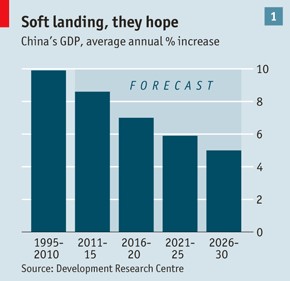
The report’s contributors were urged to think big and push hard. They did not hold back. The report sprawls like one of the land-hungry Chinese cities it criticises. The authors project a gentle slowdown of growth, which will average 7% in the second half of this decade and 5% from 2026-30 (see chart 1). That would be enough tomake China the world’s biggest economy and a high-income country, by the bank’s definition, with an income per head of about $16,000. But China will not fulfil this benign destiny unless it undertakes a bewildering array of reforms.
The report urges China’s government to stop meddling in the market for inputs, such as capital (where interest rates are set by administrative fiat, not competitive forces); labour (where rural migrants cannot settle easily in cities); and land (where local officials routinely expropriate rural plots for urban development). The government must also promote entry and competition in output markets now dominated by state-owned enterprises. The state should instead concentrate on setting rules that allow markets to function, and provide public goods the market cannot furnish. This is a hugely ambitious manifesto. But the report counts it all as only one of six areas of reform, each of which is deemed a priority.
Such laundry lists are not usually very helpful to policymakers, who need clearer guidance on what to tackle first. But the report may sprawl because many of China’s problems do: one distortion or skewed incentive invites another.
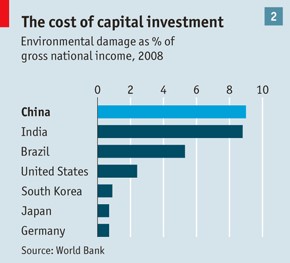
Take, for example, the criteria used in promoting local officials. The usual benchmark—growth—encourages local bureaucracies to offer investors cheap land, underpriced electricity and low taxes, anything to bring factories to their county or province. That is one reason why China’s growth has relied so heavily on investment. Capital-intensive growth has in turn taken a toll on the environment. The depletion of China’s natural resources combined with the damage to health from water pollution, soot and other particulates, cost China the equivalent of 9% of its national income (see chart 2) in 2008, the report estimates. Both fiscal reform and greener growth are therefore among the report’s six priorities. And it cites with approval Guangdong province’s experiments with using a broad “happiness” index to judge local progress and reward the bureaucrats responsible.
The capital-intensity of China’s growth has also left workers with a relatively small slice of the national cake. That has prevented China’s consumption growing as quickly as the economy as a whole. The things it does not buy itself it sells to foreigners, resulting in a troublesome trade surplus. That surplus jeopardises the friendly international relations that the report identifies as another of China’s six priorities. One problem leads to another.
Nonetheless, since the government cannot do everything at once, it has to start somewhere. The sequence of reform, the report acknowledges, may be dictated by politics as much as anything else. Nowhere is the politics of reform more ticklish than in the case of state-owned enterprises. The report envisages a more arm’s-length relationship between the state and the powerful conglomerates it still owns. These companies enjoy the benefits of state ownership with few of the obligations. They transfer 15% or less of their profits to the budget, for example. If dividends were increased to 50% of profits, a rate more in line with rich countries, budgetary revenues would jump by about 3% of GDP, the report says, money that could help fund the public services that are another of the report’s priorities. But state enterprises firmly oppose such a change.
So the report urges China to continue its long tradition of local experimentation, because “successful reforms at the local level tend to grow their own champions”. It also recommends starting with measures that face the least resistance as a way to build momentum for tougher reforms later on.
Trojan redback
One institution that may be following such a strategy is China’s central bank, the People’s Bank of China (PBOC). Its research and statistics division last week released a potential timetable for easing China’s extensive capital controls over the next ten years. The China 2030 report also foresees an eventual opening of the capital account, but not until a long list of prerequisites is fulfilled, including liberalising the exchange rate, freeing interest rates, improving the supervision of China’s banks, and deepening its financial markets.
Such preconditions are not, however, absolute, according to Sheng Songcheng, head of the central bank’s research department and the lead author of its new study (he is also a candidate for assistant governor). If you wait for the exchange rate and interest rates to be fully liberalised, he says, you may wait forever.
So the central bank may be hoping for a different sequence, dictated by politics as much as economics. Further easing of capital controls would certainly hasten the liberalisation of currency and interest rates. China’s banks would have to offer a market rate on deposits if savers had more liberty to seek higher returns elsewhere. And if capital found it easier to come and go, the central bank would have to ease its grip on the exchange rate (unless it were willing to give up monetary control at home). Capital flows might provide the external pressure the central bank needs to overcome domestic opposition. Eswar Prasad of the Brookings Institution, a Washington think-tank, calls it a “Trojan horse” strategy.
To make the horse look more attractive, reformers are touting some side-benefits of opening up. It would allow Chinese investors to snap up foreign companies at a time when Western investors are in retreat and prices are cheap. It would also permit the yuan to fulfil its destiny as an international currency.
A global currency is a mixed blessing. As the report points out, international demand for the dollar strengthens America’s currency and blunts the competitiveness of its exports. But many Chinese officials probably believethe world’s second-biggest economy deserves a currency of similar stature. A global yuan may not greatly benefit China, but it certainly befits it.
from the print edition | China
附一篇在Analect部落格過幾天經濟學人對當年人民大會的評論及另一篇紙本版對於中國經濟政策改革派的同情
China
The National Peoples Congress
What makes a rubber stamp?
Mar 5th 2012, 6:52 by T.P. | BEIJING
EACH year in early March, Beijing welcomes not only the sense of spring’s imminent arrival, but also the thousands of out-of-town delegates who descend on the capital for the once-yearly full session of the National People’s Congress (NPC), China’s version of a national legislature. It is a time of year when the weather in Beijing might yet go any which way. But not the NPC session, which is a closely scripted and tightly controlled event featuring much pageantry and precious little drama.
The orderly proceedings and the pre-arranged outcomes are predictable. So too are the frequent invocations of the term “rubber-stamp” to describe the NPC, as well as heated complaints about that term from Chinese officials and other supporters of the system.
Like many western media outlets, The Economisthas been a frequent “rubber-stamper” in its coverage of the NPC over the years. So too have many Chinese-language media, for that matter, including some of China’s own outlets.
Yet many in China take the term as an insult, feeling that it belittles the institutions and procedures by which the nation makes its laws.
Not long after the close of the 2010 NPC, your correspondent moderated a panel at Beijing’s Renmin University, where one of the panellists veered off topic to criticise western media for their biased coverage of China. The panellist, Yang Rui, a popular and often truculent host of a political talk show on state-run China Central Television (CCTV), said he found the “rubber-stamp” comparison particularly galling. When, he asked, would the foreign media finally stop using the term “rubber-stamp” to describe China’s parliament?
The answer to that question should be obvious: when it finally rejects something put before it.
Among the matters the nearly 3,000 legislative delegates get to vote on are the approval of new laws, “work reports” delivered by senior officials, and new appointees to top government posts. Unanimous votes were once common. Multiple Chinese reports have noted with interest the first occasion on which a delegate cast a “no” vote, in 1988. They also reported that in 1982, when three delegates offered the first abstentions in NPC history, a reporter’s request to report this unusual development truthfully was greeted with approval by Deng Xiaoping.
Since then things have gotten slightly more interesting. In 1992, the NPC caused something of a stir when only 1,767 delegates, two-thirds of the total, voted to approve the massive and massively controversial Three Gorges Dam project. There were 177 votes against, 644 votes to abstain, and 25 delegates who failed to vote at all.
In other cases where reports or candidates are approved by less than 75%, it is seen as a clear rebuke to the leadership.
None of this is to say that the NPC is entirely irrelevant. In important ways, the NPC—as an institution—has become more interesting than its ritual-laden yearly sessions would indicate. Its full-time professional staff has grown in size and professionalism. In the course of drafting legislation, it has taken great strides in reaching out to social stakeholders and soliciting their input. Often it even pushes back against the Communist party leadership by insisting on substantial revisions to draft laws before moving them along.
In these ways, the NPC plays a meaningful and increasingly important role in China’s governance. And there are some political scientists, Chinese and foreign alike, who reckon that China’s system may evolve in ways that give the legislature genuine independence and substantial power in decades to come.
Nor should the frequent reference to the rubber-stamp tendencies of today’s NPC be taken to suggest that empty political theatre is unique to China’s institutions. After all, in less than half a year America’s two major political parties will each hold elaborate, multi-day nominating conventions, full of over-wrought pomp, ceremony and ritual. Barring any departure from what has been standing practice for decades, all this will culminate with a grand theatrical set piece of a vote with a preordained outcome.
Indeed, many people will use terms like “rubber-stamp” and “coronation” to describe these conventions, in Charlotte, North Carolina and Tampa, Florida. Nobody will get angry about it. And why should they? After all, there is another, even more powerful force in Washington that provides actual checks and balances to the political power of the executive branch. That one bears the mark of another well-worn stamp: Gridlock.
筆者是這麼回應的
Stoking the furnace
Mar 8th 2012, 07:59
Customarily in this month, China’s Two-Conferences assembles in Beijing. At this time, the most obvious difference from the past meetings is the lower annual target of economic vision, predicted by China’s Communist Party (CCP). At this critical point, Chinese fast-growing economy is predicted to experience the next period of development. Owing to the coincidence of the World Bank president’s handover in this summer, the co-pictured photo, containing China’s next prime minister Li Ke-qiang and incumbent president Robert Zoellick, make this month’s meetings more important than ever before.
There are individual meanings of inside and outside CCP’s politics or Chinese economy in this time’s meetings, including several sensitive issue of economics and political rule’s reform. First, the successor of National Congress’ chief in the standing committees will lead Chinese to represent the sovereignty. According to the order of the fifth-generation CCP, Wang Yang may succeed Wu Bong-guo as this position while princeling party’s counterpart, Bo Xi-lai, may play the similar role to 2005’s Zhou Yong-kang to China’s incumbent President Hu Jing-tao in the alteration of generation although Bo and Hu hates each other for a long time and more horribly than Chen Liang-yu and Hu.
Second, China has more prominent profiles rising in the world from the development of opening economy until the upcoming second peaceful transition of Beijing’s power. Seen as the propeller of world economy, China is standing at the turning point of economics evolution and facing the unavoidably fateful rise-fall circle. The preview of cross happening between per-capita GDP and the percentage of GDP growth, according to World Bank-DRC report, infers that, about 2030, there will be a tendency for Chinese economy to have soft-landing, based on the loose definition, 5%, of the line whether there’s high or low growth. By the way and for this reason, I guess Lin Yi-fu, the Asian vice-president of World Bank, has the ability to take over from Mr. Zoellick. With reference to CCP’s customary order of seat, Hu Chun-hua and Zhou Qiang might be CCP’s leaders next to Xi Jin-ping and Li Ke-qiang.
Besides, through China’s sign of Free Trade Agreement (FTA) with South Korea and so on, China expand her impact on the Asian-Pacific Region improving the excitement of Foreign Direct Investment (FDI) while United States wants the expansive surroundings of Trans-Pacific Partnership agreement (TPP). The currency against U.S. Dollar and the engagement in Euro Crisis can be talked of when it comes to this year’s predictable inflation, about 4% by prime minister Wen Jia-Bao’s statement two days ago, and inequality in China between rich and poor adding to inner land and coast. China’s leaders from fourth to fifth generation’s CCP, very early, knows the importance of structural reform in order to keep the social stability. Moreover, from Lin Yi-fu’s writings, collaborating with Dr. Tsai Fang, “Chinese Economy” published by Mcgraw-Hill in 2003, whether China can benefit the world depends on the Chinese economics’ health along with the solution to the poor in farm with urbanization. Of course, the aging society in metropolitan will be a big problem in near future.
And the possible inner rebel and democratic reform are also potential problem in China. As some previous example of developing countries, Philippines in 1980s, the corrupt Ferdinand E. Marcos, who lacked of the recognition of the transition from farming to industry and financial concerned, took the measures against capitalist theory only to make the local education, economics order and law system seriously collapsed at least twice along with the Islamist-rebellion in Southern Philippines.
To be the rich country in fact like Japan and United States, Beijing may be aware of this kind of lesson in case of the inessential troubles or falling into myth of the past rise-fall circle. Since Bashan-ron in 1985, China spends nearly one generation working very hard making her economy double at least three times so that China walks constantly. With the re-evaluation of bureaucracy, enterprises, as well as financial law’s (tax) role, the establishment of stronger system must become certain in the short time - at least before this autumn’s China’s central Committee opening. Rather than India’s lower than 7% and Brazil’s only 2.7% claimed yesterday, I still have confidence of China’s 8% highly sustainable economic growth in 2012.
Recommended
6
Report
Permalink
*附近幾週經濟學者雜誌報導經濟改革前進與否之猜測
The politics of economic reform
The bees get busy
In the months before leadership change, the battle over economic reform is heating up. Two articles look at the politics of the debate, and a blueprint for change
Mar 3rd 2012 | BEIJING | from the print edition
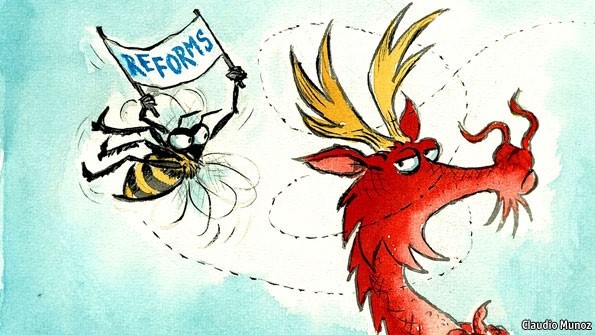
CHINA’S reformers have had a few bad years. A booming economy, they complain, has sapped the government’s will to do battle on their behalf against increasingly powerful interest groups which see no need for change. But as the Communist Party prepares to hand power to a younger generation of leaders later this year, reformists see a glimmer of opportunity. They hope to challenge the assumption that the leadership transition will inevitably be a period of risk-avoidance and caution over policy.
In their effort to push their cause, reformers have recently sponsored two reports laying out plans for long-term change. First, on February 23rd, the People’s Bank of China, the country’s central bank, circulated a ten-year timetable for the creeping liberalisation of capital markets. This would make it easier for Chinese entrepreneurs to buy foreign companies and pave the way for opening up China’s stock-, bond and property markets. Then, four days later, the reformers recruited the World Bank to their cause.
In this section
Related items
· The economics of reform: Stoking the furnaceMar 3rd 2012
· The economics of reform: Stoking the furnaceMar 3rd 2012
On February 27th the bank, along with a government think-tank called the Development Research Centre (DRC), published a 468-page report which puts the reformers’ case for changing a wide range of policies from removing impediments to labour mobility to weakening the grip of state-owned firms and strengthening farmers’ land rights (see next article). The report warned that, without such reforms, China could get caught in a “middle-income trap”, with inflation and instability leading to possible stagnation.
The significance lies not just in what is being said, but who is saying it. The central bank has long been a reformers’ outpost, and is often overruled. But the World Bank report is intriguing, partly because it has connections with the next generation of leaders, and partly because it is unusual for a government-linked organisation in China to align itself so closely with the World Bank on such a high-profile and sensitive project. Conservatives in China are deeply suspicious of the bank, which they regard as an agent of failed Western liberalism. The bank’s president, Robert Zoellick, got a taste of this at a press conference in Beijing to unveil the report. A man describing himself as an independent scholar disrupted the event with a tirade against the bank for supporting “privatisation” of state firms.
The report credits Mr Zoellick with proposing in 2010 that the bank and government should work on a joint project on challenges to China’s longer-term development. But the idea may have originated with a Chinese official. Li Keqiang, a deputy prime minister, expressed enthusiasm for the plan when Mr Zoellick raised it with him, and it was Mr Li who suggested the DRC take part, with help from the Ministry of Finance. After the report’s publication, Mr Li again met Mr Zoellick in an apparently high-profile endorsement of its findings. Mr Li is not just any deputy. Next year he is expected to take over from Wen Jiabao as prime minister.
Few analysts expect Chinese leaders suddenly to start adopting the reforms that the central bank, World Bank and the DRC suggest. But in recent weeks there have been signs that reformers are trying to influence the policy choices facing the incoming leadership. Several articles have appeared in the Chinese press noting the 20th anniversary of a tour of southern China in January and February 1992 by Deng Xiaoping. Deng used that trip to attack hardliners and press for faster market reforms. These articles have urged a bolder approach. Some have suggested the need for a “second southern tour”.
Retracing Deng’s steps
Even the Communist Party’s main mouthpiece, the People’s Daily, has weighed in. On February 23rd it said some officials wanted to keep things as they were in order to avoid criticism, but that this would eventually result in an even greater crisis. The editorial, signed by the newspaper’s commentary department, warned that mere “tinkering” with reform had been the downfall of great nations and parties.
But the reformist leanings of incoming leaders are not necessarily a sign that much will change after the party announces its new line-up in the autumn. Expectations for reform were also high a decade ago when China’s current leaders took over, but ebbed as it became clear that they lacked the will or strength to take on powerful interests such as state-owned enterprises and export industries. Xi Jinping, who is likely to take over as party chief this year and as president in 2013, will probably take time to consolidate his power.

Meanwhile, the vested interests are already preparing to defend their turf. The World Bank-DRC report suggests that control over state-owned businesses should be taken over by new independent bodies that would hand over dividends to the state budget and gradually reduce the level of state ownership. The body that oversees the state sector, the State-owned Assets Supervision and Administration Commission (SASAC), is not keen. According to a Chinese newspaper, 21st Century Business Herald, SASAC wrote to the finance ministry arguing that the proposal to scale back state ownership was unconstitutional. The newspaper also said SASAC wrote to the DRC saying it was untrue, as many reformers have asserted, that “the state [sector] is advancing and the private retreating.”
A prominent academic, quoted by another Chinese newspaper, said reforms were not being obstructed only by vested interests, but even more by a lack of enthusiasm among the general public. In the late 1990s reformist leaders were able to push through unpopular changes, including huge lay-offs in the state sector, by citing the importance of preparing the country for membership of the World Trade Organisation (which it joined in 2001). No such external excuse is at hand today. The battle over reform continues, and China’s leaders will surely need more than reports by the central bank, World Bank and a leading think-tank to win it.
Read more:"Stoking the furnace"
from the print edition | China
筆者在這裡藉當時正在開的人大政協兩會,猜了一下2013年的人事佈局、軟硬著陸及政治民主化方面例行性的預測及評論。當年汪洋的升遷來說,筆者以為會是人大常委長,從副總理一任作起而今天是政協主席; 薄熙來並沒有接周永康派系頭頭和公安部及中共政法委員會的主席,雙雙瑯璫入獄,而且根據北京跟筆者的說明,周和薄很想當馬可仕,很不幸在筆者寫的時候這兩個心神不寧,筆者沒作什麼連結居然自己承認了。筆者在這篇回顧麥格羅希爾台灣分公司,由蔡昉及林義夫所作的「中國經濟」,也順便提到了巴山輪會議。同時再對照中國官方智庫出台「中國2030」計畫,比較軟硬著陸的定義,軟著陸是在經濟回到低點平穩時,因為消費者物價指數成長即通貨膨漲、政府公債的投資前景仍在,或是政策作了供需方面的槓桿調節得宜,如央行利率方面,因此市場失靈情形也不易發生,於之後遇到經濟低迷期一陣子時,仍因體質強健而使市場有谷底反彈契機,如現在的川普總統保護主義的美國和安倍晉三作兩次三支箭的日本。就社會指標及民生上,現在的日本社會經濟結構的確很像陳水扁總統第二任的台灣,當年從核四爭議的負成長後仍然可以恢復5-7%的年均成長,而現在的蔡英文當局不能。(見2018/01/31日經中文網:日本已到「只要想就能找到工作」狀態,日本連續8季正增長,人均$3.9萬)
筆者最後一段提及習近平第一任應該會觸及金融改革,需要從官僚系統、企業及金融制度三方面著手,重新評估及適當的結構改革,是從日本前首相小泉純一郎的政策提示來的,作個回應金融市場的好政府,更強健穩固這個新的「治理」系統勢在必行。的確在2015-16年一邊作匯率的調整,也對供給面國有企業進行改革,配合習近平和王岐山主導肅貪行動而在2017年的下半年經濟有達近6.9%的標準。穩健長效的成長有作合理社會資源分配,中共的政權才會比較穩定,是筆者當年和北京提過的建議。
這裡附註百度百科的「巴山輪會議」定義,筆者在經濟學人雜誌初試啼聲時受廣大迴響的相關文章,裡面的「一名經濟學獎得主」是James Tobin(1918,3,5-2002,3,11):
================================
巴山輪會議
1985年9月2日清晨6點,一聲汽笛長鳴,“巴山”號遊輪緩緩駛出重慶朝天門碼頭,朝著長江三峽的方向駛去。航程目的地是武漢,行程6天。時任中國社會科學院經濟研究所副所長的趙人偉正在船上。這是一艘當年3月份剛剛下水的嶄新輪船,額定載客80人,以2人標準間為主,配套有會議、休閒及健身功能,相當於三星級的賓館,“在房間裡就能洗澡呢,當時算很豪華了”,趙人偉至今記得。歷時6天的 “宏觀經濟管理國際研討會”就在船上召開,後人通常把這次會議稱為“巴山輪會議”。
國內外背景
1985年,中國經濟發展走到一個關鍵點,何去何從,面臨新的抉擇。而由數十位國內外頂尖經濟專家參與的巴山輪會議,給中國經濟發展間接地提出了治理方向,讓中國人初次知道了什麼是好的宏觀經濟管理,什麼是中國眼前該做的事情。巴山輪會議”召開的一個背景是,1984年第四季度中國發生銀行信貸失控,投資猛增,消費增長過快,物價上漲幅度達到10%。如何看待宏觀經濟形勢?應採取什麼樣的對策?
1985年,中國的改革開放已經進行到第7個年頭。“從1979到80年代初那幾年,中國剛改革開放,從計劃經濟一下跳到市場經濟裡,要一個過程。從高層決策者到經濟學界,知識背景都不夠。當時學習東歐的經驗較多。無非是在原有的計劃經濟框架裡,加點市場機制到裡面。這方面東歐做得最多。但是東歐並沒有把市場經濟作為資源配置的基礎,到了1985年,中國人覺得光學東歐改革是不夠的了,也要學習西方的市場經濟國家經驗。1985年,是學習外國先進經驗的一個轉捩點。”趙人偉這樣評述巴山輪會議的背景。
1982年,中共十二大的政治報告,提出的還是“計劃經濟為主體,市場調節為補充”,到了1984年10月十二大三中全會,中共《關於經濟體制改革的決定》的說法已是“有計劃的商品經濟”。趙人偉解釋說:“商品經濟就是市場經濟,但是當時中國的官方檔中還沒直接用市場經濟這個詞。從這個時候起,整個經濟的軌道轉到市場經濟上了。沒這個背景,巴山輪的會沒法開。”
國內外嘉賓
外國人,有美國耶魯大學經濟學教授、1981年度諾貝爾經濟學獎獲得者詹姆斯·托賓,那句“不要把所有雞蛋放到一個籃子裡”名言的講述者;英國劍橋大學教授、格拉斯哥大學名譽校長阿來克·凱思克勞斯;英國牛津大學安瑟尼學院高級研究員弗拉基米爾·布魯斯;聯邦德國證券抵押銀行理事長奧特瑪·埃明格爾;匈牙利科學院經濟研究所研究部主任諾什·科爾奈;南斯拉夫政府經濟改革執行委員會委員亞歷山大·巴伊特;日本興業銀行董事、調查部部長小林實等。堪稱是一群當時世界一流的經濟學家。
還有一位重要的外國代表,菲律賓籍華人林重庚。他當時是世界銀行駐中國首席代表。巴山輪會議,最早是林重庚和中國體改委委員廖季立開始協商籌辦的,廖季立後來因病未能與會。而參加會議的外國經濟學家,主要也是林重庚請的。巴山輪會議以三家單位的名義主辦:中國經濟體制改革研究會、中國社科院、世界銀行駐京辦事處。
中國嘉賓
中國方面,領銜者為年已81歲的經濟學界元老薛暮橋,薛不僅是學界泰斗,而且曾任國家計劃委員會副主任等要職,當時為國務院發展研究中心名譽主任;安志文,國家經濟體制改革委員會副主任兼黨組書記;馬洪,國務院經濟技術社會發展研究中心總幹事;童大林,體改委副主任,等等。這些都是參與制定國家經濟政策的重要官員,年齡都在60歲上下。
除了官員,另一部分人是經濟學家:劉國光(社科院副院長)、高尚全(體改委副主任)、吳敬璉(國務院發展中心)、趙人偉、張卓元(社科院財貿研究所所長)、周叔蓮(社科院工業經濟研究所所長)等。“可以說,當時社科院與經濟有關的研究所所長都來了。”趙人偉回憶。除了劉國光外,這批學者多數當時50歲上下,正值壯年。
另有一批參加會議的“小字輩”,他們在今天格外引人注目:項懷誠,46歲,時任財政部綜合計劃司副司長,後任財政部長,現剛從社保基金會理事長位置上退休不久;洪虎,45歲,時任體改委秘書長,現職全國人大法律委員會3副主任;樓繼偉,35歲,時任國辦研究室主任,曾任國務院副秘書長、財政部部長;郭樹清,29歲,當時還是社科院博士研究生,曾任建設銀行董事長、證監會主席、山東省委書記,現任銀監會主席。他和樓繼偉,都是“擠”進來參加的會。
“當時年輕人還沒起來。而我們這批人,包括來自體改委和社科院的這兩部分學者,都是1978年以後投入改革開放中的,正站在改革的前沿。”對於這批後來成為中國改革中堅的學者們,傳統的社會主義經濟學理論顯然已經不能解釋現實問題,那麼應該到哪裡去尋求方向?——這不僅是學者們巨大的困惑,對於整個國家都是如此。
歷史意義
巴山輪會議後,到1987年,中共十三大提出的是“國家調節市場,市場引導企業”,到了1992年鄧小平南巡講話以後,中共十四大正式確立定把建立社會主義市場經濟體制作為經濟體制改革的目標。
“巴山輪會議,對中央負責起草文件的人是有很大影響的。它既有1984年十二屆三中全會的背景,又對1992年確定市場經濟有推動作用。它的最大的意義就在這裡。”趙人偉總結道。
加過巴山輪會議的很多人,通過那個會議改變了自己後來的人生道路,現在都成就了自己的一番事業,就連翻譯也不例外。
在那次會議上,很多人與國外的經濟學家建立了很好的聯繫,通過他們的幫助,許多人都得以有了出國學習的機會。比如郭樹清、樓繼偉、田源等一批人,後來都到國外學習過。
事實上,那次會議不僅讓參會的人員有機會出國學習,還推動年輕一代到西方去學習很多東西,回來後發揮了很大作用。
下一則: Old hands Mar 1st 2012, 17:12; 附Analects開版文 Here be Analects Feb. 24th
限會員,要發表迴響,請先登入


