Homer
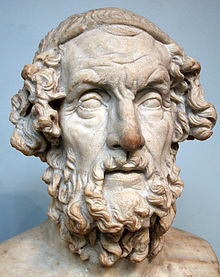
1.:the name ascribed by the Ancient Greeks to the semi-legendary author of the two epic poems.
2.the central works of Greek literature:
〈1〉the Iliad
〈2〉the Odyssey
3.many accounts of Homer's life circulated in classical antiquity, the most widespread being that he was a blind bard from Ionia
→the modern scholarly consensus is that these traditions do not have any historical value
4.The Homeric question-by whom, when, where and under what circumstances were the Iliad and Odyssey composed
→continue to be debated→two groups:
〈1〉holds that most of the Iliad and〈according to some〉the Odyssey is the work of a single poet or genius.
〈2〉The other considers the Homeric poems to be the crystallization of a process of working and re-working by many contributors and that 〝Homer〞 is best seen as a label for an entire tradition.
5.is generally accepted that the poems were composed at some point around the late eighth or early seventh century B.C.
※the poems:
〈1〉in Homeric Greek=Epic Greek
〈2〉a literary language which shows a mixture of features of the Ionic and Aeolic dialects from different centuries.
6. Period:
〈1〉The chronlogical period of Homer depends on the meaning to be assigned to the word〝Homer〞.
〈2〉Concurrent with the questions of whether there was biographical person named Homer, and what role he may have played in the development of the currently known texts, is the question of whether there ever was a uniform text of the Iliad or Odyssey
7. Life and Legends:
These stories were incorporated into the various 〝live of Homer〞, 〝compiled from the Alexandrian period onwards.〞→Various traditions have survived purporting to give details of Homer's birthplace and background.
〈1〉The satirist Lucian, in his True History, describes him as a Babylonian called Tigranes, who assumed the name Homer when take〝hostage〞〈homeros〉by the Greeks.
〈2〉When the Emperor Hadrian asked the Oracle at Delphi about Homer, the Pythia proclaimed that he was Ithacan, the son of Epikaste and Telemachus, from the Odyssey.
8.Cultural background:
William Ihne examing the sources counted as many 19 locations in classical times that claimed Homer as a citizen, including Athens, which accepted Smyrna as Homer's native city, but insisted the city was its colony.←The cause of these multiple claims was civic competition for the honor.
9.Works attributed to Honor:
〈1〉The Greeks of the sixth and early fifth centuries B.C.E understood by the works of “Homer”, generally, “the whole body of heroic tradition as embodied in hexameter verse.”The entire Epic Cycle was included.
〈2〉The genre:
→included further poems on the Trojan War, such as the Little Iliad, the Nostoi, the Cypria, and the Epigoni, as well as the Theban poems about Oedipus and his sons.
→other works, such as the corpus of Homeric Hymns, the comic mini-epic Batrachomyomachia〈”The Frog-Mouse War〉, and the Margites were also attributed to him.
→Two other poems:the Capture of Oechalia and the Phocais were also assigned Homeric authorship.
Iliad
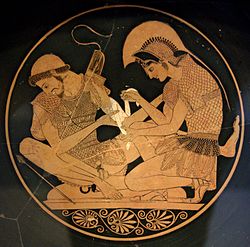
1.:is an ancient Greek epic poem in dactylic hexameter, traditonally attributed to Homer.
2.Set during the Trojan War.
※Trojan war:
〈1〉the ten-year siege of the city of Troy by a coalition of Greek states
〈2〉it tells of the battles and events during the weeks of a quarrel between King Agamemnon and warrior Achilles.
3.the story covers only a few weeks in the final year of the war, the Iliad mentions or alludes to many of the Greek legends about the siege;the earliest events, such as
→the gathering of warriors for the siege
→the cause of the war
→related concerns tend to appear near the beginning
Quiz〈1-35〉+Introduction〈36-49〉→Points
1.In the first millennium B.C.E.,the Hebrew nation reached great expansion and prosperity under Kings Solemn and David.
2.The ancient city of Troy was located in western Turkey now.
3.By the beginning of the fifth century B.C.E., the two main city-states were Athens and Sparta.
4.In general, Rome and Romans were conservative.
5.Petronius's Satyricon satirizes the nouvePetronius's Satyriconau riche.
6.The “Fertile Crescent”refers to the valley between the Tigris and Euphrates Rivers.
7.In the sixth century B.C.E., the Hebrew cities were destroyed and the population deported to Babylon.
8.Sophists were teachers.
9.In the fourth century B.C.E., the Greek city states fell to Macedon.
10.The dialectic method of Socrates was based on question and answer.
11.The ancient Greeks called themselves Hellenes.
12.The state of Isrel was created after WII.
13.Asia Minor is the ancient name for the countries in western Asia.
14.Homer was inspired by Greek oral epic poetry.
15.Ancient Greek religion both distained and worshiped their gods.
16.One of Greece's gratest contributions to Rome was rhetoric.
17.In the religion of ancient Greece, morality was created by humans.
18.Rome emerged as a world power after victory over Carthage.
19.The democracy of fifth century B.C.E., Athen was direct and open to all free men.
20.Before the fifth century B.C.E., the city-states of Ancient Greece were governed as an oligarchy.
21.The diaspora is the dispersal of Hebrews among other cultures/religions.
22.The Torah is the first five books of the Hebrew Bible.
23.Ancient Greek women's first duty was to produce sons.
24.Socrates was condemned to death for impiety.
25.The first Roman emperor was Augustus.
26.The most famous of the Sophists was Protagoras.
27.The Hebrew religion is different from other religions in the ancient world because it is monotheistic.
28.Rome's great enemy in North Africa was Carthage.
29.Ancient Greeks considered their gods arbitrary and cappricious toward humans.
30.The majority of city-states on the Peloponnese were ruled by Sparta.
31.The “Ancient World” refers to the culture of the Miditerranean Basin before 400B.C.E
32.The Peloponnesian Wars were between Athens and Sparta.
33.Latin literature began with a translation of the Odyssey.
34.The city-states of ancient Greece were alike in heritage.
35.A belief system is the way a society views the world and human life.
36. The soothsayer instruct Hector to play with his mother for mercy.
37.The Trojans waiting for morning outside of the Greek fortifications.
38.Hector's funeral pyre concludes the epic.
39.Apollo is frequently throughout the poem preventing the Greeks from winning the war outright.
40.After being insulted by Agamemnon's request of a replacement war prize, Achilles threatens to kill Odysseus.
41.After being defeated by Hector and Achilles, Patroclus predicts Hector's death.
42.Diomedes convinces Agamemnon not to abandon the war.
43.Achilles drags Hector's body around the city behind a chariot in order to celebrate his victory over Hector.
44.Chryseis, a young beautiful girl, is a prize ignites the conflict between Achilles and Agamemnon.
45.The news of the death of Patroclus rallies Achilles' return to the war.
46.Both Trojan and Greek warrior culture placed great importance on the preservation and care of dead comrade's corpes.
47.The Iliad begins with opening lines that state an invocation to the muses.
48.Apollo lifts the plague from the Greeks.
49.Zeus can't save his mortal son Sardon because the gods agreed to a nonintervention pact for the war.
限會員,要發表迴響,請先登入


