鸚鵡螺號核子動力潛艇(USS Nautilus SSN-571)是隸屬於美國海軍的一艘作戰用潛水艇。它除了是世界上第一艘實際運作服役的核子動力潛艇外,也是第一艘實際航行穿越北極的船隻。
http://youtu.be/HR3WwVW-tdA
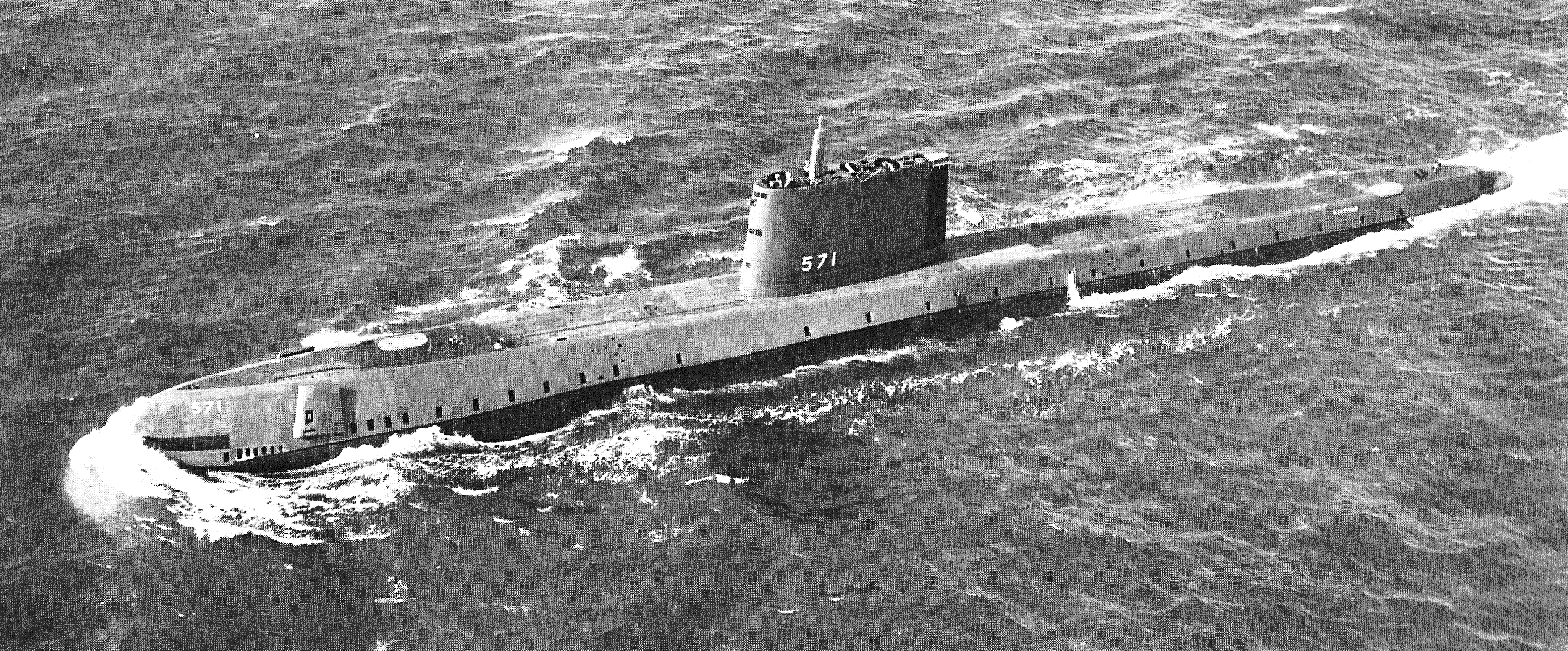
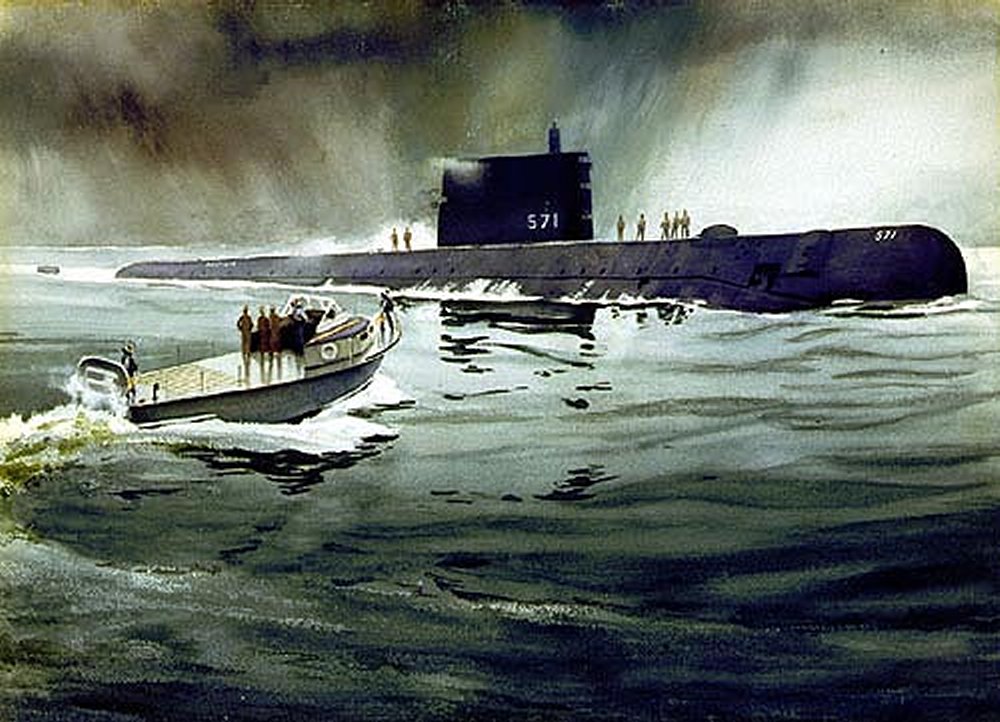


使用核能來作為船隻動力源的觀念,最早是由第二次世界大戰時代的物理學家菲力普·艾貝爾森(Philip Abelson)開始鼓吹,他撰寫了世界上第一篇如何將核子反應爐裝置在潛艇中,以同時提供潛艇潛航時所需的推進力與電力之報告。在他的報告中提到可將潛艇用作一個飛彈發射台,等於是將潛艇的作用由戰術的攻擊用艦艇轉化為戰略武器載台。艾貝爾森的概念獲得了人稱「核動力海軍之父」(Father of the Nuclear Navy)的美國海軍上將海曼·里科弗(Hyman G. Rickover)之支持,並促使美國國會在1951年7月批准一紙建造案,授權建造一艘核子動力潛艇。稍後在12月12日時美國海軍部(U.S. Navy Department)正式公告新建造的潛艇將編號為SSN-571,並命名為鸚鵡螺號。是美國第六艘使用此名的船隻,也是第三艘使用此名的潛艇。並與法國作家儒勒·凡爾納所著小說《海底兩萬里》中的潛艇同名。
鸚鵡螺號在6月9日離開西雅圖港,並在6月19日進入楚克奇海(Chukchi Sea,北冰洋的一部份),但卻因為在淺海水域遇到太多流冰而被迫折返。6月28日它航抵夏威夷珍珠港,並在那裡暫停等待北極地區較好的海象。7月23日鸚鵡螺號出海北航,於8月1日時潛入巴羅海谷(Barrow Sea Valley)。在8月3日東岸日光節約時間(EDST)23時15分抵達地理北極,成為世界上第一艘航抵北極點的船隻。自北極點開始它又繼續在冰下航行了96小時、2,945公里(1,830英里),在格陵蘭東北外海浮上海面,成功地完成以潛航方式穿越北極的任務
USS Nautilus (SSN-571) is the world's first operational nuclear-powered submarine. She was the first vessel to complete a submerged transit to the North Pole on 3 August 1958. Sharing names with the submarine in Jules Verne's Twenty Thousand Leagues Under the Sea, and named after another USS Nautilus (SS-168) that served with distinction in World War II, Nautilus was authorized in 1951 and launched in 1954. Because her nuclear propulsion allowed her to remain submerged far longer than diesel-electric submarines, she broke many records in her first years of operation, and traveled to locations previously beyond the limits of submarines. In operation, she revealed a number of limitations in her design and construction. This information was used to improve subsequent submarines.
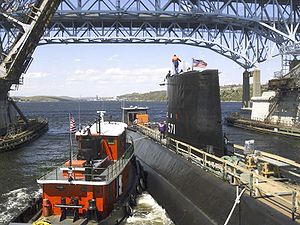
Nautilus was decommissioned in 1980 and designated a National Historic Landmark in 1982. She has been preserved as a museum of submarine history in Groton, Connecticut, where she receives some 250,000 visitors a year.

1979年春天,鸚鵡螺號自格羅頓啟航,踏上它最後一個航程,在1979年5月26日航抵加州巴耶霍(Vallejo)的梅爾島海軍造船廠(Mare Island Naval Shipyard)。最後在1980年3月3日除役並自美國的海軍船隻名冊(Naval Vessel Register)上註銷


USS Nautilus (SSN-571) is the world’s first operational nuclear-powered submarine. She was also the first vessel to complete a submerged transit across the North Pole.
Namesake of the submarine in Jules Vern’s Twenty Thousand Leagues Under the Sea, Nautilus was authorized in 1951 and launched in 1954. Because her nuclear propulsion allowed her to remain submerged for far longer than diesel-electric submarines, she broke many records in her first years of operation and was able to travel to locations previously beyond the limits of submarines. In operation, she revealed a number of limitations in her design and construction; this information was used to improve subsequent submarines.
The Nautilus was decommissioned in 1980 and designated a National Historic Landmark in 1982. She has been preserved as a museum of submarine history in Groton, Connecticut where she was launched. she receives some 250,000 visitors a year.
On August 3, 1958, the U.S. nuclear submarine (核子潛艇) Nautilus (鸚鵡螺號) accomplishes the first undersea voyage (航行) to the geographic North Pole. The world's first nuclear submarine, the Nautilus dived at Point Barrow, Alaska, and traveled nearly 1,000 miles under the Arctic (北極的) ice cap (冰帽) to reach the top of the world. It then steamed on to Iceland, pioneering a new and shorter route (路徑) from the Pacific to the Atlantic and Europe.
The USS Nautilus was constructed under the direction of U.S. Navy Captain Hyman G. Rickover, a brilliant Russian-born engineer who joined the U.S. atomic program in 1946. In 1947, he was put in charge of the navy's nuclear-propulsion (核子動力) program and began work on an atomic submarine. Regarded as a fanatic (狂熱者) by his detractors (誹謗者), Rickover succeeded in developing and delivering the world's first nuclear submarine years ahead of schedule. In 1952, the Nautilus' keel (龍骨) was laid by President Harry S. Truman, and on January 21, 1954, first lady Mamie Eisenhower broke a bottle of champagne across its bow (船首) as it was launched into the Thames River at Groton, Connecticut. Commissioned (服役) on September 30, 1954, it first ran under nuclear power on the morning of January 17, 1955.
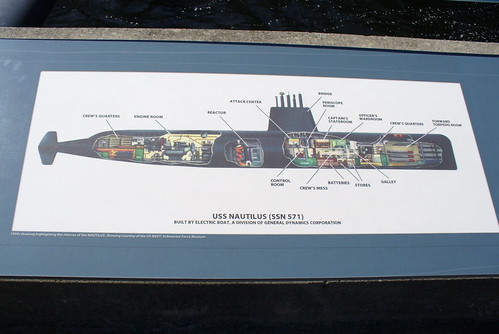
Much larger than the diesel-electric submarines that preceded (在…之前) it, the Nautilus stretched (展開) 319 feet and displaced (排水量) 3,180 tons. It could remain submerged for almost unlimited periods because its atomic engine needed no air and only a very small quantity of nuclear fuel. The uranium-powered (鈾動力) nuclear reactor (核子反應爐) produced steam that drove propulsion turbines, allowing the Nautilus to travel underwater at speeds in excess of 20 knots.
In its early years of service, the USS Nautilus broke numerous submarine travel records and on July 23, 1958, departed Pearl Harbor, Hawaii, on "Operation Northwest Passage"--the first crossing of the North Pole by submarine. There were 116 men aboard for this historic voyage, including Commander William R. Anderson, 111 officers and crew, and four civilian scientists. The Nautilus steamed north through the Bering Strait and did not surface until it reached Point Barrow, Alaska, in the Beaufort Sea, though it did send its periscope up once off the Diomedes Islands, between Alaska and Siberia, to check for radar bearings (. On August 1, the submarine left the north coast of Alaska and dove under the Arctic ice cap.
The submarine traveled at a depth of about 500 feet, and the ice cap above varied in thickness from 10 to 50 feet, with the midnight sun of the Arctic shining in varying degrees through the blue ice. At 11:15 p.m. EDT on August 3, 1958, Commander Anderson announced to his crew: "For the world, our country, and the Navy--the North Pole." The Nautilus passed under the geographic North Pole without pausing . The submarine next surfaced in the Greenland Sea between Spitzbergen and Greenland on August 5. Two days later, it ended its historic journey at Iceland. For the command during the historic journey, President Dwight D. Eisenhower decorated Anderson with the Legion of Merit.
After a career spanning 25 years and almost 500,000 miles steamed, the Nautilus was decommissioned on March 3, 1980. Designated a National Historic Landmark in 1982, the world's first nuclear submarine went on exhibit in 1986 as the Historic Ship Nautilus at the Submarine Force Museum in Groton, Connecticut.
_Groton_CT_2002_May_08.jpg)


