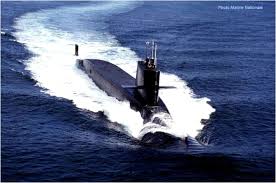
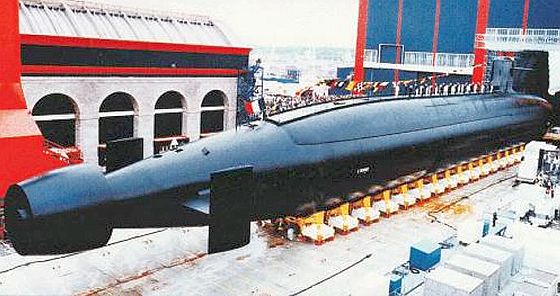
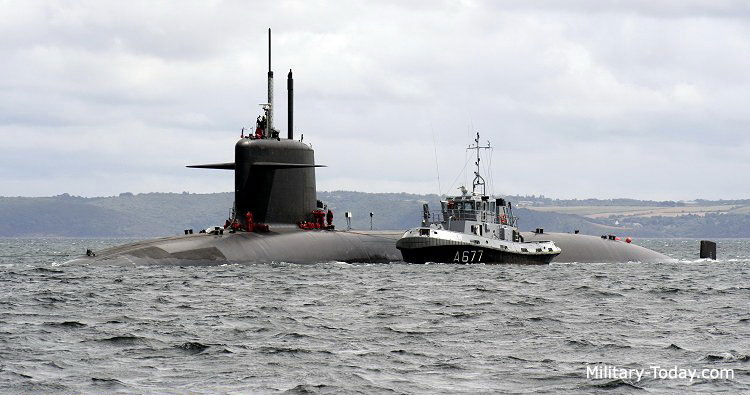
根據可靠情資透露出法國海軍凱旋級核潛艇(Classe Le Triomphant)是法國海軍現役的彈道導彈核潛艇傳聞法國海軍將派遣S619核潛艇猛烈號前往中國南海巡弋?
則配備了更先進的M51導彈(M51)。M51安裝在猛烈號後,於2010年在大西洋法國水域進行測試,成功發射導彈。新型的M51導彈,提升到超過10,000公里。
西方戰略觀察家分析201606-08的中國與美國潛艦對抗賽,最後第三回合的競賽,為了表示公平,公正,公開,中國及美國,邀請法國,英國及俄羅斯,派遣核子潛艦做裁判及見證人,一方面監督中,美雙方避免擦槍走火,玩真格的大打出手,城門失火殃及池魚,另一方面就是救援,萬一演員雙方發生災難事件,好出現救援?
具信Le Triomphant (S619)已於20160715黃昏時分,離開母港前往中國南海尋弋,順便欣賞南海的美麗風景?
根據估計S619已正常航速潛行,大約在20160815日左右時間,會出現中國南海水域只是保秘正確位置,以免中國及美國潛艦騷擾?
此外英國與俄羅斯的核子潛艦,一般咸信在201608月初及中旬時候現身中國南海,屆時聯合國5個常任理事國中,美,英,法,蘇的核子潛艦聚集南海,向南海龍王祝壽,並且抱歉,打擾南海龍王的清夢.


Le Terrible (S619) est le quatrième sous-marin nucléaire lanceur d'engins français de la classe Le Triomphant.
Il est armé de 16 missiles nucléaires mer-sol balistiques stratégiques, le premier avec des missiles de type M51 dont la portée et la précision ont été améliorées par rapport aux M45 actuellement en service sur les autres SNLE français. Il est évoqué une portée de 8 000 km (contre 6 000 km pour les M45) et une précision de 200 m.
Son armement comprend également un panachage de 18 armes défensives torpilles F17, F21 (à partir de 2017) et des missiles antinavires Exocet SM39 à changement de milieu.

| General characteristics | |
|---|---|
| Class and type: | Triomphant-class submarine |
| Displacement: |
|
| Length: | 138 m (453 ft) |
| Beam: | 12.50 m (41.0 ft) |
| Draught: | 10.60 m (34.8 ft) |
| Propulsion: |
|
| Speed: | over 25 knots (46 km/h; 29 mph) |
| Range: | Unlimited distance; 20–25 years |
| Test depth: | Over 400 m (1,300 ft) |
| Complement: |
|
| Sensors and processing systems: |
|
| Electronic warfare & decoys: |
ARUR 13 |
| Armament: | |


 2樓. hsr2016/07/23 19:32The South China Sea disputes involve the interests of the United States, particularly with regard to freedom of ... This mix of objectives will require a nuanced array of policies that, taken together, move a difficult and .... has an important submarine base on Hainan Island ..... Russia, the Netherlands, and France already.
The Encirclement of China is Well Underway: France Prepares to Lead EU Missions in the South China Sea.
The naval encirclement of China is well underway. It was started over a decade ago by the United States with the re-militarization of Japan and the tightening of Washington's military partnerships with countries like Australia and South Korea. The same is true about the missile shield being erected in South Korea, which targets China, Russia, and North Korea.
The excerpts that will follow are taken from a 14 July 2016 article written by Yo-Jung Chen, a Japanese-educated naturalized French diplomat that immigrated to France from Taiwan. The retired French diplomat wrote the article in The Diplomat seeking to justify the deployment of the French military into the South China Sea. Coming from a retired French diplomat who was stationed in Asia, the article offers some some insights. Aside from his post as the deputy consul of the French Consulate-General in San Francisco, Yo-Jung's Chinese background helped qualify him as the press attaché for the French Embassy in China and deputy consul at the French Embassy in Singapore.
hsr 於 2016/07/23 19:36回覆-
1樓. hsr2016/07/23 19:03
To the surprise of many, a seemingly unrelated European power, France, has announced its intention of coordinating the navies of fellow European Union nations to conduct Freedom of Navigation Operations or FONOPs in South China Sea. On June 5, at the Shangri-la Dialogue in Singapore, French Defense Minister Jean-Yves Le Drian mentioned this initiative for joint EU patrols of “the maritime areas of Asia” and for a “regular and visible presence there.”
Although China was not named in Le Drian’s speech (China is not the only country with sovereignty claims in the South China Sea), the French initiative was generally interpreted as a bad news for Beijing, who was already irritated by what it sees as “outside interference” by the United States and its allies in China’s territorial feuds with countries bordering South China Sea.
From a strictly strategic viewpoint, France’s announced plan will not have a determining impact on the situation in the South China Sea. After all, despite being a major military power with global reach, France’s military presence in the region is limited. Besides, outside of France, what other EU nation has a permanent naval and air presence in the Pacific?
But however small the strategic impact may be, the French initiative promises to weigh in heavily on the diplomatic front, adding significantly to China’s already stark isolation in this case.
However, despite what appears to be a challenge to China in the South China Sea, France and the EU have carefully maintained strict neutrality in specific territorial disputes. This neutrality, reiterated by Mogherini on July 13 in Beijing, is after all in line with what China has consistently asked the EU. It should ensure that Beijing would not react beyond mere expressions of displeasure to a French/EU FONOP which, in strict official term, is not aimed at China alone hsr 於 2016/07/23 19:05回覆This being said, while the French Navy continues to be present in the South China Sea, the prospect of an EU fleet patrolling these waters may still be a long way away, given the multiple crises and divisions within the European bloc, especially after Brexit. But as a EU founding member most active in pushing for a common defense policy, France is best suited for coordinating such an operation among EU partners. hsr 於 2016/07/23 19:06回覆


