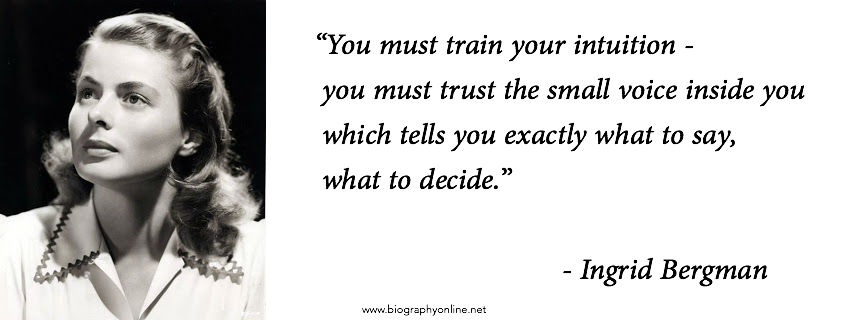




Ingrid Bergman 100 https://youtu.be/MZ-i1UF1ItA
https://youtu.be/wxMeu34o_jQ?list=RDzaAqze81y4Y
英格麗·褒曼(Ingrid Bergman,生於瑞典首都斯德哥爾摩,瑞典國寶級電影女演員],曾獲三座奧斯卡金像獎(兩座奧斯卡最佳女主角獎及一座奧斯卡最佳女配角獎),《北非諜影》的主演。1999年,美國電影學會選她為百年來最偉大的女演員第4名。
2015年在她百歲冥誕之際,第68屆坎城影展海報主視覺,是以她的的清爽笑容作為緬懷[。坎城影展表示,她是摩登偶像,自由女性,也是大膽的演員。是好萊塢明星,也是新寫實主義要角,飾演於多種角色,落腳於各個國家,但從未失去她的優雅和單純。自由、無畏與現代主義是影展年復一年透過獲獎藝術家和電影所強調的價值,也曾於1973年擔任第26屆坎城影展評審團主席的褒曼也鼓勵著電影節朝這一價值方向行進。影展期間播放了紀錄片《英格麗•褒曼》,伴隨著兒女們的回憶回顧了褒曼的一生。
As Time Goes By" - Casablanca - The Original Sam (Dooley Wilson) song .
褒曼與亨佛萊·鮑嘉共同主演了1942年的經典《北非諜影》。她在《北非諜影》中的演出也許是她的演員生涯中最著名的一次。英格麗·褒曼並不認為她在《北非諜影》的演出是她的最愛:「我演出許多更重要的電影,但這是人們會想去談論的唯一一部關於亨佛萊·鮑嘉的電影。」關於亨佛萊·鮑嘉,她則是說:「我不曾真正了解他,我親了他,但我不了解他。」
As Time Goes By"
A kiss is still a kiss
A sigh is still (just) a sigh
The fundamental things apply
As time goes by
And when two lovers woo
They still say: I love you
On that you can rely
No matter what the future brings
As time goes by
Moonlight and love songs - never out of date
Hearts full of passion - jealousy and hate
Woman needs man - and man must have his mate
That no one can deny
It's still the same old story
A fight for love and glory
A case of do or die
The world will always welcome lovers
As time goes by

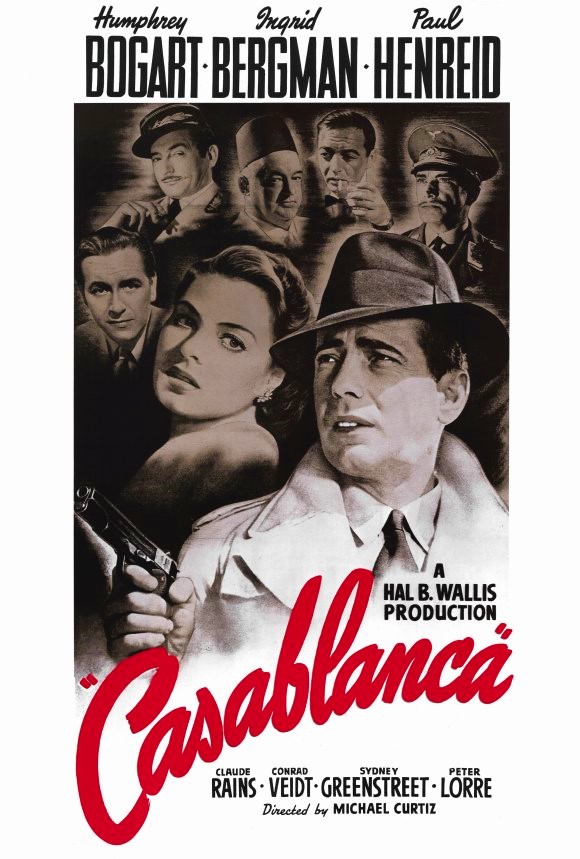




Ingrid Bergman (Swedish pronunciation: [ˈɪŋːrɪd ˈbærjman]; 29 August 1915 – 29 August 1982) was a Swedish actress who starred in a variety of European and American films. She won three Academy Awards, two Emmy Awards, four Golden Globe Awards and the Tony Award for Best Actress. She is ranked as the Fourth greatest female star, out of 25, of American cinema of all time by the American Film Institute. She is best remembered for her roles as Ilsa Lund in Casablanca (1942), and as Alicia Huberman in Notorious (1946), an Alfred Hitchcock thriller starring Cary Grant.
Before becoming a star in American films, she had been a leading actress in Swedish films. Her first introduction to U.S. audiences came with her starring role in the English-language remake of Intermezzo (1939). In the United States, she brought to the screen a "Nordic freshness and vitality", along with exceptional beauty and intelligence, and according to the St. James Encyclopedia of Popular Culture, she quickly became "the ideal of American womanhood" and one of Hollywood's greatest leading actresses.[4] Her producer David O. Selznick later called her "the most completely conscientious actress" he had ever worked with. He started her with a one-film role at her insistence (Intermezzo), then signed a four-film contract (also at her insistence) rather than a typical seven-year acting contract.
Casablanca (1942).After the onset of World War II, Bergman "felt guilty because she had so misjudged the situation in Germany" while she was there filming Die vier Gesellen (The Four Companions). According to one of her biographers, Charlotte Chandler (2007), she had at first considered the Nazis only a "temporary aberration, 'too foolish to be taken seriously.' She believed Germany would not start a war." Bergman felt that "The good people there would not permit it." Chandler adds, "Ingrid felt guilty all the rest of her life because when she was in Germany at the end of the war, she had been afraid to go with the others to witness the atrocities of the Nazi extermination camps.After completing one last film in Sweden and appearing in three moderately successful films (Adam Had Four Sons, Rage in Heaven and Dr. Jekyll and Mr. Hyde, all 1941) in the United States, Bergman co-starred with Humphrey Bogart in the classic film Casablanca (1942), which remains her best-known role. In this film, she played the role of Ilsa, the beautiful Norwegian wife of Victor Laszlo, played by Paul Henreid, an "anti-Nazi underground hero" who is in Casablanca, a haven from the Nazis. Bergman did not consider Casablanca to be one of her favorite performances. "I made so many films which were more important, but the only one people ever want to talk about is that one with Bogart." In later years she stated, "I feel about Casablanca that it has a life of its own. There is something mystical about it. It seems to have filled a need, a need that was there before the film, a need that the film filled.8