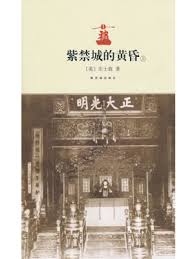
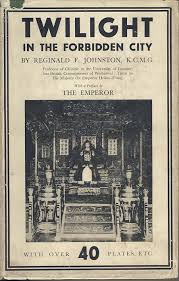
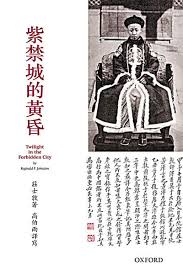
《紫禁城的黃昏》(Twilight in the Forbidden City)是里吉納德‧莊士敦關於清末皇帝宣統帝溥儀的回憶錄,
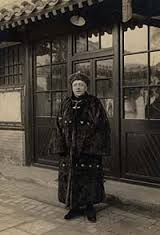
莊士敦是宣統的老師,也見證了19世紀20至30年代的動蕩時期。他的觀點和現在很多人的觀點相異。他亦是倫敦大學中文教授和英國駐威海衛專員.
Johnston was tutor to the Emperor and an eyewitness to events in China in the 1920s and 1930s. Johnston was also a professor of Chinese at the University of London as well as the British Commissioner of Weihaiwei.
Johnston provides a good deal of anecdotal material for the last days of the Qing court before the 1911 Revolution. He knew many of the active players in those events, and his observations on the Qing court's political structure, and in particular the Imperial Household Department, are of historical significance. Johnston had little to say about Empress Dowager Cixi and many other principal players in these events,
twilight in the Forbidden City is a history of an entire period and not an exclusive portrait of the last emperor of China. The film The Last Emperor features the book.


In 1919, he was appointed tutor of thirteen-year-old Puyi who still lived inside the Forbidden City in Beijing as a non-sovereign monarch.
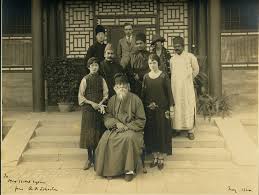
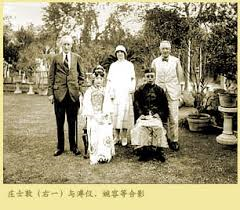
As the Scottish-born tutor to the Dragon Emperor, Johnston and Isabel Ingram, daughter of an American missionary and the empress's tutor, were the only foreigners in history to be allowed inside the inner court of the Qing Dynasty. Johnston carried high imperial titles and lived in both the Forbidden City and the New Summer Palace.
Johnston was appointed Professor of Chinese in the University of London in 1931, a post based at the School of Oriental and African Studies, to which he bequeathed his library in 1935. This library, one of the finest collections of Chinese and East Asian books in the country, consists of over 16,000 volumes. He was not a natural teacher,[citation needed] and hated university administration.
He retained his ties with Puyi, which proved an embarrassment after the former emperor assumed the throne of the Japanese puppet state of Manchukuo.
Johnston retired in 1937, having acquired the small island of Eilean Righ in Loch Craignish, Scotland, on which he created for himself a Chinese Garden and flew the flag of Manchukuo. After a short illness, he died in Edinburgh. In his will, he requested that no religious ceremony be conducted. In accordance with his wishes, he was cremated. His ashes were scattered on the island of Eilean Righ and surrounding Loch.
He never married but was at one stage engaged to the historian Eileen Power, and was close to author Stella Benson.
Mrs Elizabeth Sparshott, to whom he was engaged at the time leading up to his death, burned many of his letters and other materials, at Johnston's request.
Johnston's book Twilight in the Forbidden City (1934) describes his experiences in Beijing and was used as a source for Bernardo Bertolucci's film dramatization of Puyi's life The Last Emperor. He was portrayed by Peter O'Toole in the film.
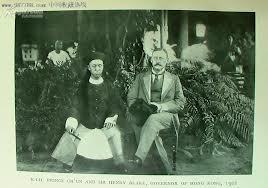
莊士敦,1874年生於蘇格蘭首府愛丁堡。1894年畢業于愛丁堡大學,後進入牛津大學瑪格德琳學院主修現代歷史、英國文學和法理學,獲文學碩士學位。1898年,經過激烈角逐,莊士敦考入英國殖民部,同年以東方見習生身份被派往香港,在香港港英殖民地政府任職,先後任輔政司助理、總督私人秘書等職。
1904年5月,派往威海衛,先後任秘書、南區行政長官和正華務司等職。1902年7月,穿越雲南、越南,然後又到了緬甸;1906年溯長江而上去了四川、西藏,並拜會達賴喇嘛;1908年和1913年,相繼到了五臺山、九華山、普陀山等地。根據沿途見聞完成了《從北京到瓦城》等著述。
1919年2月,經李經邁的推薦,離威赴京,至紫禁城教授溥儀英語、數學、世界史、地理;師生感情甚篤,曾封“一品頂戴”、“毓慶宮行走”,溥儀亦因莊的教導眼界大開,走向世界。此前,英國政府授予他“高級英帝國勳爵士”勳章(CBE)。
1927年任英國駐威海衛總督;1930年10月1日威海衛歸還中國,莊士頓返回英國。
1931年他于倫敦大學擔任教授,專業研究非洲及亞洲,惟學術評價並不高。
1934年寫成了《紫禁城的黃昏》一書,記述了溥儀從民國成立到1924年被迫出宮這段時期的變故。1935年,莊士敦最後一次來中國,到長春造訪了溥儀。晚年定居在愛丁堡的愛倫島。至1938年於愛丁堡去世,享年64歲。
莊士敦是近代惟一一位在紫禁城中生活過、也是中國幾千年帝王史上惟一一位具有“帝師”頭銜的外國人。莊士敦除向溥儀傳授英語、天文、地理、算學及歐洲法制史外,更教給他英國紳士風度和禮儀,並不時向溥儀介紹國內外重大社會變革,甚至將《新青年》等激進刊物帶給溥儀閱讀。為使溥儀更多地接觸外界事物,莊士敦還向溥儀引見了英國駐華公使及駐華艦隊司令、日本駐華公使,以及泰戈爾、胡適等人,成為溥儀與外界溝通的重要橋樑。
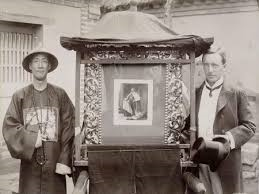
莊士敦對溥儀產生了深刻的影響,用溥儀自己的話說:“莊士敦是我靈魂的重要部分。”莊士敦積極參與宮中廢除太監、改革財力管理及以外交關係等重大事務的處理,被溥儀賜“頭品頂戴”、“毓慶宮行走”、“賞坐二人肩輿”、“賞穿帶貂褂”等格外恩賞。
1924年,馮玉祥將溥儀驅逐出紫禁城後,莊士敦多方協調,使溥儀逃入日本使館。
莊士敦1904年初到威海衛,便開始了對中國儒家經典和古典文學的刻苦研讀,並逐漸變成一種對中國文化的酷愛和癡迷。他除了取個中國名字莊士敦外,還采《論語》“士志於道”之意,為自己另外起了一個儒氣十足的字:志道。在威海期間,他對中國文化的學習範圍遍佈經史子集,兵醫農工,琴棋書畫,詩詞歌賦,對儒、道、墨、釋以及唐詩宋詞、天文地理,有著廣泛的涉獵。
1930年10月1日,莊士敦在代表英國政府參加威海衛歸還儀式後,卸任回國。臨行前,他給威海人留下了一句話:“我堅信你們將會得到一位比我能力強的領導人,但絕不會遇到像我那樣對威海衛有如此深厚感情的領導人。”
回國後,莊士敦擔任了倫敦大學中文教授,兼任外交部顧問。錢鐘書先生留學英國時,就曾受過他的指導。儘管人在英國,但中國仍是莊士敦最關心的。尤其是對溥儀,莊士敦始終滿懷同情。1935年,莊士敦最後一次來中國,到長春造訪了溥儀,但婉拒了溥儀的留任邀請。
光緒二十七年(1901),莊士敦以 “林紹陽”的筆名在倫敦出版了《一個中國人關於基督教傳教活動向基督教世界的呼籲》一書,指責基督教會傳教士試圖改變中國社會的做法等,引起英國宗教界的猛烈抨擊,稱他為“古怪的佛教徒”。
1934 年莊士敦寫成了《 紫禁城的黃昏》一書,記述了滿清王朝盤踞紫禁城200多年後的黃昏時期——從民國成立到1924年溥儀出宮這段時期的變故、沒落的真實情形,引起轟動。晚年定居在愛丁堡的愛倫島,他為自己的居室分別起了中國名字,如松竹廳、威海衛廳、皇帝廳等等。在島上掛起了偽滿洲國的國旗,他終日把玩溥儀所賜之物,無心世事。每逢年節。他就穿起清朝的服裝,邀請親友到島上相聚。如此數年,從未放棄。1938年,在對中國往事的無盡思念中,莊士敦走到了生命的終點,時年64歲,終生未娶。


