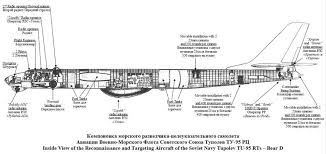
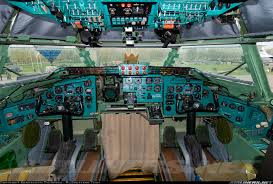
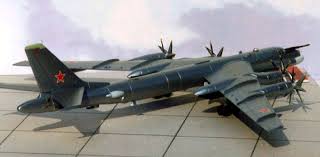
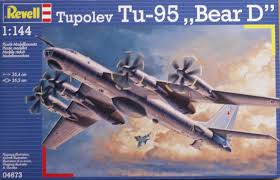
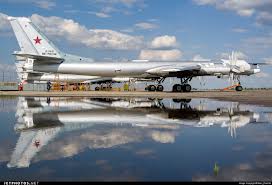
The Tupolev Tu-95 (Russian: Туполев Ту-95; NATO reporting name: "Bear") is a large, four-engine turboprop-powered strategic bomber and missile platform. First flown in 1952, the Tu-95 entered service with the Soviet Union in 1956 and is expected to serve the Russian Air Force until at least 2040] A development of the bomber for maritime patrol is designated Tu-142.
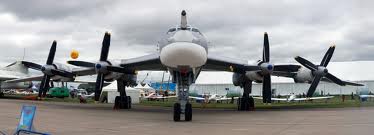
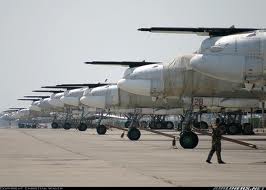
The aircraft has four Kuznetsov NK-12 engines, each driving contra-rotating propellers. It also remains the only propeller-powered strategic bomber still in operational use today. The tips of the propeller-blades move faster than the speed of sound, making it one of the noisiest military aircraft Its distinctive swept-back wings are at a 35° angle.


For a long time, the Tu-95 was known to U.S./NATO intelligence as the Tu-20. While this was the original Soviet Air Force designation for the aircraft, by the time it was being supplied to operational units it was already better known under the Tu-95 designation used internally by Tupolev, and the Tu-20 designation quickly fell out of use in the USSR.[citation needed] Since the Tu-20 designation was used on many documents acquired by U.S. intelligence agents, the name continued to be used outside the Soviet Union.[citation needed]
Initially the United States Department of Defense evaluated the Tu-95 as having a maximum speed of 644 km/h (400 mph) with a range of 12,500 km (7,800 mi)] These numbers had to be revised upward numerous times.


Tu-95(俄語:Ту–95,英語:Tu-95),北約代號:Bear(熊),是蘇聯圖波列夫設計局所研製,是目前全世界唯一仍服役中的大型四渦輪螺旋槳發動機之長程戰略轟炸機、空射飛彈發射平台、海上偵察機,以及軍用客機。Tu-95在冷戰期間大量服役於蘇聯空軍和蘇聯海軍航空隊,蘇聯海軍航空隊使用的機型改稱Tu-142。
蘇聯解體後,烏克蘭曾接收約70架原屬蘇聯空軍的Tu-95系列機,但現已全部退役。而俄羅斯空軍接收的Tu-95系列機到2007年時仍在服役,預計將持續服役至2040年1Tu-95的動力來源為4具庫茲涅佐夫設計局(Кузнецов)(局號OKB-276)研製的NK-12渦輪螺旋槳發動機,裝置在一個突出於翼前緣的長條形發動機艙中,每具發動機各驅動一組同軸反轉螺旋槳(Contra-rotating propellers),使得螺旋槳可以維持最大效率的同時,也充分使用發動機提供的驅動力;圖波列夫設計局又將Tu-95的主翼後掠35°,這樣的設計使得Tu-95保持任務執行中高速飛行的效率。


冷戰中另外一見值得一提的事就是在1961年10月30日早上11時32分,蘇聯在北冰洋新地島群島北緯73.85°東經54.50°地點試爆了第一顆全世界有史以來最大的核武器:沙皇炸彈。
該炸彈威力相當於50百萬噸TNT, 爆炸後的蕈狀雲高達60km, 比珠穆朗瑪峰還高七倍多;爆炸的熱源連在100km以外的人體都會受到3級燒傷。執行這一次試爆任務的飛機是一架Tu-95V型轟炸機,另外伴隨一架Tu-16獾式噴射轟炸機作為觀測機。任務機從10,500m的高空(大約200棟台北101大樓疊起來的高度)將炸彈釋放,炸彈經由氣壓感測器感測到4,200m的高度時自動引爆。

冷戰時期,西方國家戰機曾經(現在也是)頻繁的被派遣去攔截Tu-95轟炸機,並妨礙其執行任務。當其過份接近北大西洋公約組織國家的領空時,兩方接觸的機會就更高了。這種情況下,有時會發生兩方進行非官方無線電或手勢性的通訊。
2010年1月28日下午1時4分,中華民國空軍陽明山雷達站發現一架不明機出現在台灣東北方向154海浬處南下,航速320海浬,沿台灣東北部防空識別區邊緣活動,並於1時15分進入台灣防空識別區短暫停留,在實施全球共同緊急G波道廣播後,該機隨即轉向日本琉球方向,脫離台灣防空識別區。在後來兩三天的比對後,確認是TU-95長程戰略轟炸機,這型飛機曾在越戰期間經常出沒台灣東南方,又再度出現。
On June 9, 2014 United States Air Force fighters intercepted four Tu-95s in international airspace off the coasts of Alaska and Northern California.]
From late July to early August 2014, Russian strategic nuclear bombers have flown at least 16 incursions into northwestern U.S. air defense identification zones, an unusually sharp increase in aerial penetrations, according to U.S. defense officials. The numerous flight encounters by Tu-95 Russian Bear H bombers prompted the scrambling of U.S. jet fighters on several occasions.
 1樓. hsr2014/09/15 18:33hsr 於 2014/09/15 18:34回覆


