★ The Metamorphosis
Published in 1915, The Metamorphosis is a widely read Novella from Franz Kafka. It is widely read in schools throughout the world.
The story follows Gregor Samsa, a traveling salesman who works to provide for his parents and sister. One morning he awakens to find that he has been transformed into a monstruous insect. He is unable to work and becomes a claustrophile, attached to closed-in spaces. Since he can no longer support the family, they begin working again.
The story may be based on Kafka's personal experience with severe insomnia which made him dependent upon his sister. Indeed, in the story Grete Samsa becomes his caretaker after the metamorphosis. That relationship starts off cordially and cooperatively but deteriorates to a passive aggressive state with Grete leaving his room in disarray to spite Gregor. She dreams of attending the music conservatory to play the violin, a dream that Gregor had been working towards, and hoped to announce on Christmans Eve. Instead Grete begins work as a salesgirl.
Mr. Samsa, Gregor's father, returns to work after the metamorphosis. He is unkind and harsh to Gregor. Mrs. Samsa, his mother struggles alternatively between her maternal instincts and her fear and revulsion of the her son's new form.
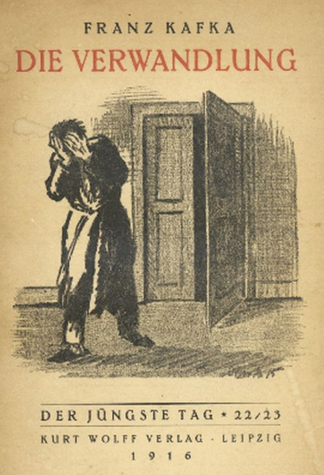
* metamorphosis
( 形而上 , form )
★ mockery : the act of mocking someone or something
mock = make fun of
laugh at
e.g. Are you mocking me?
★ bull's-eye
The bullseye, or bull's-eye, is the centre of a target, and by extension the name given to any shot that hits the bullseye. By extension, the word bullseye can refer to any design or pattern featuring prominent concentric circles, visually suggesting an archery target, and "hitting the bullseye" is a term for an unexpectedly good success.

★ Worship
Worship is an act of religious devotion usually directed towards a deity. An act of worship may be performed individually, in an informal or formal group, or by a designated leader.
★ Les Miserables
Les Misérables is a French historical novel by Victor Hugo, first published in 1862, that is considered one of the greatest novels of the 19th century. In the English-speaking world, the novel is usually referred to by its original French title. However, several alternatives have been used, including The Miserables, The Wretched, The Miserable Ones, The Poor Ones, The Wretched Poor, The Victims and The Dispossessed. Beginning in 1815 and culminating in the 1832 June Rebellion in Paris, the novel follows the lives and interactions of several characters, particularly the struggles of ex-convict Jean Valjean and his experience of redemption.
Examining the nature of law and grace, the novel elaborates upon the history of France, the architecture and urban design of Paris, politics, moral philosophy, antimonarchism, justice, religion, and the types and nature of romantic and familial love. Les Misérables has been popularized through numerous adaptations for the stage, television, and film, including a musical and a film adaptation of that musical.
The appearance of the novel was highly anticipated and advertised. Critical reactions were diverse, but most of them were negative. Commercially, the work was a great success globally.
Official Movie Trailer
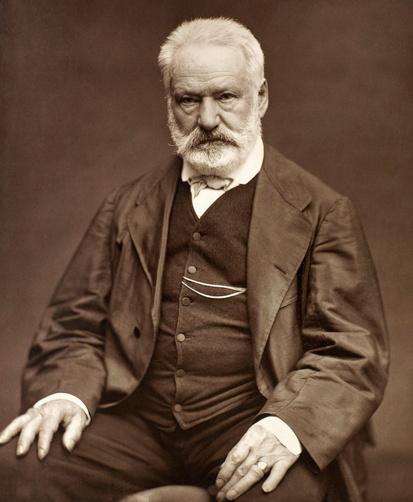
Victor Marie Hugo(26 February 1802 – 22 May 1885) was a French poet, novelist, and dramatist of the Romantic movement. He is considered one of the greatest and best-known French writers. In France, Hugo's literary fame comes first from his poetry and then from his novels and his dramatic achievements.
John Donne
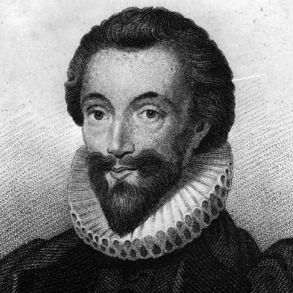
John Donne was an English poet and a cleric in the Church of England. He is considered the pre-eminent representative of the metaphysical poets. His works are noted for their strong, sensual style and include sonnets, love poems, religious poems, Latin translations, epigrams, elegies, songs, satires and sermons. His poetry is noted for its vibrancy of language and inventiveness of metaphor, especially compared to that of his contemporaries. Donne's style is characterised by abrupt openings and various paradoxes, ironies and dislocations. These features, along with his frequent dramatic or everyday speech rhythms, his tense syntax and his tough eloquence, were both a reaction against the smoothness of conventional Elizabethan poetry and an adaptation into English of European baroque and mannerist techniques. His early career was marked by poetry that bore immense knowledge of English society and he met that knowledge with sharp criticism. Another important theme in Donne's poetry is the idea of true religion, something that he spent much time considering and about which he often theorized. He wrote secular poems as well as erotic and love poems. He is particularly famous for his mastery of metaphysical conceits.
No Man is an Island
No man is an island,
Entire of itself,
Every man is a piece of the continent,
A part of the main.
If a clod be washed away by the sea,
Europe is the less.
As well as if a promontory were.
As well as if a manor of thy friend's
Or of thine own were:
Any man's death diminishes me,
Because I am involved in mankind,
And therefore never send to know for whom the bell tolls;
It tolls for thee.
The Flea
Mark but this flea, and mark in this,
How little that which thou deniest me is;
It sucked me first, and now sucks thee,
And in this flea our two bloods mingled be;
Thou know’st that this cannot be said
A sin, nor shame, nor loss of maidenhead,
Yet this enjoys before it woo,
And pampered swells with one blood made of two,
And this, alas, is more than we would do.
Oh stay, three lives in one flea spare,
Where we almost, nay more than married are.
This flea is you and I, and this
Our mariage bed, and marriage temple is;
Though parents grudge, and you, w'are met,
And cloistered in these living walls of jet.
Though use make you apt to kill me,
Let not to that, self-murder added be,
And sacrilege, three sins in killing three.
Cruel and sudden, hast thou since
Purpled thy nail, in blood of innocence?
Wherein could this flea guilty be,
Except in that drop which it sucked from thee?
Yet thou triumph’st, and say'st that thou
Find’st not thy self, nor me the weaker now;
’Tis true; then learn how false, fears be:
Just so much honor, when thou yield’st to me,
Will waste, as this flea’s death took life from thee.
A Valediction: Forbidding Mourning
As virtuous men pass mildly away,
And whisper to their souls to go,
Whilst some of their sad friends do say
The breath goes now, and some say, No:
So let us melt, and make no noise,
No tear-floods, nor sigh-tempests move;
'Twere profanation of our joys
To tell the laity our love.
Moving of th' earth brings harms and fears,
Men reckon what it did, and meant;
But trepidation of the spheres,
Though greater far, is innocent.
Dull sublunary lovers' love
(Whose soul is sense) cannot admit
Absence, because it doth remove
Those things which elemented it.
But we by a love so much refined,
That our selves know not what it is,
Inter-assured of the mind,
Care less, eyes, lips, and hands to miss.
Our two souls therefore, which are one,
Though I must go, endure not yet
A breach, but an expansion,
Like gold to airy thinness beat.
If they be two, they are two so
As stiff twin compasses are two;
Thy soul, the fixed foot, makes no show
To move, but doth, if the other do.
And though it in the center sit,
Yet when the other far doth roam,
It leans and hearkens after it,
And grows erect, as that comes home.
Such wilt thou be to me, who must,
Like th' other foot, obliquely run;
Thy firmness makes my circle just,
And makes me end where I begun.
★ compass

Ernest Hemingway
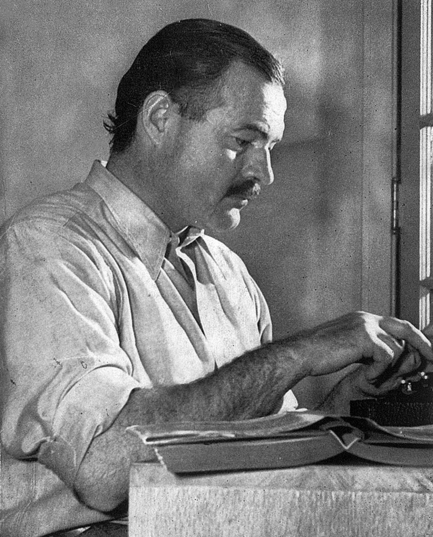
Ernest Miller Hemingway (July 21, 1899 – July 2, 1961) was an American novelist, short story writer, and journalist. His economical and understated style had a strong influence on 20th-century fiction, while his life of adventure and his public image influenced later generations. Hemingway produced most of his work between the mid-1920s and the mid-1950s, and won the Nobel Prize in Literature in 1954. He published seven novels, six short story collections, and two non-fiction works. Additional works, including three novels, four short story collections, and three non-fiction works, were published posthumously. Many of his works are considered classics of American literature.
For Whom the Bell Tolls
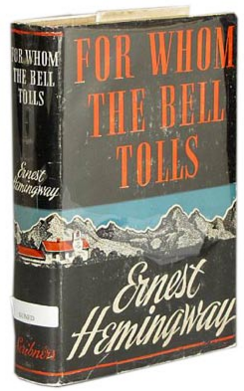
For Whom the Bell Tolls is a novel by Ernest Hemingway published in 1940. It tells the story of Robert Jordan, a young American in the International Brigades attached to a republican guerrilla unit during the Spanish Civil War. As a dynamiter, he is assigned to blow up a bridge during an attack on the city of Segovia. The novel is regarded as one of Hemingway's best works.
The Old Man and the Sea
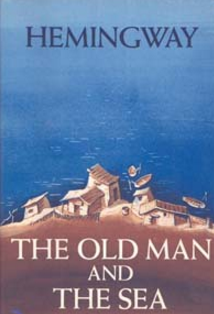
The Old Man and the Sea is a short novel written by the American author Ernest Hemingway in 1951 in Bimini, Bahamas, and published in 1952.[1] It was the last major work of fiction by Hemingway that was published during his lifetime. One of his most famous works, it tells the story of Santiago, an aging Cuban fisherman who struggles with a giant marlin far out in the Gulf Stream off the coast of Florida.
The Hot Chick
The Hot Chick is a 2002 American comedy film about a teenage girl whose mind is magically swapped with that of a 30-year-old criminal.

The Sorcerer's Apprentice
The Sorcerer's Apprentice is a 2010 American fantasy adventure film.
★ hemo- : related to blood
hemoglobin ( 血紅素 )
-uro- : related to urine
urology : the study of diseases of the urinary system, or medical treatment for them
urogenital : relating to the organs that remove liquid waste from your body, and to your sex organs
★ con- : together
conjoin : to join together, or to make things join together
confederation : a group of people or organizations that are united
Gone with the Wind
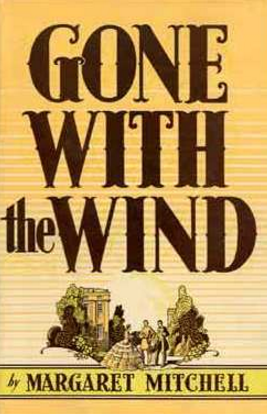
Gone with the Wind is a novel written by Margaret Mitchell, first published in 1936. The story is set in Clayton County, Georgia, and Atlanta during the American Civil War and Reconstruction era. It depicts the struggles of young Scarlett O'Hara, the spoiled daughter of a well-to-do plantation owner, who must use every means at her disposal to claw her way out of the poverty she finds herself in after Sherman's March to the Sea. A historical novel, the story is a Bildungsroman or coming-of-age story, with the title taken from a poem written by Ernest Dowson.
Non Sum Qualis eram Bonae Sub Regno Cynarae
by Ernest Dowson
Last night, ah, yesternight, betwixt her lips and mine
There fell thy shadow, Cynara! thy breath was shed
Upon my soul between the kisses and the wine;
And I was desolate and sick of an old passion,
Yea, I was desolate and bowed my head:
I have been faithful to thee, Cynara! in my fashion.
All night upon mine heart I felt her warm heart beat,
Night-long within mine arms in love and sleep she lay;
Surely the kisses of her bought red mouth were sweet;
But I was desolate and sick of an old passion,
When I awoke and found the dawn was gray:
I have been faithful to thee, Cynara! in my fashion.
I have forgot much, Cynara! gone with the wind,
Flung roses, roses riotously with the throng,
Dancing, to put thy pale, lost lilies out of mind;
But I was desolate and sick of an old passion,
Yea, all the time, because the dance was long:
I have been faithful to thee, Cynara! in my fashion.
I cried for madder music and for stronger wine,
But when the feast is finished and the lamps expire,
Then falls thy shadow, Cynara! the night is thine;
And I am desolate and sick of an old passion,
Yea, hungry for the lips of my desire:
I have been faithful to thee, Cynara! in my fashion.
Dirty, dangerous and demeaning
Dirty, Dangerous and Demeaning (often Dirty, Dangerous and Demanding or Dirty, Dangerous and Difficult), also known as the 3Ds, is an American neologism derived from an Asian concept, and refers to certain kinds of labor often performed by unionized blue-collar workers.
The term originated from the Japanese expression 3K: kitanai, kiken, kitsui(respectively 汚い "dirty", 危険 "dangerous", きつい "demanding"), and has subsequently gained widespread use, particularly regarding labor done by migrant workers.
Typically, any task, regardless of industry, can qualify as a 3D job. These jobs can bring higher wages due to a shortage of willing qualified individuals and in many world regions are filled by migrant workers looking for higher wages.
限會員,要發表迴響,請先登入


