
A new satellite photo purchased by FAS from DigitalGlobe shows a Chinese Jin-class SSBN at Yulin (Sanya) Naval Base on Hainan Island. Additional piers are outside the left frame of the photo. Click on image for larger photo. North is left.
 美國聲B1B.長程戰績轟炸機可以摧毀中國南海的榆林軍港.
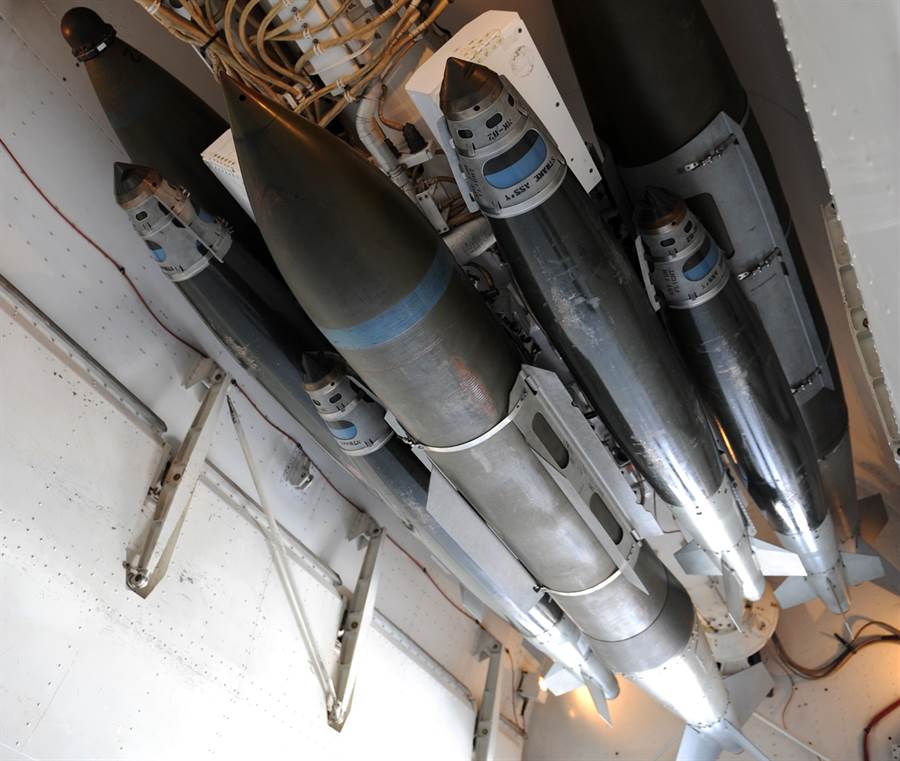 B-1B轟炸機還可以攜帶24枚反艦導彈LRASM,射程930公里,同樣可以遠距離攻擊中共的航母艦隊,中共的遼寧號或山東號航母艦隊,並無經過驗證的反導彈系統,可能還沒預警,就被摧毀了?。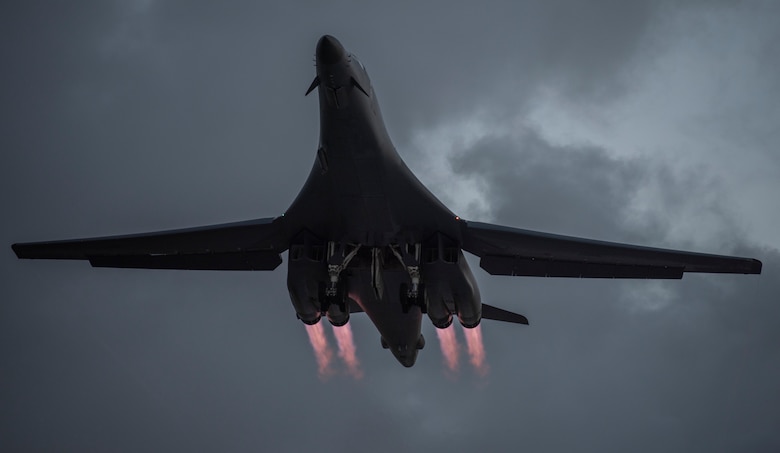

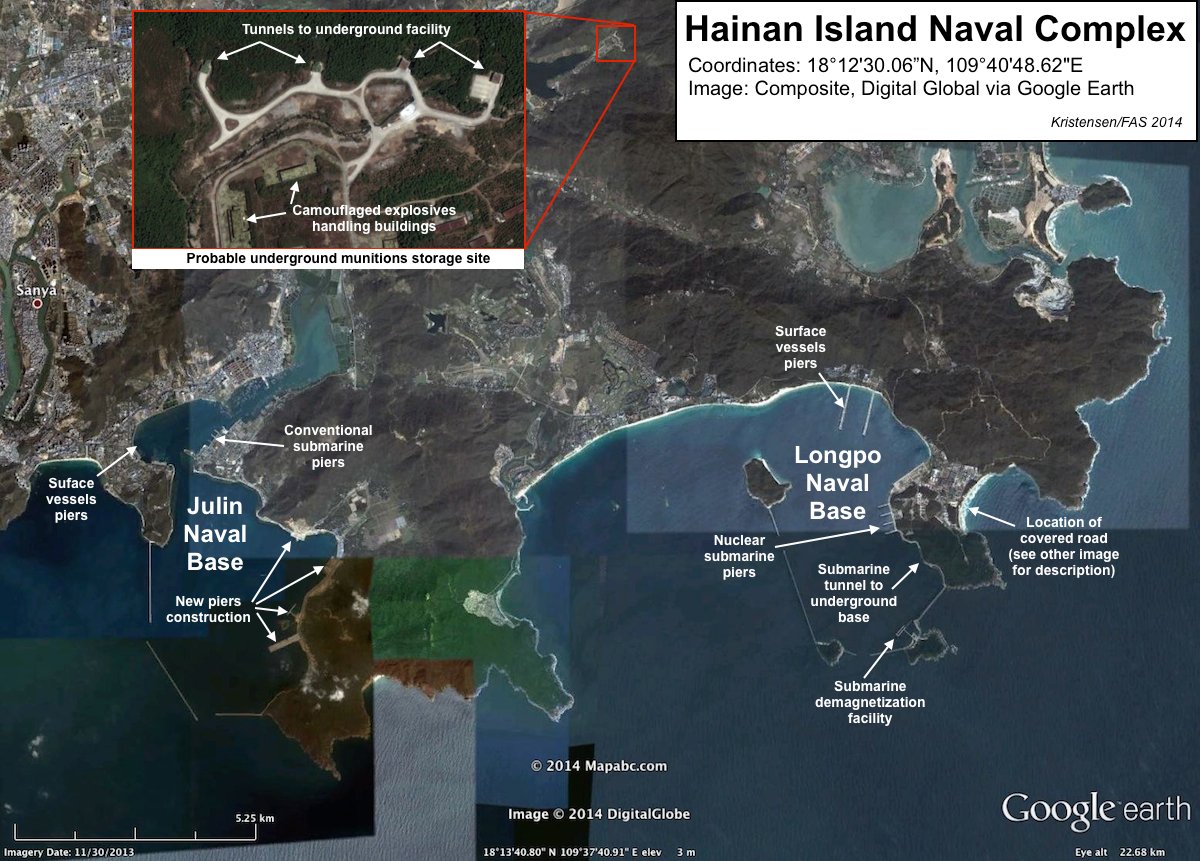
中國海南省三亞市榆林港及亞龍灣龍坡的榆林海軍基地爲中國解放軍海軍的潛艇(以及航空母艦)在南中國海海域的巡弋。榆林基地內,核潛艇位于圖中右側龍坡基地,常規潛艇位于左側榆林基地,上方紅框爲可能的地下彈藥貯藏點.中國海軍解放軍通常在岩石露頭(露出地面的岩層)處建造地下潛艦洞庫,這樣可以在洞庫上方提供較深的防護。洞庫入口通常朝向內陸(有水體連接),這樣更難被由海洋方向而來的力量攻擊。軍事專家分析認為潮汐的影響到水平面的高低差,以及陽光日照及月光的影響到,都可以協助洞口的隱蔽性,提高了戰備能力,其實各國的海軍在第二次世界大戰起,就已應用地下洞穴建造海軍潛艦基地的實例.

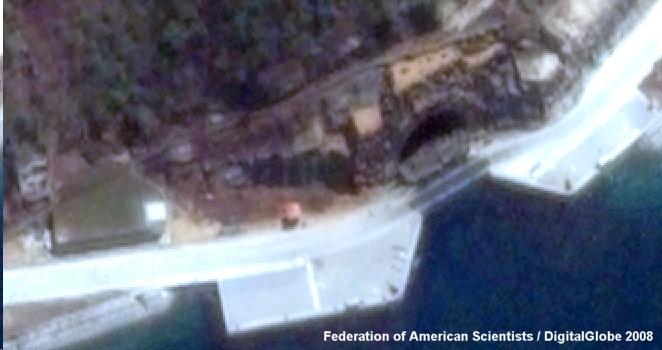
中國海南省三亞市榆林港及亞龍灣龍坡的榆林海軍基地爲中國解放軍海軍的潛艇(以及航空母艦)在南中國海海域的巡弋。榆林基地內,核潛艇位于圖中右側龍坡基地,常規潛艇位于左側榆林基地,上方紅框爲可能的地下彈藥貯藏點.中國海軍解放軍通常在岩石露頭(露出地面的岩層)處建造地下潛艦洞庫,這樣可以在洞庫上方提供較深的防護。洞庫入口通常朝向內陸(有水體連接),這樣更難被由海洋方向而來的力量攻擊。
軍事專家分析認為潮汐的影響到水平面的高低差,以及陽光日照及月光的影響到,都可以協助洞口的隱蔽性,提高了戰備能力,其實各國的海軍在第二次世界大戰起,就已應用地下洞穴建造海軍潛艦基地的實例.

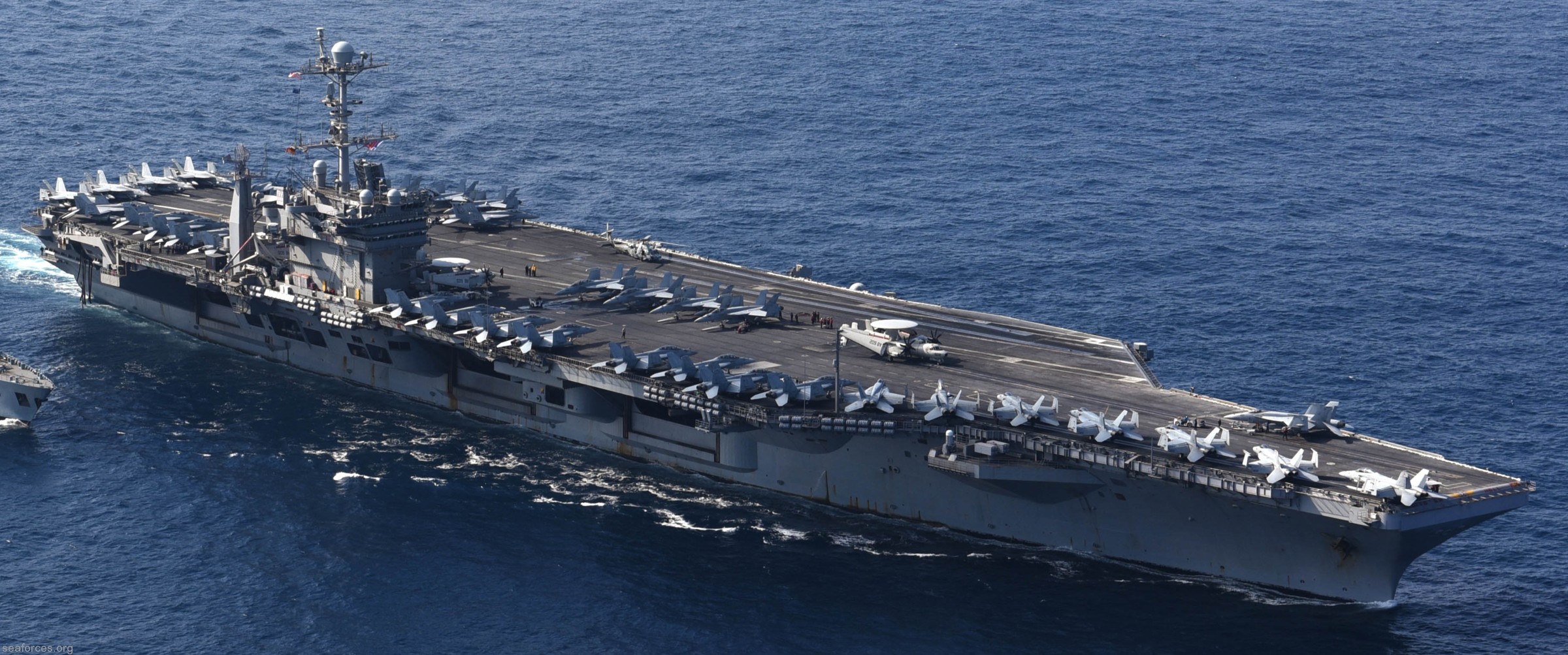
美國3航空母艦戰鬥群,極為可能在川普競選失敗狀況下出現於中國南海開戰?
北約某大國際戰略研究所分析如下:
1: 202006-08.為期90天,中國與美國在中國南海,實兵實彈的進攻與防守軍事演習,已經於20200831.零時正式結束.
2:美國海軍以雙航空母艦戰鬥群的姿態,做為藍軍攻擊隊(BAG),進行攻擊中國南海各個軍事戰略要地.CVN-75.CVN-72.
3:中國海軍展開反擊戰略,分別於黃海(渤海灣)東海及南海,展開實兵實彈演習,其中包括台灣海峽水域的演習.
4:國際軍事觀察家分析研判,中國與美國雙方,經由國防部長熱線電話,協調,溝通,瞭解到自我克制,以免擦槍走火,真正的發生戰爭.
5:演習最高潮於20200828.中國向南海發射DF-26/B.DF-21.導向飛彈而圓滿結束,中國證實了其東風飛彈的優勢,可以擊沈美國海軍的航空母艦及其他軍艦等設施,.包括攻擊與反封鎖,美國在太平洋第一島鏈及第二島鏈,尤其是關島的美國海軍基地與空軍基地,換句話說中國的戰略意圖就是徹底摧毀關島,斬草除根.
6:美國已經於20200828日,得到DF-26/B.DF-21.導向飛彈的參數值,飛彈發射時間,位置,
高度速度等軍事機密所以美國航空母艦CVN-75.已經得到中國飛彈參數已經返回日本橫虛賀海軍基地.
7:美國空軍曾經多次以B1B.長程戰略轟炸機攜帶24枚空對地巡航導彈JASSM,射程超過1000公里。巡弋中國南海鎮壓態勢十足因為。B-1B轟炸機無需飛入中國內陸,在距離中國海岸線500公里外,即可發起攻擊。
8:國際軍事專家評估若是,中國與美國實際發生戰爭,則雙方都損失慘重,戰爭沒有贏家,這樣一來為什麼,美國大軍壓境入侵中國南海,始終保持自我克制,就知道其中的奧妙是如何.
9:美國總統大選的腳步愈來愈近喇,川普極為可能失去連任美國總統寶座的機會,而進行最後一役的武力進攻南海? 國際戰略分析認為,如果川普勝選連任美國總統,則小規模外科手術式的打擊,轟炸中國南海黃岩島了事,中國日後重新建設不是難事,如果川普競選失利,美國軍方在客的慫恿之下,對於中國南海大打出手,甚至於擊毀西沙群島中的燈塔及無人雷達站,做為洩恨與洩氣之舉未嘗不可?
10:中國南海局勢始終詭譎多變化,無論是誰贏得南海戰爭,勢所難免付出慘重代價,西方國家軍事顧問及國際戰略專家研判,2020.Q4.第四及季,202011上旬如果川普選情告急,那麼一來中國南海勢所難免又出現美國海軍雙航空母艦巡弋的戰爭遊戲,替川普抬高選情? 所以說20200901-20201031..這60天是中,美雙方高掛免戰牌?
那麼一來海底的中國與美國的潛艦活動,造照常進行而已,在中國南海裡水下進行,貓抓老鼠的躲貓咪的遊戲,好不熱鬧?
根據俄羅斯情報透露出,美國海軍即將進行 "2020.獵殺中國南海龍王計劃","2020. Plan to Hunting the Dragon King in the South China Sea",美國派遣俄亥俄級戰略核子潛艦 Ohio-class .SSBN.以及洛杉磯級攻擊型核子潛艦Los Angeles-class .SSN.各一艘前往中國南海復仇?
因為 20200205.中國海軍095.SSN.長征級核子攻擊型潛艦,於中國南海某處,首戰成功告捷,"擊退",美國海軍SSBN俄亥俄級型核子潛艦1艘SSBN734以及SSN洛山磯級攻擊型核子潛艦1艘SSN762.


The Los Angeles-Class Submarine: The Navys Old Sub That Could Sink Russias/CHINA Navy.

USA/Los Angeles-class submarine.SSN.
據信中國海軍派遣094.SSBN戰略核子潛艦以及 095.SSN.攻擊型核子潛艦應戰.其中095SSN.已經利用量子無線電監聽設備測出,美國SSBN.傳出播放California Dreamin.的音樂,相信是由關島美軍廣播電台所播出其頻道.AFNK/PACIFIC.13302 khz.5756 khz.頻率,皆被中國海軍095SSN.測得,他們(美國潛艦已經出發,預期210200901零時整,準時出現於中國南海某處海域躲藏500公尺的深海.進行"2020.獵殺中國南海龍王計劃",
"2020. Plan to Hunting the Dragon King in the South China Sea",

Los Angeles-class submarine too old?


 .
.
美國海軍為Pennsylvania SSBN.735.掛上GOOD LUCK.橫幅,預祝幸運,凱旋返航,不要被中國南海龍王獵殺,成為海龍王的女婿?
China navy 094.SSBN. .
.

China navy 095.SSN.

USA .SSN attack to China SSN?

.USA.B1B.BOMBER
美國軍事情報公開中國海南省榆林港軍事密秘?
A Closer Look at China’s Critical South China Sea Submarine Base .
A deeper look at Yulin-East, China’s burgeoning submarine bastion in the South China Sea.
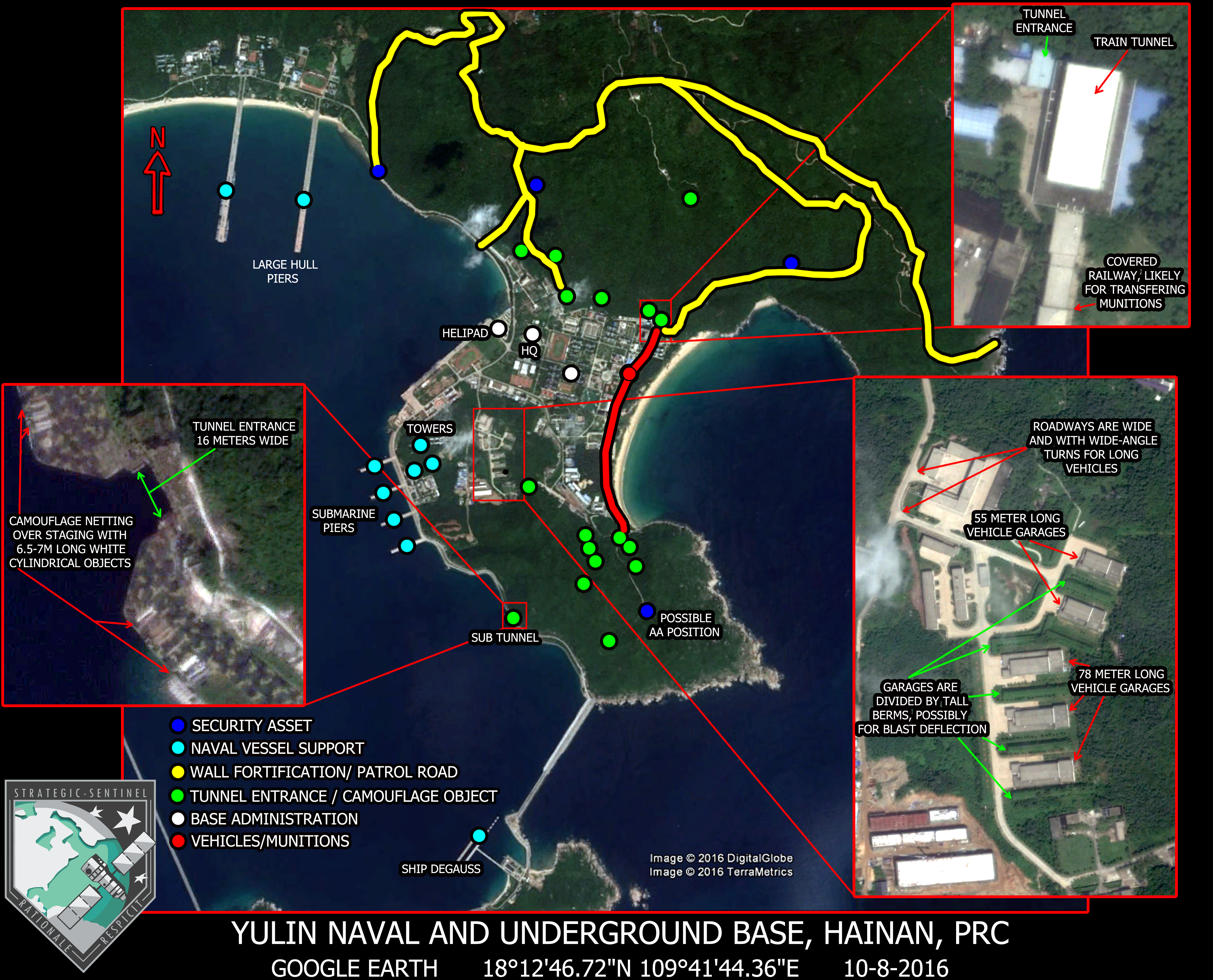
Base Infrastructure As could be expected, Yulin-East is positively crawling with logistical infrastructure. The geographic layout and quantity of these roadways, pipelines, radio towers, and tunnels serve as indicators of the base’s intended purpose and importance. The nearly dozen tunnel entrances to Yulin-East’s granite mountain bespeak not only redundancy, but size of the underground structure and the value of ensuring supply lines for the submarines inside. The use of a tram to schlep supplies into the mountain indicates that China plans to transport more material than a convoy of trucks could accommodate alone. The covered railway is also a safer, more resilient method of transport, but probably not resilient enough to warrant the associated costs of construction (as opposed to simply another road) unless more carrying capacity was logistically necessary. The number and size of submarine piers, the vast network of munitions transport, and the large underground facility sheltered under a mountain all indicate that China plans to accommodate as many SSBNs (and/or SSNs) at Yulin-East as possible. The Tang-class sub, the Jin’s successor, will likely need to be based at Yulin as well. The Tang-class is rumored to carry 24 JL-2 ICBMS; even if this is an overstatement, the Tang will probably be larger than its predecessor, and thus would need the wide accommodations of Yulin’s tunnel entrance.
The People’s Republic has methodically assembled the necessary force structure to make Yulin a major command and control center — and a vitally important, well-defended one in the case of a conflict. The number and size of administrative buildings suggest more officer involvement than other common Chinese naval bases. The sizeable, dense mountain makes for effective, bunkered defense in case of a major bombing raid. Yulin and Yulin-East together can house two full carrier strike groups, plus a generous handful of additional nuclear submarines. The base is designed to accommodate a wide variety of conventional and nuclear forces, some fortifying China’s strategic deterrent and others enhancing China’s coercive power in the South China Sea. Additionally, though China has been building artificial island bases at an impressive clip, the effort necessary to construct an equally-fortified base of this magnitude on a small island deep in the South China Sea would redefine herculean. (Recall that construction is still ongoing at Yulin-East after 17 full years.) Simply put, if China does want to use a base on Hainan’s southern coast as a potential command and control center for its South Sea Fleet, they have gone out of their way to make Yulin-East a qualified candidate.
The infrastructure at Yulin-East often raises more questions than answers. Do all of the tunnel entrances bored into the southeastern mountain connect to the larger internal structure? If so, identifying such entrances could provide critical information as to the size and shape of the underground facility. But some of these tunnel entrances may lead to standalone munitions or supply depots, potentially designed specifically to misdirect or confuse an adversary’s security analysts. In addition, the three radio towers could indicate an intended major Command and Control role for Yulin-East. But they could also merely serve as redundancies in case nearby radio or harbor control towers fail or are destroyed. Until we know the answers, it is difficult to determine whether some of these structures deviate from standard PLAN doctrine. We at Strategic Sentinel have flagged structures like this to watch going forward, when trends (or deviations thereof) may arise.
Striking Yulin When discussing strike options against a military base, one must consider more than the base’s theater and point defense systems. Yulin will presumably be boasting some advanced SAM technology, if it isn’t already, and as we’ve noted, anti-ship cruise missile launchers are already deployed. But with a target like Yulin, firmly in the heart of valued Chinese territory like Hainan Island, theater and point defenses constitute merely a fraction of the threat calculus. A strike against any Hainan Island target must be considered within the context of a broader, large-scale conflict. If the United States or China wished to slap each other’s wrist, targets like Hawaii or Hainan would not be considered. Striking a highly populated, well-defended, valued piece of (undisputed) sovereign Chinese territory like Hainan Island would represent but one operation in an enormous great power war.
One of the first and most prominent challenges facing the United States in a strike on Yulin-East (read: a war with China) would be the logistical hurdle of moving forces into theater. The current US military presence in the Asia-Pacific is not enough to sustain a great power war, not even with the determined assistance of regional US allies. The necessary, massive global force restructuring alone would be challenging and expensive, rife with opportunity and financial costs not seen in decades. The United States could, certainly, successfully strike Yulin and other targets on Hainan Island. But it had better be willing to invest a vast sum of money, effort, military hardware, and lives.

China navy 093B SSN.
Satellite images appear to catch Chinese submarine entering underground base.
A rare #satellite image of what appears to be a #Chinese Type 093 sub at the entrance of a not-so-secret, subterranean base at Chinas southern #Hainan island. Yulin Naval Base is home to subs of #China’s South Sea Fleet and provides convenient access to the South China Sea.
Striking Yulin-East is doable, but difficult. Having already overcome the logistical and financial challenges, U.S. forces would likely need to fight their way through Chinese Integrated Air Defense Systems (IADS) in the South China Sea to reach Hainan. This could include the evasion or destruction of recently purchased S-400s that may soon guard China’s nearby artificial islands. Hainan Island is home to PLAN and PLAAF aircraft, including the J-11, which would hit the skies in a heartbeat if they detected US aircraft approaching with deadly intent. Assuming U.S. planners prioritized accordingly and deployed F-22 Raptors for the mission, these J-11s might literally not know what hit them. (The F-22 is designed to strike enemy aircraft long before they show up on their adversary’s radar.) Still, the electronic warfare environment at Hainan is increasingly dense, and the Raptor’s avionics may struggle in this theater as a result. The US could deploy the very capable EA-18 Growler electronic warfare plane to assist, but at the noticeable loss of operational stealth.
Once U.S. aircraft made it through Chinese IADS, eliminated enemy interceptors, and found a way to navigate the challenging electronic environment, the distinctions between potential theater or point defense assets at Yulin-East mean comparatively little. The United States would, as I noted before, presumably devote its most capable assets to a target as formidable as Hainan Island. The F-22 Raptors, the B-2 Spirits, perhaps some F-35 Lightnings. The detection capabilities of Chinese air defense systems do not yet pose a threat to the F-22 or B-2; whether modern air defenses can reliably identify and track the F-35 remains the subject of fierce debate among military analysts. After scaling logistical mountains and fighting their way through waves of Chinese air defenses, U.S. bombs may not even be able to penetrate the base’s mountain.
China’s decision to build one submarine tunnel entrance into the mountain at Yulin-East leaves the resident submarines vulnerable to being trapped. A B-2 Spirit Bomber taking off from its base in Missouri could slide right through China’s air defense network, drop two Massive Ordnance Penetrators at the tunnel entrance, and return home. If the MOPs perform as planned, the submarine sanctuary within Yulin-East will have become a cage. Multiple tunnel entrances and exits would have mitigated this vulnerability, but it appears China made the best of what geography had to offer. The surrounding bay appears too shallow for the construction of an underwater entrance, and drilling one into the ocean-facing side of the island would be much more difficult and expensive than the current tunnel. Still, what looks like an obvious strategic flaw is likely instead a calculated risk. China’s Jin-class submarines, as second-strike guarantors, would spend as little time inside the mountain as possible. And in the case of a conflict, it would most behoove China to disperse their nuclear submarines as widely as possible, keeping them far away from obvious targets like the Yulin base.
Whether the United States’ Massive Ordnance Penetrator can even destroy the tunnel entrance is up for some debate. The MOP — a 30,000lb bomb with 5,300lbs of explosive material — is conspicuously silent about its specifications. Neither the Air Force nor Boeing has provided official statistics about exactly how far the bomb can penetrate into earth, reinforced concrete, or granite. That said, Air Force Brigadier General Hamm has explained that the MOP is specifically designed with ~20,000psi granite in mind.
ot coincidentally, high-density granite such as this protects the Iranian nuclear facility at Fordow, a major potential target of a U.S. first strike. Unsatisfied with the bomb’s progress and penetrative capabilities, the U.S. Air Force threw more money at the MOP in 2013, as tensions flamed over Iran’s nuclear program. Fordow is protected by 80 meters of granite mountain, whereas Yulin is protected by less than half that. Measured thirty meters past the tunnel entrance, the mountain’s elevation stands at just under 115ft (35m). Presumably, then, a bomb designed to hit Fordow would be capable of successfully striking the Yulin entrance. Additionally, the DOD commissioned another redesign in 2015 to further increase effectiveness. Even if the Massive Ordnance Penetrator does not successfully trap the submarines on the first pass, or if China is able to clear the tunnel entrance relatively quickly, the Pentagon could almost certainly “mow the grass” at this site as necessary.
Conclusion:In wartime, Yulin-East’s strategic vulnerabilities would presumably be ruthlessly exploited by the United States. No other military — not Japan’s, not India’s, not Russia’s — could reliably and successfully trap China’s submarines within their underground facility. Especially if China deploys their purchased S-400s on-site, only B-2 Spirit Bombers and F-22 Raptors could reliably turn the South Sea Fleet’s home into a cage. Though the single tunnel entrance warrants classification as an obvious design flaw, it is important to remember that it was known, accepted, and mitigated to the best of China’s ability. With only one adversary capable of leaning on the base’s most glaring vulnerability, China has deployed its best defensive equipment, built bunkers deep into the mountain, and hopes for the best.
Strategic Sentinel will be keeping a close watch on Yulin-East over the coming years as additional assets are deployed to the area. Eventually, as more nuclear submarines leave their shipyards, analysts will have a better idea of just how many submarines the underground facility can hold. We’ll be scrutinizing satellite imagery and other open sources to determine exactly which theater and point defense technologies are housed in those garages, what class of surface vessels the PLAN docks at those northern piers, and any new or ongoing construction projects. Yulin-East will be one of the most strategically valuable military bases in the Asia-Pacific, and we at Strategic Sentinel will monitor it accordingly.