當德國第6軍團在史達林與會格勒被包圍後,蘇聯紅軍發動了更大規模攻勢以打擊德國南方集團軍的其它單位。1943年1月2日蘇軍發動星球行動,在1月至2月初間攻破德軍防線和攻佔卡爾可夫、別爾哥羅德及庫爾斯克。雖然蘇軍行動成功,但參戰單位補給線過份延伸。第6軍團在2月2日投降後,蘇軍中央方面軍轉向西面及在2月25日向德國南方集團軍及中央集團軍發動進攻。然而連續數月之作戰令蘇軍損失慘重,有些單位只剩下1,000至1,500人,2月19日德國南方集團軍總司令埃里希·馮·曼施坦因陸軍元帥利用新到增援的武裝親衛隊及兩個裝甲軍發動反攻。
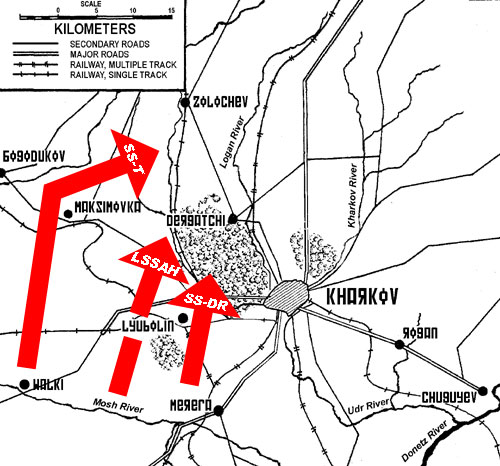
雖然德國人戰力下降,德意志國防軍仍然側擊、包圍及打敗蘇軍在卡爾可夫南面的裝甲部隊。這令曼施坦因能在3月7日開始發動對卡爾可夫的進攻;雖然德軍總部命令從北面包圍卡爾可夫,但武裝親衛隊裝甲軍在3月11日直接進攻該城,引致武裝親衛隊第1阿道夫·希特勒警衛旗隊裝甲師在3月15日攻佔該城前進行了4天激烈的逐屋爭奪戰。兩天後德軍又攻佔了別爾哥羅德,形成了一個突出部,導致了1943年7月的庫爾斯克戰役;雖然德軍的進攻令蘇軍付出了大約70,000人傷亡的代價,但由於在卡爾可夫的逐屋爭奪戰,令武裝親衛隊裝甲軍付出很大代價,德軍到3月底共損失參戰兵力的44%。
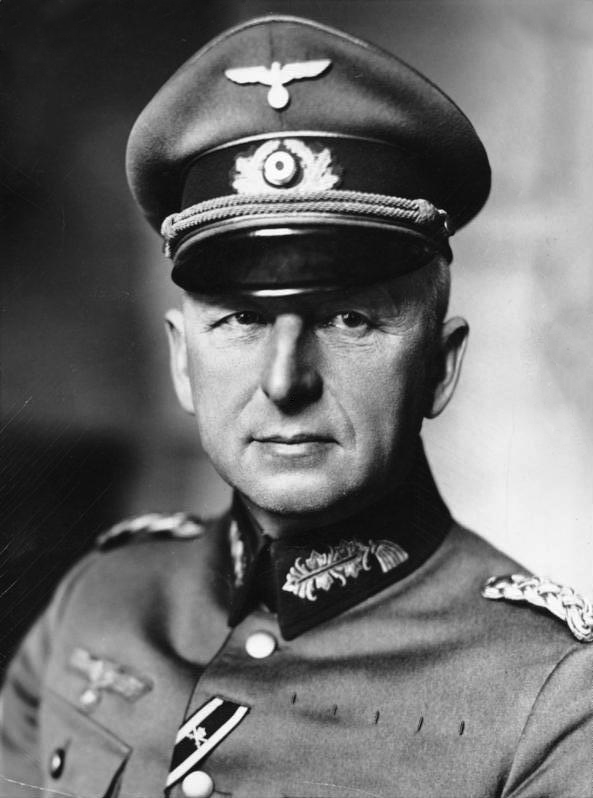
德國陸軍南方集團軍群總司令的埃里希·馮·曼施坦因照片

德軍在卡爾可夫的勝利,希特勒面臨兩個選擇:
- 「反擊方法」:是蘇軍必然重新發動的攻勢及實行與在卡爾可夫相類似的行動:容許蘇軍攻入來、自己後撤、再反攻及包圍敵人;
- 「先發制人的方式」:由南方集團軍及中央集團軍聯合對庫爾斯克突出部實施大規模進攻;德軍的頓涅茨克行動令蘇軍損失了52個師],總計70,000人至80,000人,其中大約45,200陣亡或失蹤,另有41,200人。1943年4月至7月蘇軍需要在這地區重建其部隊及準備迎接德軍重新發動之攻勢,即庫爾斯克戰役
-
The Third Battle of Kharkov was a series of battles on the Eastern Front of World War II, undertaken by the German Army Group South against the Red Army, around the city of Kharkov (or Kharkiv)[4] between 19 February and 15 March 1943. Known to the German side as the Donets Campaign, and in the Soviet Union as the Donbas and Kharkov operations, the German counterstrike led to the recapture of the cities of Kharkov and Belgorod.
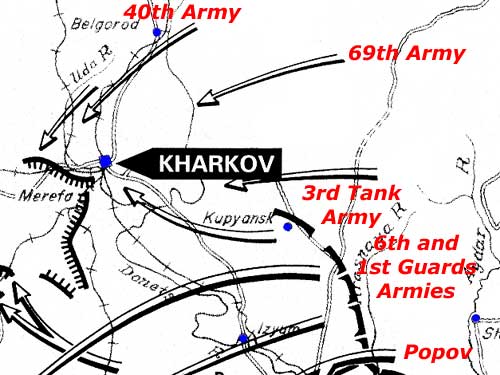
As the German Sixth Army was encircled in Stalingrad, the Red Army undertook a series of wider attacks against the rest of Army Group South. These culminated on 2 January 1943 when the Red Army launched Operation Star and Operation Gallop, which between January and early February broke German defenses and led to the Soviet recapture of Kharkov, Belgorod, Kursk, as well as Voroshilovgrad and Izium. The Soviet victories caused participating Soviet units to over-extend themselves. Freed on 2 February by the surrender of the German Sixth Army the Red Army's Central Front turned its attention west and on 25 February expanded its offensive against both Army Group South and Army Group Center. Months of continuous operations, however, had taken a heavy toll on the Soviet forces and some divisions were reduced to 1,000–2,000 combat effective soldiers. On 19 February, Field Marshal Erich von Manstein launched his Kharkov counterstrike, using the fresh II SS Panzer Corps and two panzer armies.
The Wehrmacht flanked, encircled, and defeated the Red Army's armored spearheads south of Kharkov. This enabled Manstein to renew his offensive against the city of Kharkov proper on 7 March. Despite orders to encircle Kharkov from the north the SS Panzer Corps instead decided to directly engage Kharkov on 11 March. This led to four days of house-to-house fighting before Kharkov was recaptured by the 1st SS Panzer Division on 15 March. The German forces recaptured Belgorod two days later, creating the salient which in July 1943 would lead to the Battle of Kursk. The German offensive cost the Red Army an estimated 90,000 casualties. The house-to-house fighting in Kharkov was also particularly bloody for the German SS Panzer Corps, which had approximately 4,300 men killed and wounded by the time operations ended in mid March.
哈爾科夫,又譯卡爾可夫,是烏克蘭第二大城市,蘇聯第四大城市,1941年8月26日基輔淪陷之後,10月24日,這座城市被德軍南方集團軍群第6集團軍司令馮·賴歇瑙元帥率部攻克。哈爾科夫位於烏克蘭東北部,是烏克蘭最大的工業和交通中心,也是蘇聯西南部的重要工業中心和主要交通樞紐,處於通往莫斯科、列寧格勒、克裡木和高加索的咽喉要道。而北頓涅茨河縱貫全境,其豐富的天然氣、煤、泥炭和磷灰石等礦藏,為希特勒垂涎已久的必奪之物





Paul Hausser receiving his Knight’s Cross on 8August 1941, while still commander of SS Division Das Reich. It was part of the XX XXVIth Panzer Corps from the Fourth Panzer Army operating with Army Group ‘Centre’. Hausser would hand over command of Das Reich to Willi Bittrich in October 1941.
There were two significant battles for Kharkov (now Kharkiv, Ukraine) in 1943, during which this Donets Basin (Donbas) city, the Soviet Union’s fourth largest, was the scene of fierce urban combat. The first, 11–14 March, occurred during a successful German counteroffensive to regain ground lost to Soviet advances after the victory at Stalingrad, while the second, 21–23 August, occurred during a major Soviet counteroffensive following the Battle of Kursk. Each confrontation at Kharkov was nested in a larger set of operations, with each set tracing different trajectories and producing differing outcomes.
FIRST 1943 BATTLE
There had been two previous battles for Kharkov in 1941 and 1942, and that which the Germans called the ‘‘Third Battle of Kharkov’’ resulted from Soviet overreach on the southern flank of the eastern front during the winter of 1943. Various thrusts and counterthrusts by both the Red Army and the Wehrmacht before and after the capitulation of the German Sixth Army at Stalingrad on 2 February 1943 had left large gaps in the German lines between Voronezh and Rostov-na-Donu (Rostov-on-Don). In early February, as Field Marshal Erich von Manstein regrouped his scattered formations in the south to establish a coherent defense, Soviet Stavka, the Headquarters of the Supreme High Command, resolved to press the initiative. Accordingly, the armies of two Soviet fronts, Voronezh (General Filipp Golikov) and Southwest (General Nikolay Vatutin), knifed through the middle and lower Don Valley to envelop Kharkov, with the ultimate objective of pinning Manstein’s forces against the Sea of Azov and the Dnieper River bend. Initially unable to stem the tide, the Germans gave ground nearly everywhere, including Kharkov, where on 15 February, I SS Panzer Corps—despite orders to stand fast— retired to the southwest after offering feeble resistance. Its commander, Obergruppenführer Paul Hausser, saw little purpose in making the city ‘‘a second Stalingrad.’’
Success, however, was to prove ephemeral for Stavka, at least for a time, with the result that Kharkov would not long remain in Soviet hands. Joseph Stalin and his generals had underestimated the resilience of the Wehrmacht and its associated SS formations and had overestimated the capacity of overtaxed Soviet logistics and depleted combat units to maintain offensive momentum. Worse, Soviet intelligence on German dispositions and intentions remained dangerously uncertain. Between 17 and 19 February, Soviet offensive operations culminated in the face of growing German resistance along a north-south line lying roughly 50 kilometers (30 miles) west of the Kursk-Kharkov meridian and cutting east in the extreme south to the Mius River. By now, Manstein had reorganized his troops into a resurrected version of Army Group South, and he was regrouping his armor and air assets to conduct a bold counterstroke spearheaded by the Fourth Panzer Army and Hausser’s SS Panzer Corps. Manstein’s intent was sequentially to smash leading elements of the two advancing Soviet fronts head-on and then to sink a deep thrust between them to bypass Kharkov on the way to seizing Belgorod and its crossings over the Donets River.
The result was mayhem for the overextended Soviets. From 19 to 21 February, XLVIII Panzer Corps and SS Panzer Corps overpowered and obliterated the forward formations of Vatutin’s Sixth and First Guards armies. On 20 February, the First Panzer Army and XL Panzer Corps joined in the fray to begin destruction of another of Vatutin’s advancing tentacles, Mobile Group Popov. With the German Fourth Air Fleet commanding the skies for the last time over German counteroffensive operations on the eastern front, the last week of February witnessed a merciless German pursuit of jumbled Soviet formations in full flight back to the Northern Donets River. Altogether the Soviets lost the bulk of two field armies, including 9,000 prisoners, an estimated 23,000 dead, 615 tanks, and 1,000 artillery pieces. After briefly pausing to regroup, Manstein’s panzers turned northwest to confront Golikov’s Third Tank and Sixty-Ninth armies on the southwest approaches to Kharkov. There, in an exercise of maneuver virtuosity between 1 and 5 March, German armored formations repeatedly outflanked and relentlessly pursued Golikov’s defenders, levying the loss of an additional forty-five thousand troops on the Soviets.
As German exploitation continued, Hausser’s SS Corps remained under orders to bypass Kharkov. However, the temptation for vindication proved too strong to resist. With rapid seizure of the city seemingly within easy grasp, Hausser allocated two SS divisions to the task. As a result, between 11 and 14 March, Kharkov was the scene of savage house-to-house fighting, during which Hausser’s SS troops reclaimed their honor at the cost of 11,500 casualties. Meanwhile, Army Group South’s remaining armored pincers lacked sufficient combat power to fully encircle and liquidate large Soviet troop pockets east and south of Kharkov. Although Manstein thereby probably lost an opportunity to produce a German equivalent of the Soviet victory at Stalingrad, momentum carried this last major successful German offensive on the eastern front to Belgorod. With this city in German hands on 25 March, the spring thaw halted operations for both sides. The line of farthest German advance became the southern shoulder of the Kursk salient that was to feature so prominently in Manstein’s next offensive, Operation Citadel, resulting in the Battle of Kursk.


