foreshadowing
Foreshadowing or guessing ahead is a literary device by which an author hints what is to come. It is used to avoid disappointment. It is also sometimes used to arouse the reader.
A hint that is designed to mislead the audience is referred to as a red herring. A similar device is the flashforward (also known as prolepsis). However, foreshadowing only hints at a possible outcome within the confinement of a narrative. A flashforward is a scene that takes the narrative forward in time from the current point of the story in literature, film, television, and other media. Foreshadowing is sometimes employed through characters explicitly predicting the future.
https://en.wikipedia.org/wiki/Foreshadowing
https://en.wiktionary.org/wiki/foreshadowing
metaphor
A metaphor is a figure of speech that identifies something as being the same as some unrelated thing for rhetorical effect, thus highlighting the similarities between the two. While a simile compares two items, a metaphor directly equates them, and does not use "like" or "as" as does a simile. One of the most commonly cited examples of a metaphor in English literature is the "All the world's a stage" monologue from As You Like It:
https://en.wikipedia.org/wiki/Metaphor
Orphan 孤兒
Hades
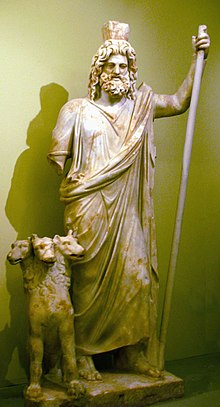
Hades (/ˈheɪdiːz/; Ancient Greek: ᾍδης or Άͅδης, Háidēs) was the ancient Greek chthonic god of the underworld, which eventually took his name.
In Greek mythology, Hades was regarded as the oldest son of Cronus and Rhea, although the last son regurgitated by his father.[n 1]He and his brothers Zeus and Poseidon defeated their father's generation of gods, the Titans, and claimed rulership over thecosmos. Hades received the underworld, Zeus the air, and Poseidon the sea, with the solid earth—long the province of Gaia—available to all three concurrently. Hades was often portrayed with his three-headed guard dog Cerberus and, in later mythological authors, associated with the Helm of Darkness and the bident.
https://en.wikipedia.org/wiki/Hades
mult-
multiple
chapel

A chapel is a religious place of fellowship, prayer and worship that is attached to a larger, often nonreligious institution or that is considered an extension of a primary religious institution. It may be part of a larger structure or complex, such as a college,hospital, palace, prison, funeral home, church, synagogue or mosque, located on board a military or commercial ship, or it may be an entirely free-standing building, sometimes with its own grounds. Many military installations have chapels for the use of military personnel, normally under the leadership of a military chaplain.
限會員,要發表迴響,請先登入


