Herodotus
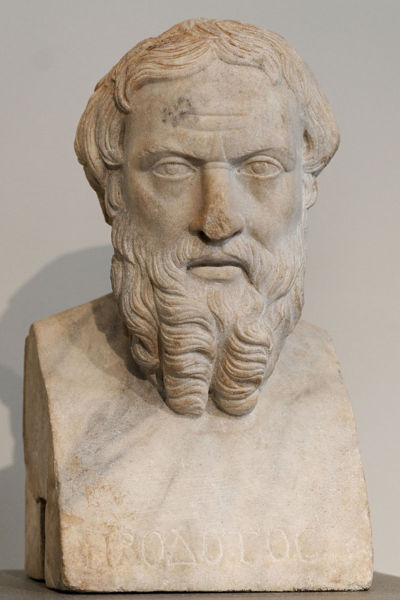
Herodotus was a Greek historian who was born in Halicarnassus in the Persian Empire (modern-day Bodrum, Turkey) and lived in the fifth century BC (c. 484–c. 425 BC), a contemporary of Socrates. He is widely referred to as "The Father of History" (first conferred by Cicero);he was the first historian known to have broken from Homeric tradition to treat historical subjects as a method of investigation—specifically, by collecting his materials systematically and critically, and then arranging them into a historiographic narrative. The Histories is the only work which he is known to have produced, a record of his "inquiry" (or ἱστορία historía) on the origins of the Greco-Persian Wars, including a wealth of geographical and ethnographical information. Some of his stories were fanciful and others inaccurate; yet he states that he was reporting only what was told to him and was often correct in his information. Despite Herodotus' historical significance, little is known of his personal history.
Drama

Drama is the specific mode of fiction represented in performance.The term comes from a Greek word meaning "action" , which is derived from "to do" . The two masks associated with drama represent the traditional generic division between comedy and tragedy. They are symbols of the ancient Greek Muses, Thalia, and Melpomene. Thalia was the Muse of comedy (the laughing face), while Melpomene was the Muse of tragedy (the weeping face). Considered as a genre of poetry in general, the dramatic mode has been contrasted with the epic and the lyrical modes ever since Aristotle's Poetics (c. 335 BCE)—the earliest work of dramatic theory.
*alter- : change
ex. party alternation
Icarus
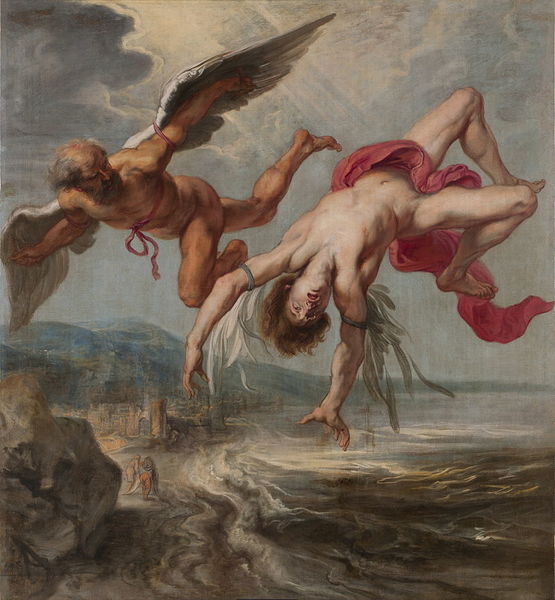
In Greek mythology, Icarus is the son of the master craftsman Daedalus, the creator of the Labyrinth. Often depicted in art, Icarus and his father attempt to escape from Crete by means of wings that his father constructed from feathers and wax. Icarus' father warns him first of complacency and then of hubris, asking that he fly neither too low nor too high, so the sea's dampness would not clog his wings or the sun's heat melt them. Icarus ignored his father's instructions not to fly too close to the sun, when the wax in his wings melted and he fell into the sea. This tragic theme of failure at the hands of hubris contains similarities to that of Phaëthon.
Golden Fleece-Mary has a little lamb
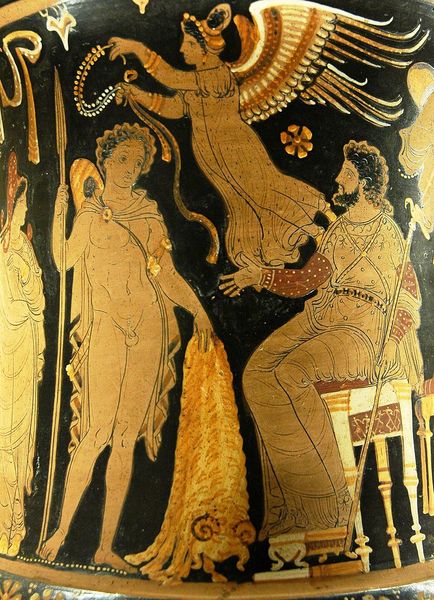
In Greek mythology, the Golden Fleece is the fleece of the gold-hair winged ram, which was held in Colchis.The fleece is a symbol of authority and kingship. It figures in the tale of the hero Jason and his band of Argonauts, who set out on a quest for the fleece by order of King Pelias, in order to place Jason rightfully on the throne of Iolcus in Thessaly. Through the help of Medea, they acquire the Golden Fleece. The story is of great antiquity and was current in the time of Homer (eighth century BC). It survives in various forms, among which the details vary.
Chorus
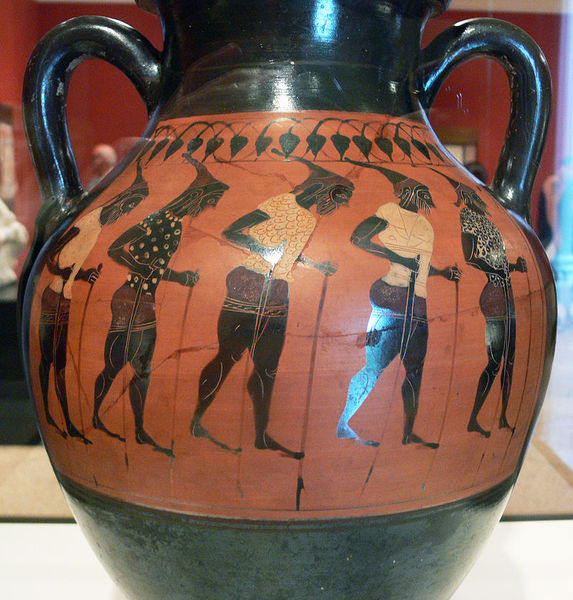
A chorus, in the context of Ancient Greek tragedy, comedy, and satyr plays, is a homogeneous, non-individualised group of performers, who comment with a collective voice on the dramatic action.The chorus consisted of between 12 and 50 players, who variously danced, sang or spoke their lines in unison and sometimes wore masks.
限會員,要發表迴響,請先登入


